
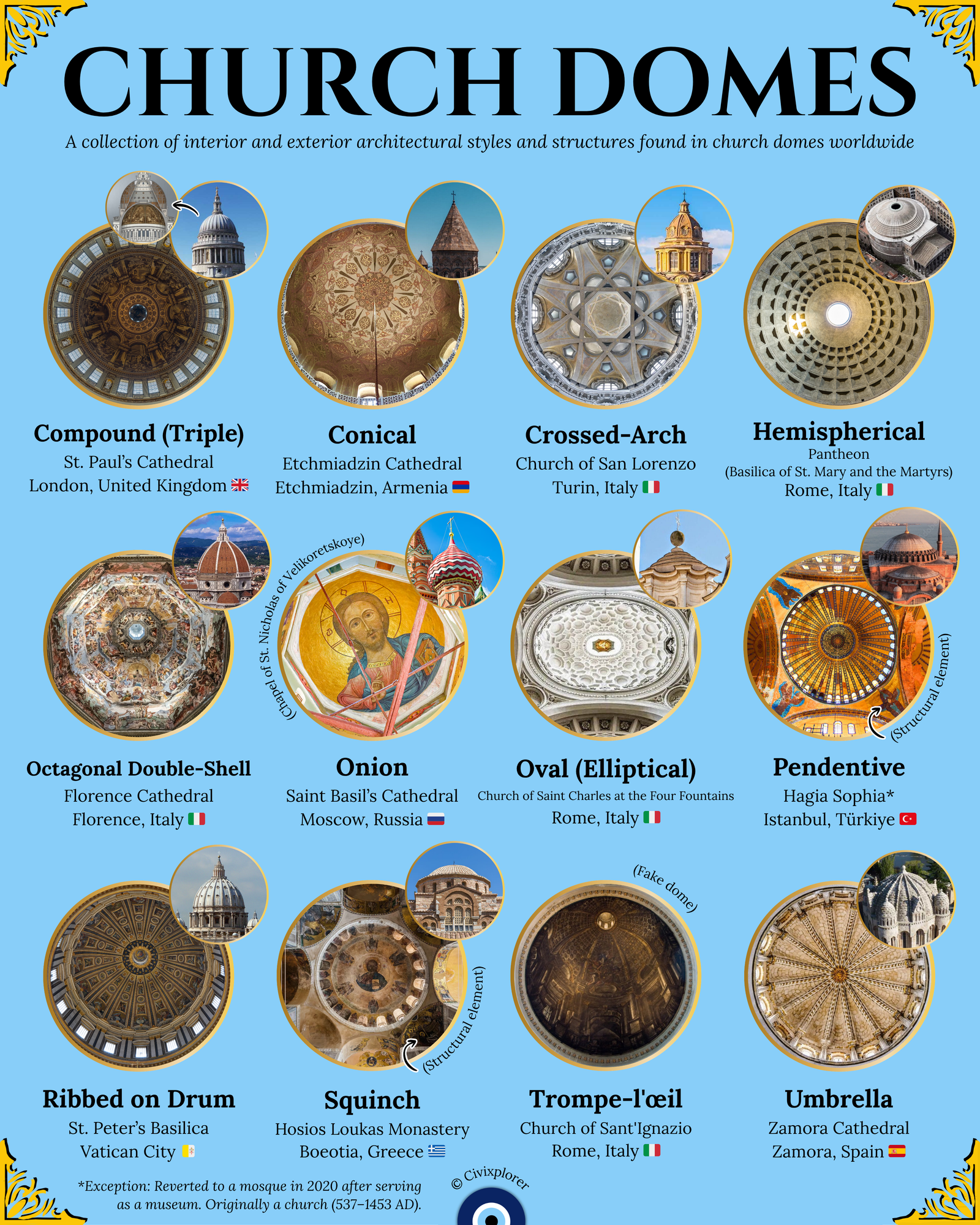
Domes have served as the crowning glory of religious architecture for millennia, symbolizing the heavens and representing the absolute pinnacle of human engineering. From the ancient concrete of Rome to the vibrant, multicolored clusters of Moscow, these structures are a fascinating intersection of theology, mathematics, and environmental adaptation. By exploring these "eyes to the sky," we can trace the evolution of how humanity has solved complex structural problems across different cultures and climates.
The Engineering Revolution: Bridging the Square
For centuries, a fundamental challenge haunted architects: how to place a circular dome over a square or rectangular room. The Hagia Sophia in Istanbul provided a Byzantine breakthrough with the pendentive. This curved, triangular element bridges the gap between the corners of a square room and the circular base of a dome, allowing massive structures to appear as if they are "floating" without intermediate supports. An earlier, sturdier solution can be seen at the Hosios Loukas Monastery, where squinches were used to fill in corners and create an octagonal base for the dome to rest upon.
The Race for the Skyline: Multi-Shell Masterpieces
During the Renaissance and Baroque periods, the competition for the most majestic skyline led to the invention of multi-shell domes. A dome that looked perfect from the inside often appeared too squat from the street. Filippo Brunelleschi famously solved this at the Florence Cathedral by designing an octagonal double-shell dome. This engineering miracle used two concentric shells—one for structural support and a lighter one for weatherproofing—bound by hidden ribs. Later, at St. Paul’s Cathedral in London, Sir Christopher Wren took this further with a triple-shell system, utilizing a hidden brick cone to support the immense weight of the stone lantern at the very top.
Climate, Culture, and Optical Illusions
In many regions, dome design was a direct response to the local environment or even financial constraints. The iconic onion domes of Saint Basil’s Cathedral in Russia are highly functional; their bulbous shape prevents heavy snow from accumulating and crushing the roof. Symbolically, they represent burning candles reaching toward heaven. In contrast, when the Church of Sant'Ignazio in Rome ran out of funds for a real dome, they turned to art. The artist Andrea Pozzo created a trompe-l'œil masterpiece—a flat ceiling painted with such masterful perspective that it creates the perfect illusion of a soaring, ribbed cupola.
A Legacy of Architectural Confidence
Whether it is the unreinforced concrete of the Pantheon, which remains the largest of its kind after nearly two thousand years, or the mathematical "star vault" of San Lorenzo in Turin, church domes are more than just roofs. They are adaptive solutions that reflect the mathematical confidence, budget realities, and cultural identity of their eras. From the conical domes of Armenia to the ribbed "umbrella" forms in Spain, each structure tells a unique story of how we have attempted to reach for the divine through stone and geometry.
Comments (0)
Join the Conversation
Login to share your thoughts with the community.
Login to Comment