
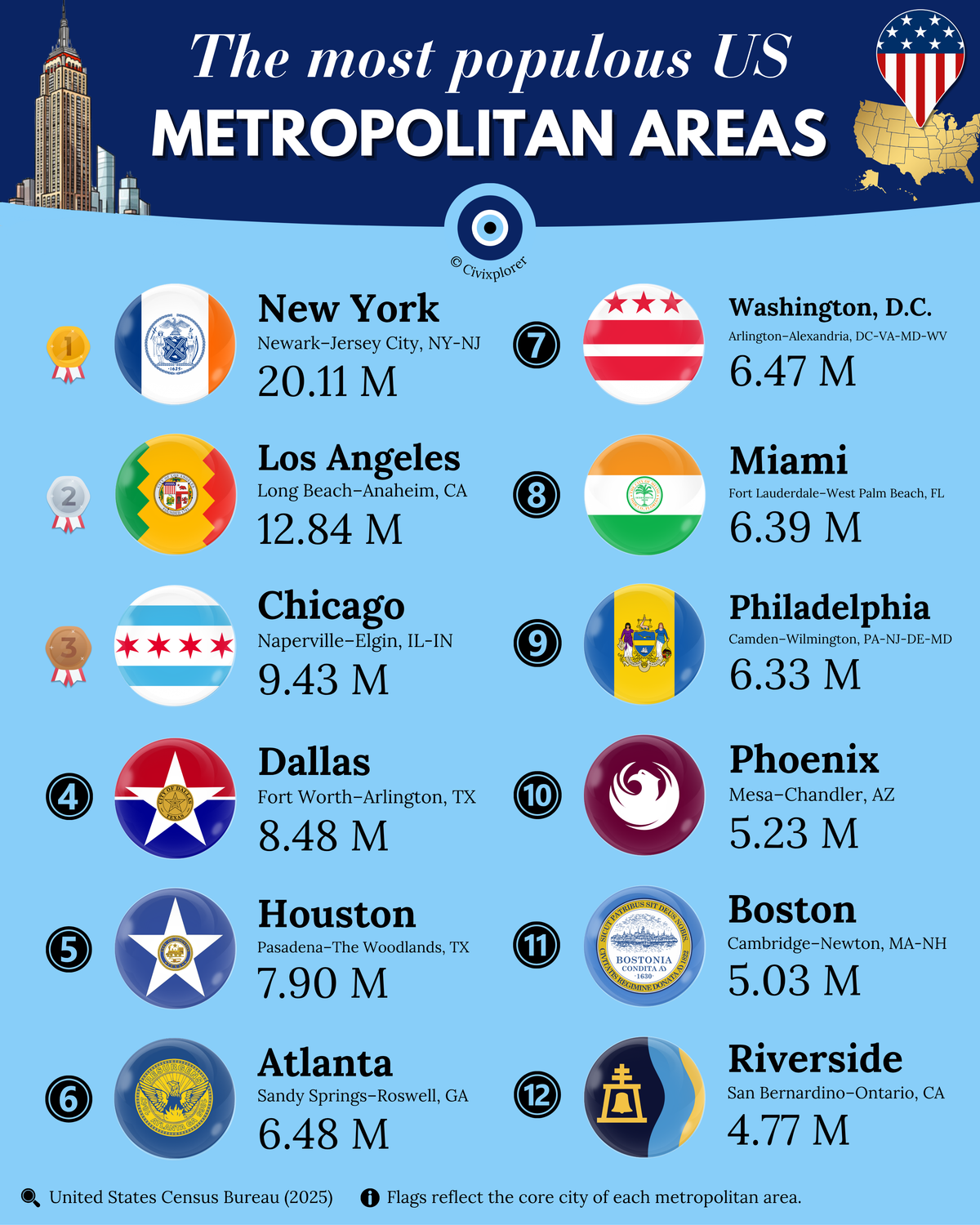
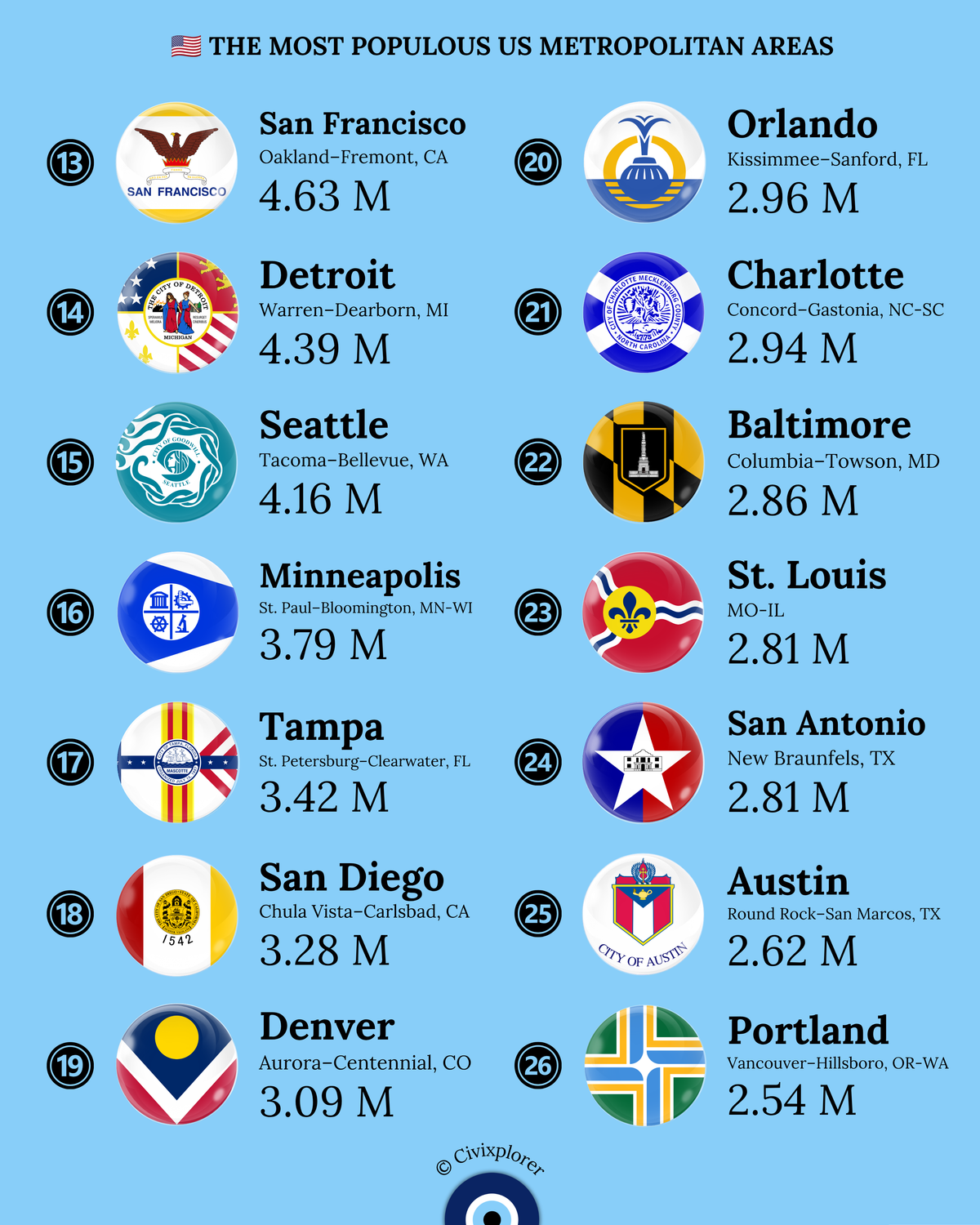
When we think of the United States, we often think of iconic cities. However, to truly understand the country's demographic and economic power, we must look beyond city limits and into Metropolitan Statistical Areas (MSAs). These regions represent entire urban labor markets—multi-county areas tied together by commuting patterns and social integration. Based on the 2025 US Census Bureau projections, the map of American population is undergoing a historic shift.
The Giants: New York, Los Angeles, and the Chicago Exception At the top of the hierarchy, New York–Newark–Jersey City remains the undisputed leader with over 20.11 million residents. Its scale is driven by historical primacy and a dense, polycentric structure that integrates parts of four states. In second place, Los Angeles (12.84 million) represents a different model: horizontal expansion and spatial sprawl. While these two remain the "megaregions" of the U.S., their growth is slowing due to high living costs and saturation.
Chicago (9.43 million) maintains the third spot, but its trajectory tells a story of legacy rather than momentum. While it remains the undisputed capital of the Midwest, it is currently seeing flat growth or slight declines as residents migrate toward lower-cost states.
The Rise of the Sun Belt
The most explosive story in this ranking is the dominance of the Sun Belt. The middle of the top 10 is now a powerhouse of Southern and Southwestern growth. Dallas–Fort Worth (#4 with 8.48 million) and Houston (#5 with 7.90 million) are rapidly closing the gap with the "Big Three." Texas, in particular, is creating a massive urban corridor—the Texas Triangle—fueled by business-friendly tax structures and large-scale corporate relocations.
Similarly, Florida has emerged as a diversified economic powerhouse. Miami (#8), Tampa (#17), and Orlando (#20) are no longer just retirement havens; they are magnets for domestic migration and international finance. Austin, Texas (#25), despite being near the bottom of this list, stands out as the fastest-growing major metro in the nation, reflecting the massive "tech-odus" to the South.
Hidden Realities: Riverside vs. San Francisco
One of the most surprising takeaways from this data is the ranking of Riverside–San Bernardino (#12). With 4.77 million people, the "Inland Empire" is now more populous than globally recognized hubs like San Francisco (#13) or Seattle (#15).
This highlights a fascinating "spillover" economy. As coastal California becomes prohibitively expensive, working-class families and logistics industries have pushed eastward. It also reveals the quirks of statistical boundaries: if the San Francisco Bay Area were measured as a Combined Statistical Area (including Silicon Valley), it would rank in the top 5. However, as a standalone MSA, it reflects the geographic and economic constraints of the peninsula.
Stagnation in the Rust Belt and Stability in D.C.
While the South surges, traditional industrial centers in the Rust Belt like Detroit (#14) and St. Louis (#23) continue to face relative decline. Their suburban areas provide stability, but they are no longer leading national growth.
In contrast, Washington, D.C. (#7) remains uniquely stable. Anchored by federal government employment and defense contractors, its growth is institutionally driven, making it more resilient to the economic cycles that affect industrial or tech-heavy regions.
Conclusion
The 2025 rankings prove that the U.S. is becoming increasingly Sun Belt-centric. The center of gravity is moving toward the South and Southwest, driven by a search for affordability, warmer climates, and new economic opportunities. The American urban system is no longer just a collection of cities; it is a networked system of regional urban megaregions.

Comments (0)
Join the Conversation
Login to share your thoughts with the community.
Login to Comment