
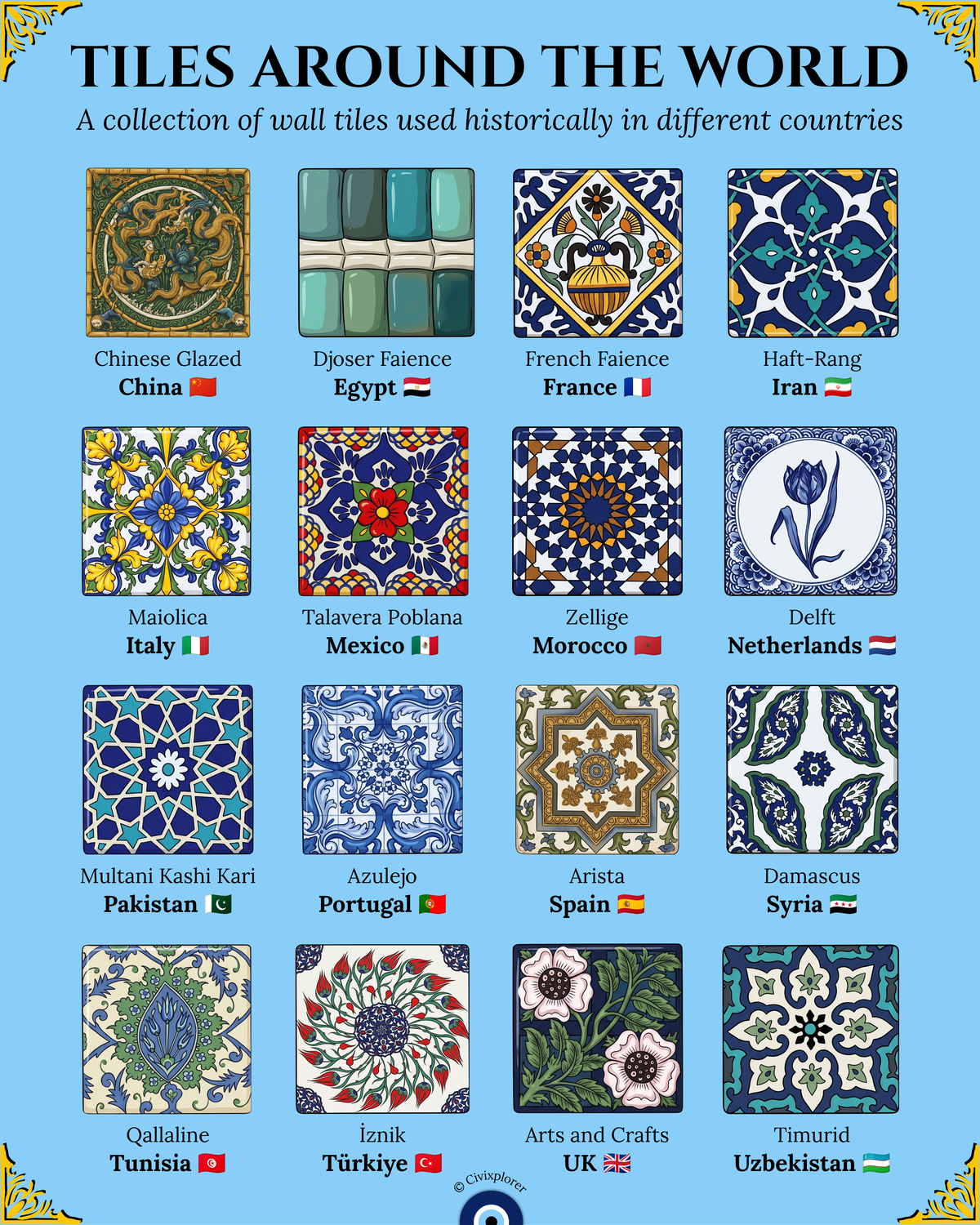
The history of architectural ceramics is not a collection of isolated regional crafts, but rather a fascinating story of global trade, technological borrowing, and cultural exchange. Across centuries and continents, artisans developed distinct visual languages while continuously adapting ideas from neighboring civilizations. From subterranean royal tombs in ancient Egypt to the vibrant streets of colonial Mexico, wall tiles have served as enduring records of human creativity, religious patronage, and imperial ambition.
The journey begins in ancient Egypt with Djoser faience, created nearly 4,600 years ago for the Step Pyramid at Saqqara. Made from silica and ground quartz rather than traditional clay pottery, these turquoise pieces were crafted to replicate the woven reed mats of royal palaces. Thousands of years later, as Islamic traditions expanded, artisans channeled theological restrictions on depicting living beings into masterworks of geometric complexity. Traditions like Moroccan Zellige perfected the art of hand-chiseled mosaic assemblies, while Iranian Haft-Rang introduced multi-colored glaze techniques that allowed intricate floral and geometric patterns to be fired on single panels. In Ottoman Türkiye, court potters at İznik achieved incredible technical leaps by inventing fritware ceramics celebrated for vibrant cobalt blues and a distinctive raised tomato-red glaze.
A major driving force behind European tilemaking was the relentless ambition to replicate Chinese porcelain. Because China closely guarded its porcelain manufacturing methods, European and American workshops turned to tin-glazing as an ingenious workaround. By adding tin oxide to lead glaze, potters created an opaque white surface over earthenware that served as a canvas for delicate painting. This single technology fueled Renaissance Italian Maiolica, French Faience, and Dutch Delftware, where 17th-century potters combined Chinese blue-and-white motifs with local scenes and tulips. This trade network reached across the globe to colonial Mexico, where Talavera Poblana fused Spanish ceramic methods with Chinese porcelain styles arriving via the Pacific Manila Galleon trade routes.
In the Iberian Peninsula, ceramic arts bridged Islamic and Western European cultures. The Portuguese Azulejo—derived from the Arabic word for polished stone—became integrated into entire building facades, while Spanish artisans mastered the Arista technique using molded ridges to keep glazes separated. Centuries later in 19th-century Britain, the Arts and Crafts movement emerged under figures like William Morris, offering a soulful return to handcrafted floral motifs in response to Victorian industrialization. Together, these sixteen traditions prove that iconic tile styles were rarely solitary inventions, but rather dynamic chapters in a shared worldwide conversation.

Comments (0)
Join the Conversation
Login to share your thoughts with the community.
Login to Comment