
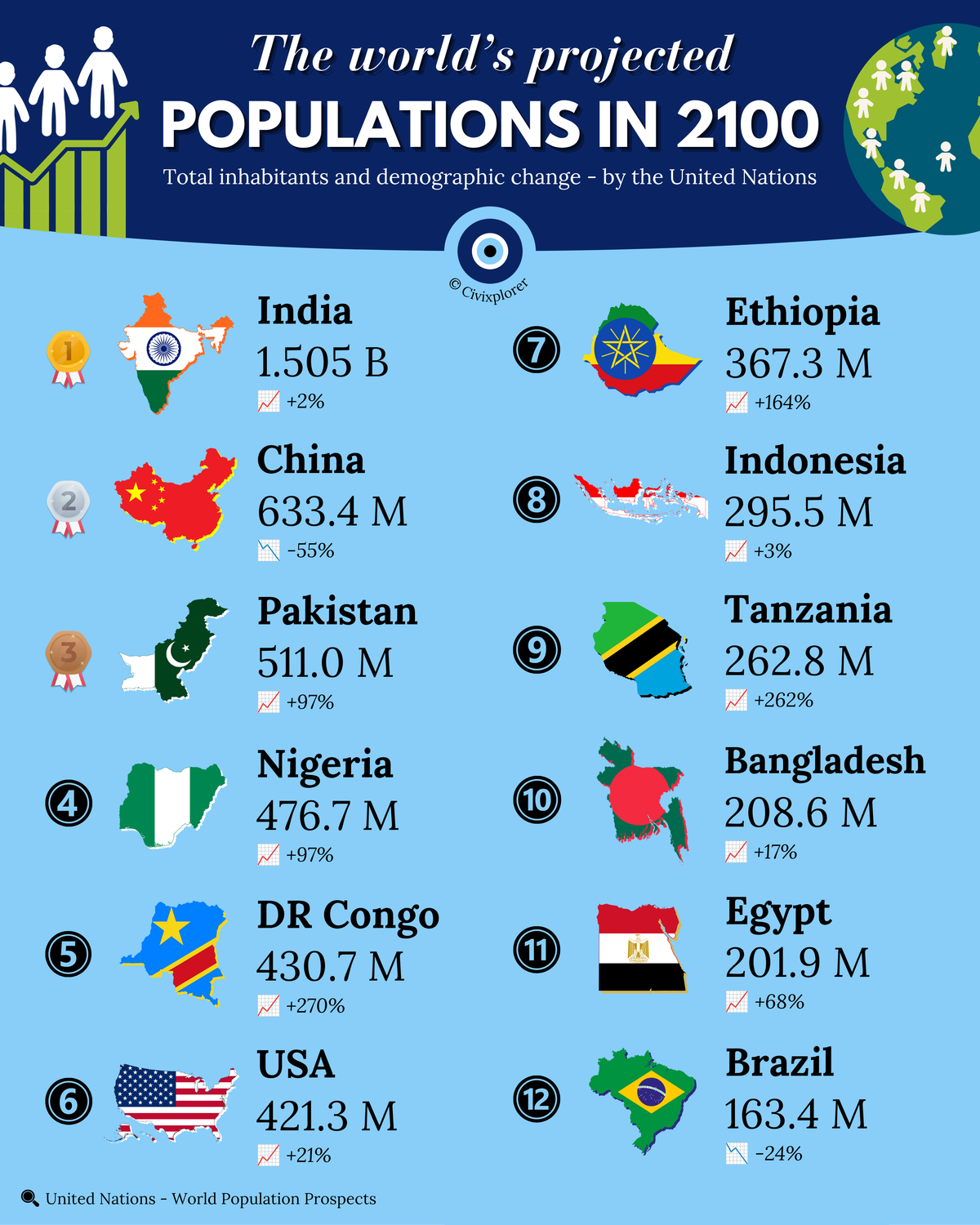
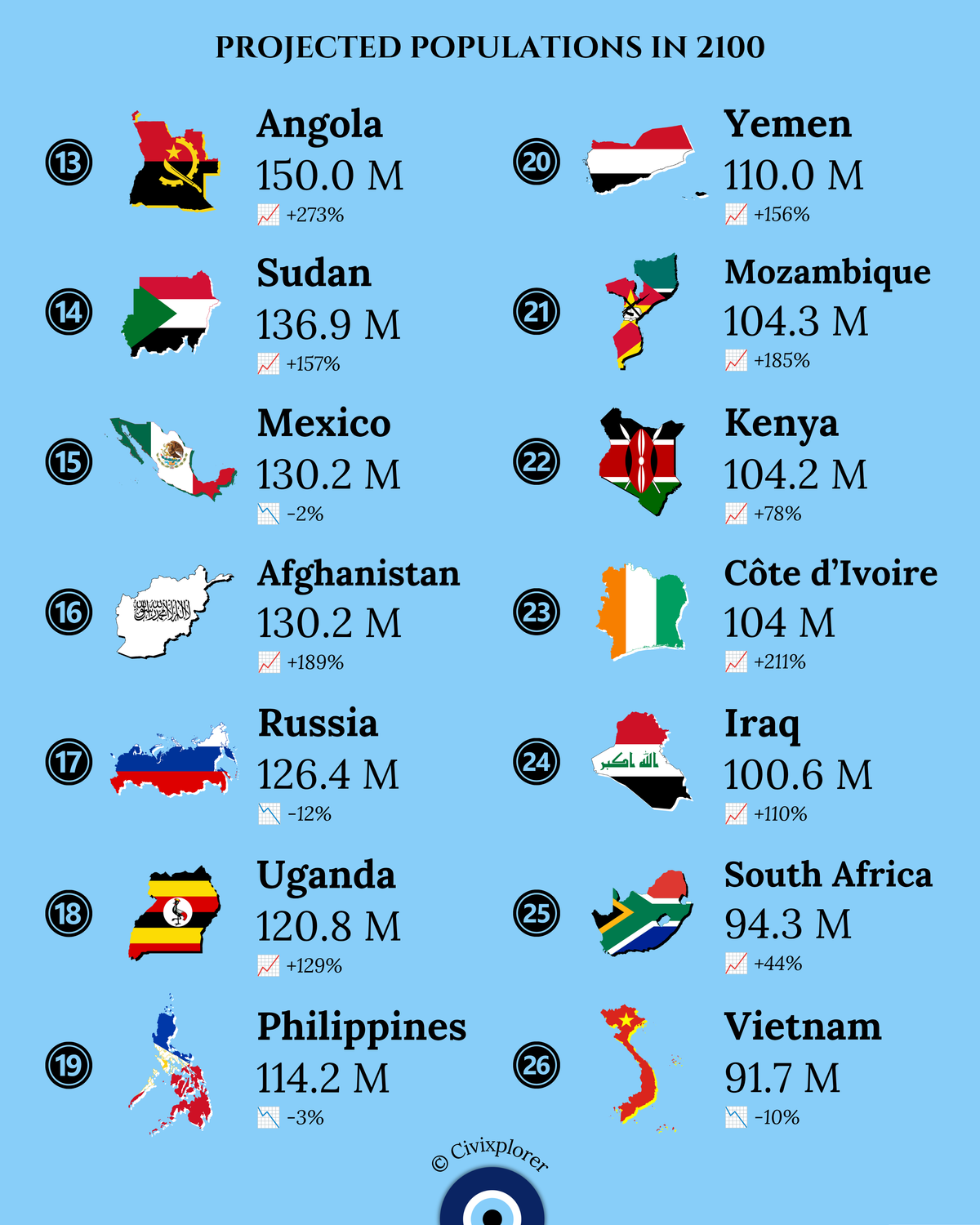
The global demographic landscape is on the verge of a historic transformation. According to the United Nations World Population Prospects (2024), the world is moving away from the population patterns that defined the 20th century toward a radical realignment of human geography. While the global population is expected to peak at approximately 10.3 billion in the mid-2080s, the real story lies in where people will be living by the year 2100.
The Rise of the African Century
The most significant trend highlighted in these projections is the meteoric growth of Sub-Saharan Africa. By the end of the century, the continent is expected to represent roughly one-third of humanity. Countries like the Democratic Republic of the Congo (+270%), Angola (+273%), and Tanzania (+262%) are projected to see triple-digit growth. Nigeria is set to become the world’s fourth-largest nation, reaching nearly 477 million people. This "demographic momentum" is driven by persistently high fertility rates and a heavily youth-skewed median age, positioning Africa as the primary engine of global population growth.
China’s Dramatic Demographic Reversal
In a stark contrast, China is projected to experience a staggering -55% reduction in its population, falling from its current heights to approximately 633 million by 2100. This contraction is the long-term legacy of the one-child policy combined with rising urban living costs and shifting cultural attitudes toward family. China, once the symbol of rapid expansion, may become the world’s most prominent example of population contraction and rapid societal aging.
India at the Helm
India is expected to remain the world’s most populous country in 2100 with 1.505 billion inhabitants. Although its population will have peaked and begun a modest decline by then, its enormous base ensures it retains the top spot. Interestingly, India’s fertility has already dropped to replacement levels, meaning its position at the top is maintained by existing momentum rather than continued high birth rates.
The American Exception
Among high-income, industrialized nations, the United States stands as a notable outlier. While most developed countries are expected to shrink, the U.S. is projected to grow by +21% to 421 million people. This growth is almost entirely driven by net immigration, which offsets a domestic birth rate that has fallen below replacement levels. This allows the U.S. to maintain its position as a top-tier global population center while peers in Europe and East Asia face significant declines.
Latin America and Russia’s Contraction
The projections also reveal a cooling of growth in formerly booming regions. Brazil is expected to see a -24% decline, falling to 163 million, while Russia faces a -12% contraction. These shifts highlight how rapidly these regions have moved through the demographic transition, moving from high growth to stabilization and decline in just a few generations.
Geopolitical Implications
This demographic reordering will inevitably shift the global center of gravity. A world defined by an aging Eurasia and a young, expanding Africa will face new challenges in economic potential, migration patterns, and political influence. The central question for the coming decades is not just which countries will have the most people, but which will successfully convert these demographic shifts into sustainable advantages.

Comments (0)
Join the Conversation
Login to share your thoughts with the community.
Login to Comment