
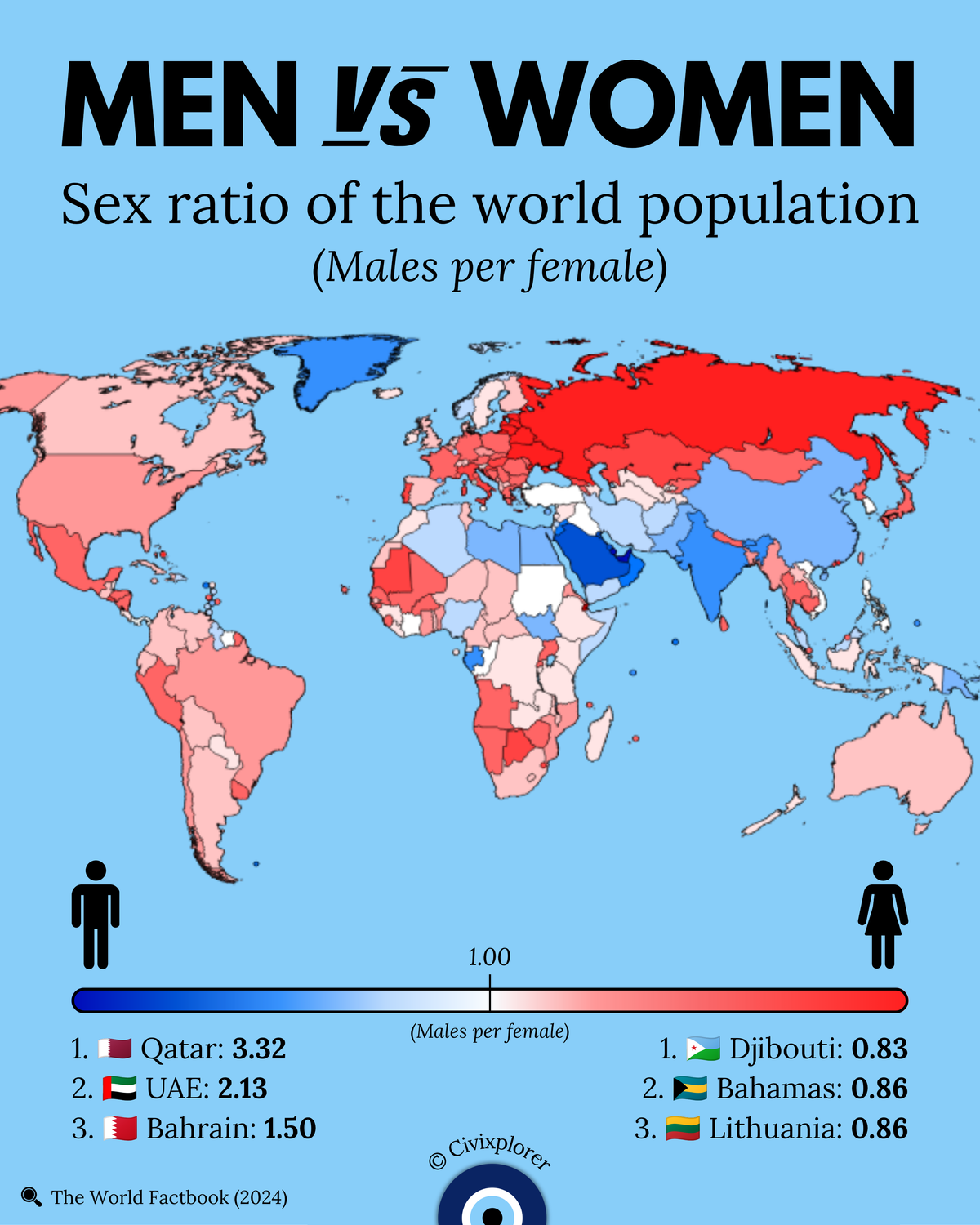
The distribution of the human population across gender lines is far from uniform across the globe. While biology establishes a natural secondary sex ratio baseline of approximately 105 boys born for every 100 girls, female longevity typically erodes this male surplus over time, leaving most closed, aging societies with a slight female majority between 0.95 and 0.98 males per female. Globally, overall human demographics sit near a balanced parity of roughly 1.01 to 1.02 males per female. However, visualizing 2024 CIA World Factbook data on a diverging scale centered at 1.00 reveals how economic migration, cultural practices, and life expectancy disparities create dramatic regional imbalances.
The most extreme male surpluses on Earth are concentrated in the Persian Gulf, where nations like Qatar reach an astonishing 3.32 males per female, followed by the United Arab Emirates at 2.13 and Bahrain at 1.50. Rather than reflecting high birth rates or local genetics, these dark blue regions are an artifact of rapid economic expansion powered by massive temporary labor immigration. Foreign non-citizens comprise up to 85% to 90% of the total population in these nations, with recruitment concentrated heavily among young men working in construction, energy, and infrastructure sectors. Outside the Middle East, Greenland presents another notable male surplus between 1.10 and 1.12 males per female, driven by young women emigrating to Denmark for higher education while local industries like commercial fishing and construction retain a male-dominated workforce.
In contrast, male surpluses across Asia stem from historical birth distortions rather than worker inflows. In China (1.04 overall) and India (1.06 overall), traditional son preference, small family norms, and the widespread adoption of prenatal sex selection elevated birth ratios to between 1.09 and 1.10 boys per female over recent decades. Because these two nations encompass over a third of humanity, their adult male cohorts significantly influence the global average despite national policies and urban trends now normalizing birth ratios.
On the opposite end of the spectrum, Eastern Europe and the Baltic states display the world's most pronounced female majorities, shaded in intense red. Lithuania and Russia sit at 0.86 and 0.87 males per female respectively, alongside neighboring Latvia, Belarus, and Estonia. This skew is driven primarily by a severe adult male mortality gap linked to cardiovascular disease, high alcohol consumption, smoking, and occupational hazards. In older age cohorts aged 65 and above, the ratio collapses to roughly 0.51 to 0.53, resulting in nearly two women for every man. Other regional female majorities include Djibouti (0.83) and The Bahamas (0.86), where combinations of labor out-migration, regional displacement, and elevated male mortality shape the resident population.


Comments (0)
Join the Conversation
Login to share your thoughts with the community.
Login to Comment