
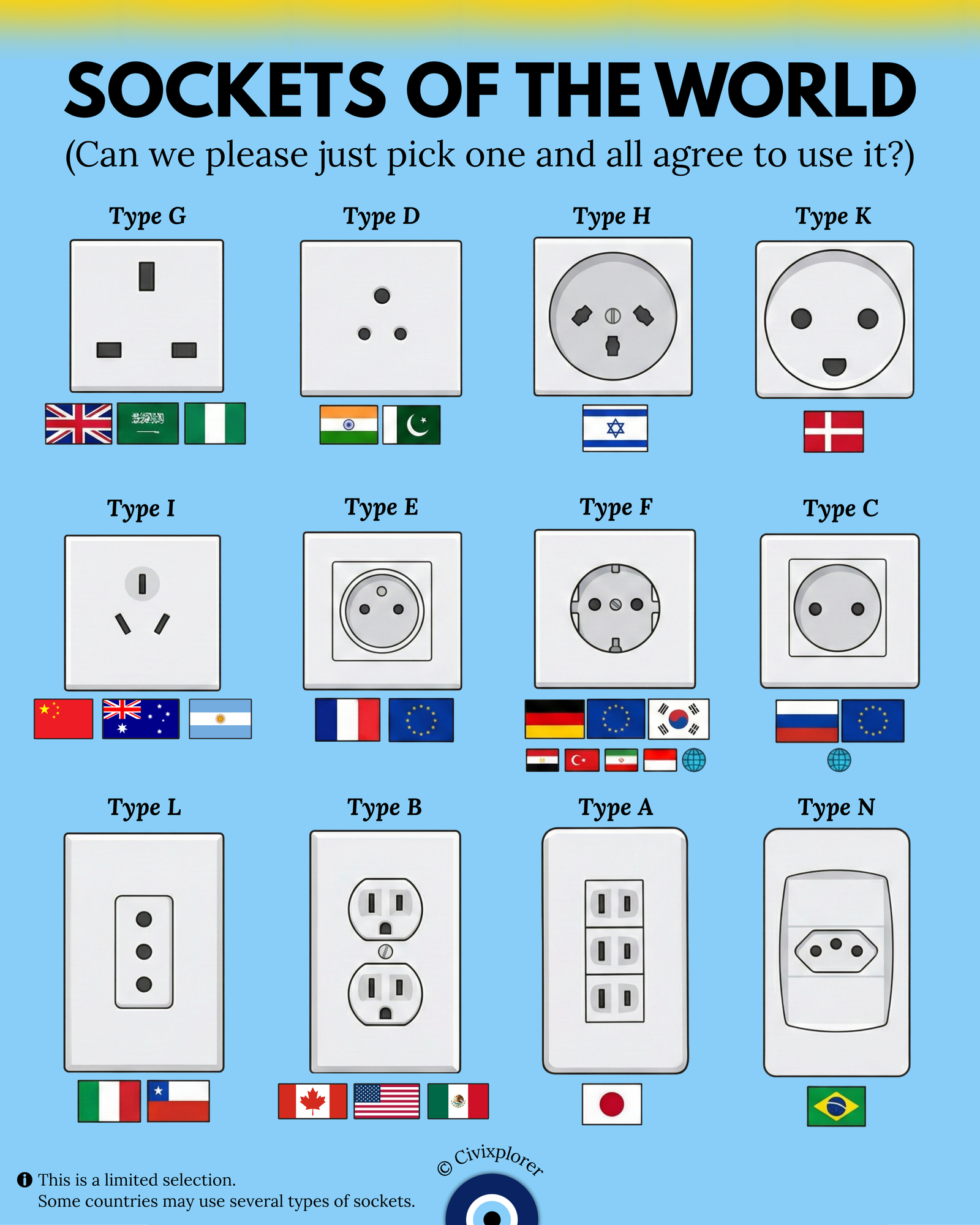
The chaotic landscape of global electrical sockets is a common frustration for international travelers, yet it tells a fascinating story of history and engineering. This variety exists because the electrical grid was never a unified global project; instead, electrification happened independently in different nations during the late 19th and early 20th centuries. Early appliances often had to be screwed into lightbulb sockets until inventors began patenting dedicated wall plugs to improve safety.
Safety philosophies eventually led to an explosion of different three-prong designs as countries sought to "ground" their electrical currents. A notable example is the British Type G plug, which was a strategic response to post-war copper shortages. To save material, the UK adopted a "ring circuit" wiring system that required each plug to have its own internal fuse, resulting in the bulky but exceptionally safe design used today.
One might wonder why we cannot simply agree on a single standard. The primary obstacle is the voltage barrier: North America operates on 110-120V, while most of Europe and other regions use 220-240V. Physical plug differences serve as a vital safety measure to prevent users from plugging low-voltage devices into high-voltage sockets, which could cause appliances to catch fire. Additionally, the immense economic cost of replacing billions of installed sockets makes a global shift practically impossible.
Despite these challenges, some progress has been made toward unification. Brazil stands as a rare success story, having fully transitioned to the Type N standard to resolve its historical mix of incompatible plugs. For the rest of the world, the de-facto travel companion remains the Type C Europlug, which is designed to fit into several different socket types across Europe, Russia, and beyond.
Comments (0)
Join the Conversation
Login to share your thoughts with the community.
Login to Comment