
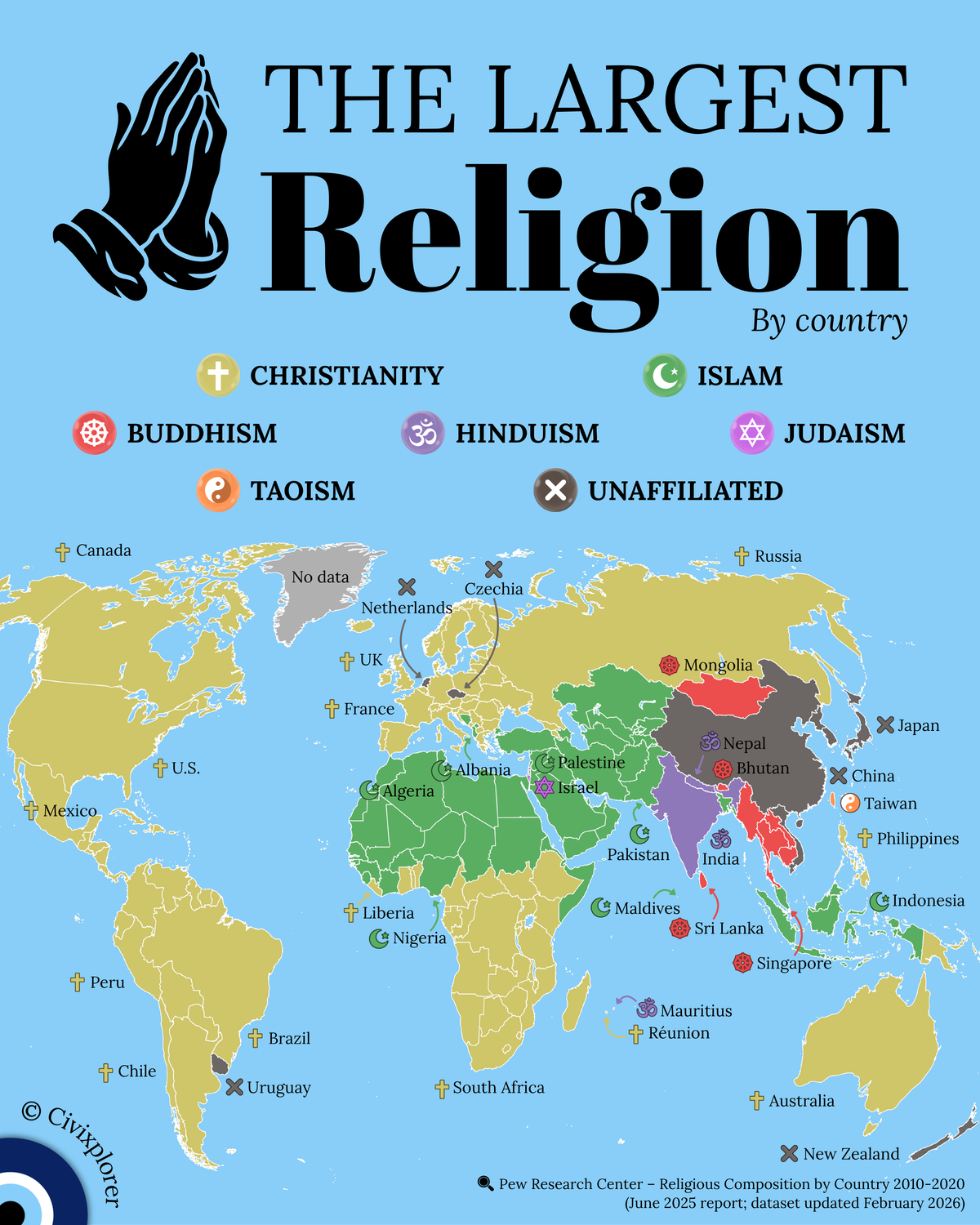
Understanding global belief systems requires looking beyond static borders to examine how history, migration, and demographic shifts continuously reshape human geography. Based on comprehensive Pew Research Center estimates covering 201 countries and territories, modern cartography visualizes the single largest religious group in each nation around the year 2020. Globally, Christianity remains the largest religious tradition at approximately 28.8% of the world's population, followed closely by Islam at 25.6% and the religiously unaffiliated at 24.2%. Hinduism accounts for 14.9% of humanity, while Buddhism represents 4.1%, with Judaism making up roughly 0.2%. Crucially, this geographic mapping identifies plurality or leading self-identified affiliation rather than an absolute majority in every territory.
The geographic distribution of major faiths reveals remarkable historical shifts, most notably within Christianity, whose demographic center of gravity has moved decisively to sub-Saharan Africa. While European colonization historically spread Christian traditions across the Americas and Oceania, sub-Saharan Africa now hosts 30.7% of the global Christian population compared to 22.3% in Europe, driven by higher fertility rates and rapid demographic expansion. Meanwhile, Islam forms an extensive geographic belt stretching from North Africa and the Middle East across Central and South Asia to Southeast Asia. Although the Middle East remains the faith's historical heartland, approximately 59% of the world's Muslim population resides in the Asia-Pacific region, with Indonesia maintaining the world's largest individual Muslim population.
In contrast to widely dispersed global religions, Hinduism demonstrates an extraordinary geographic concentration in South Asia. Approximately 95% of all Hindus live in India, where they comprise roughly 79% of the population, alongside Nepal and a colonial indentured labor diaspora in Mauritius. Buddhism presents another compelling trajectory, having originated in India but now remaining overwhelmingly concentrated in East and Southeast Asia across mainland nations such as Thailand, Myanmar, Cambodia, and Bhutan. Meanwhile, Judaism represents a distinct demographic footprint, standing as the predominant religious group solely in Israel, which accounts for nearly half of the global Jewish population alongside major diaspora communities in North America.
Perhaps the most striking modern development is the rise of the religiously unaffiliated, which now forms the world's third-largest global category. This trend reflects two distinct phenomena: widespread secularization across Western nations like the Netherlands, Czechia, New Zealand, and Uruguay, alongside unique cultural syncretism in East Asia. In China and Japan, where formal religious membership differs from Western concepts, millions engage in traditional spiritual practices and ancestor rites while identifying as unaffiliated in demographic surveys. Similarly, Taiwan stands out on global maps with other religions—including Daoism and folk traditions—as its largest category, illustrating how lived religion often defies rigid classification. Ultimately, these patterns confirm that global religious geography is a dynamic, evolving landscape shaped by generational replacement, migration, and changing demographic realities.

Comments (0)
Join the Conversation
Login to share your thoughts with the community.
Login to Comment