
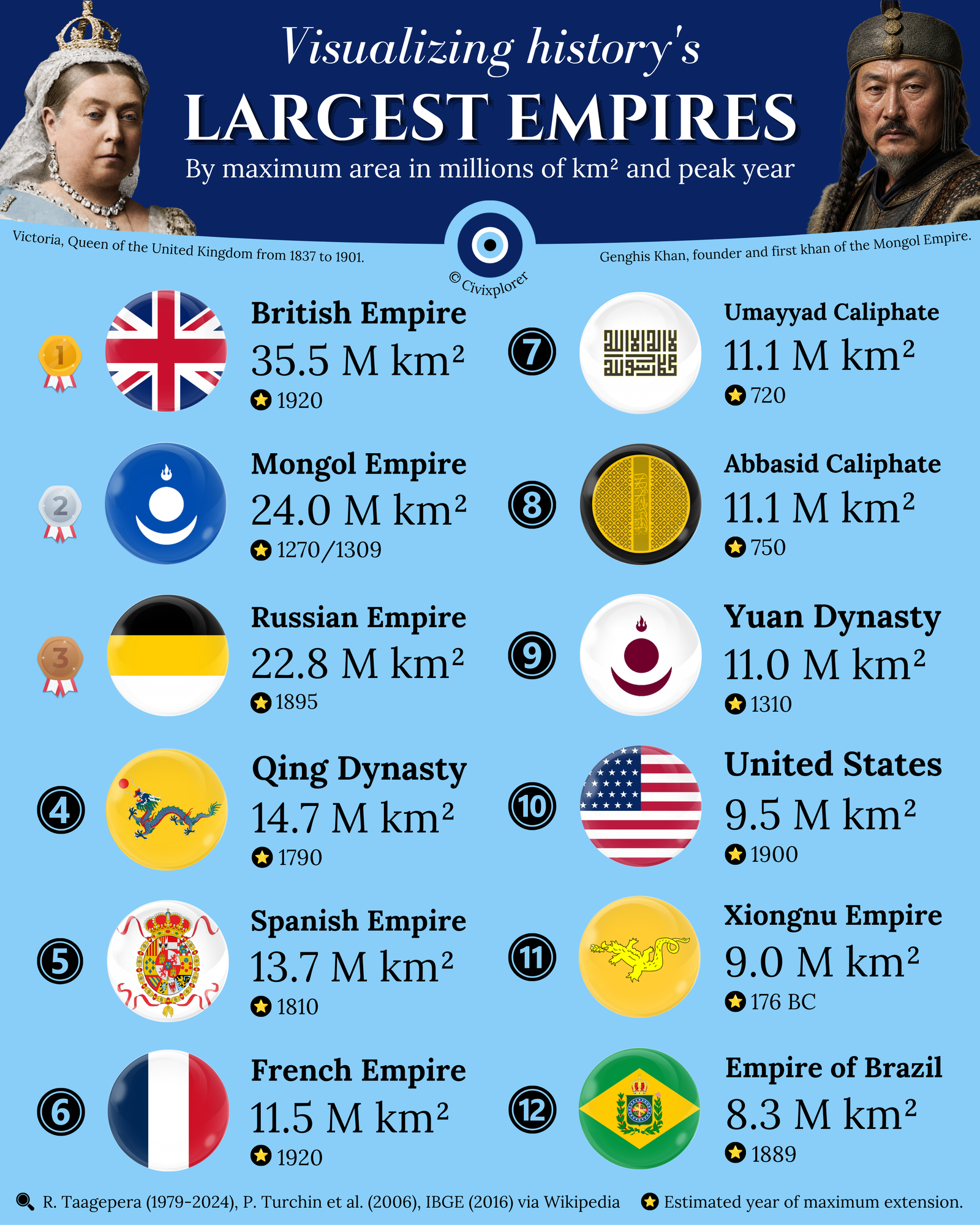
The history of humanity is a chronicle of expansion, and nothing illustrates this better than the rise of the world’s most massive polities. Using dry land area as the primary metric, we can visualize the sheer scale of these historical giants. This ranking draws from the pioneering research of scholars like Rein Taagepera and Peter Turchin, who utilized historical atlases to quantify the undisputed military and taxation reaches of these states at their absolute peaks.
The 1920 Paradox: Maritime Supremacy
At the top of the list sits the British Empire, which in 1920 reached a staggering 35.5 million km², covering roughly a quarter of the Earth’s land surface. Interestingly, both the British and the French Empire (ranking 6th at 11.5 million km²) reached their territorial maximums just after World War I. This was driven by the League of Nations mandate system, which allowed them to partition former Ottoman and German territories. However, this peak was fragile, as it coincided with the rising tide of global decolonization movements.
The Contiguous Land Leviathans
Unlike the maritime empires, the Mongol Empire remains the largest contiguous land empire in history. Peaking between 1270 and 1309 with 24 million km², the Mongols utilized the vast Eurasian Steppe as a superhighway for their mobile cavalry. Similarly, the Russian Empire reached its zenith in 1895 with 22.8 million km², a feat achieved through a relentless eastward expansion across Siberia to the Pacific, eventually consolidated by the Trans-Siberian Railway.
Dynastic Power and Global Firsts
The Qing Dynasty represents the largest historical extent of China, reaching 14.7 million km² in 1790. Much of the territorial shape of modern China traces back to these Qing expansions. Meanwhile, the Spanish Empire holds the title of the first truly global empire, with possessions on every inhabited continent. At its 1810 peak of 13.7 million km², Spain controlled the vast majority of the Americas, though Napoleon’s invasion of the mainland soon triggered a wave of independence.
The Caliphates and Steppe Confederations
The Umayyad and Abbasid Caliphates (both peaking around 11.1 million km² in the 8th century) demonstrate the explosive reach of early Islamic expansions, stretching from Iberia to the Indus Valley. Looking further back into antiquity, the Xiongnu Empire (9.0 million km²) proves that nomadic confederations on the Mongolian steppe could pressure even the mightiest sedentary civilizations like Han China through innovative military organization.
Defining Empire in the Americas
The inclusion of the United States (ranking 10th with 9.5 million km² in 1900) and the Empire of Brazil (ranking 12th with 8.3 million km² in 1889) highlights the evolution of the term. For the U.S., the peak year follows the completion of Manifest Destiny and the acquisition of overseas territories like the Philippines and Hawaii. For Brazil, its massive size is a testament to the anti-colonial monarchy that successfully maintained the vast Portuguese colonial borders while suppressing regional rebellions.
The Tipping Point of Overstretch
A recurring theme across these twelve giants is that reaching a maximum territorial area often served as a historical tipping point. Whether due to administrative exhaustion, nationalist uprisings, or economic shifts, the moment of greatest expansion frequently preceded immediate restructuring or collapse. These empires did not just redraw maps; they left behind the languages, legal systems, and cultural legacies that define our modern geopolitical landscape.

Comments (0)
Join the Conversation
Login to share your thoughts with the community.
Login to Comment