
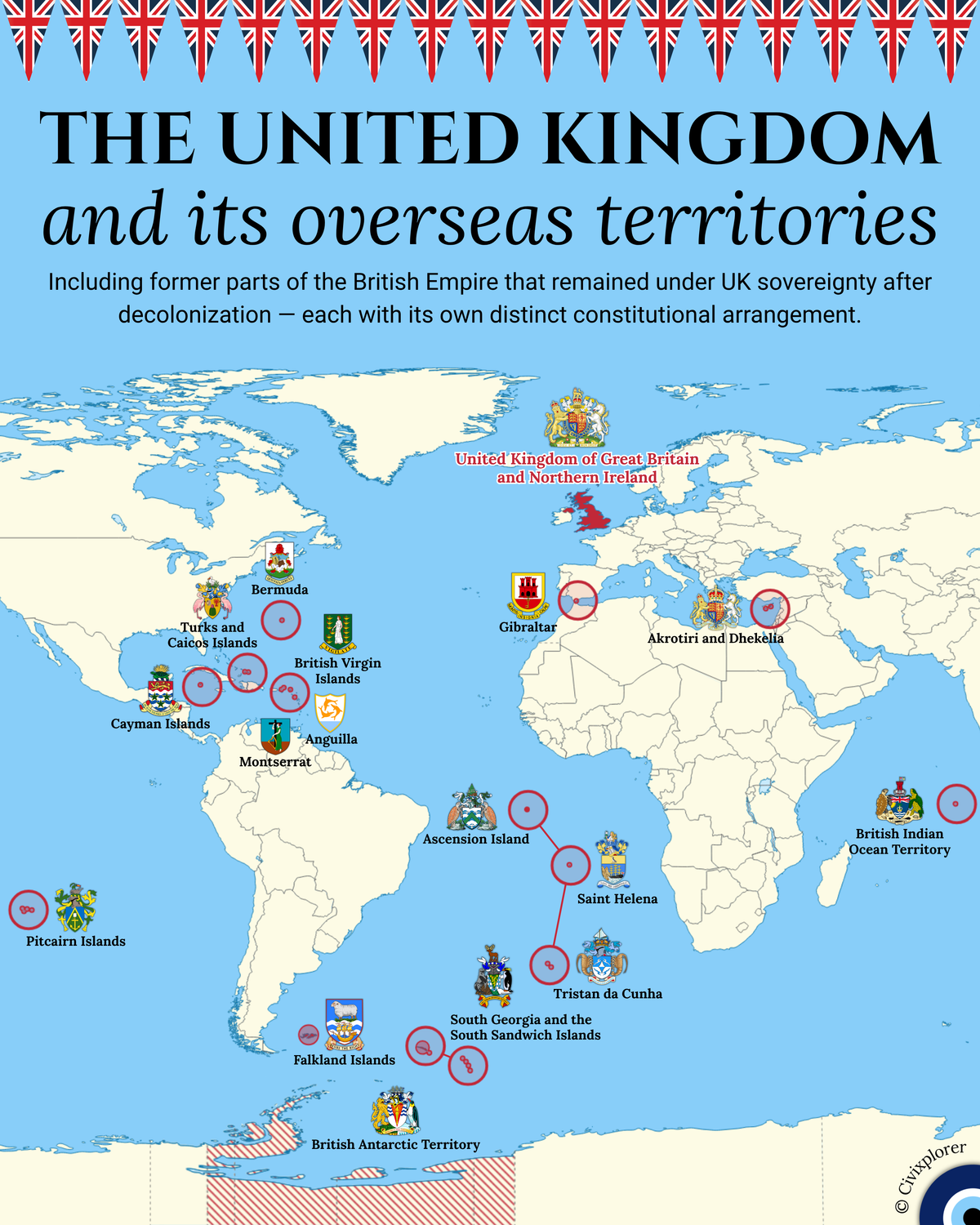
The modern map of the world still bears the intricate markings of history, and nowhere is this more visible than in the 14 British Overseas Territories (BOTs) scattered across the globe. Often mistaken for being part of the United Kingdom proper, these territories represent a unique post-imperial sovereignty, where former parts of the British Empire have remained under UK jurisdiction after the waves of decolonization. From the sun-drenched beaches of the Caribbean to the frozen expanse of Antarctica, these outposts grant the UK a continued global footprint that extends far beyond the British Isles.
The Constitutional Landscape
It is vital to distinguish between the United Kingdom of Great Britain and Northern Ireland and its overseas territories. While the UK Parliament retains ultimate legislative authority and responsibility for defense and foreign affairs, most BOTs enjoy a high degree of internal self-government through locally elected assemblies. These are not colonial relics in the traditional sense; they exist today through a combination of local consent, strategic utility, and logistical reality. In many cases, such as the Falkland Islands or Gibraltar, the local populations have explicitly voted to maintain their link to the British Crown.
A World of Diversity
The geographic spread of these territories is staggering, covering almost every major ocean:
- The Caribbean Hubs: This region includes financial and tourism powerhouses like Bermuda, the Cayman Islands, and the British Virgin Islands, alongside territories like Montserrat, which remains a fascinating study in environmental vulnerability due to its active volcanic history.
- The South Atlantic and Antarctic: Remote outposts like Saint Helena, Ascension, and Tristan da Cunha serve as critical maritime relays. Further south, the Falkland Islands and the British Antarctic Territory highlight the UK's interests in the sub-Antarctic region, though the latter is governed by the 1959 Antarctic Treaty, which freezes all territorial claims in favor of scientific research.
- Strategic Chokepoints: Gibraltar commands the entrance to the Mediterranean, while Akrotiri and Dhekelia on Cyprus function as "Sovereign Base Areas," serving as essential military and intelligence hubs for the Eastern Mediterranean.
Geopolitical Flashpoints in 2026
The status of these territories is not without international friction. The British Indian Ocean Territory (BIOT), specifically the Chagos Archipelago, remains one of the most volatile geopolitical topics. Despite a 2025 treaty intended to transfer sovereignty to Mauritius, the process remains stalled in 2026 due to the strategic importance of the joint UK-US military base on Diego Garcia. Similarly, long-standing disputes with Spain over Gibraltar and Argentina over the Falkland Islands continue to spark diplomatic maneuvers, reminding us that these small outposts are often at the center of global power projections.
Economic and Strategic Value
Beyond symbolism, these territories grant the UK vast Exclusive Economic Zones (EEZs), providing access to rich marine resources, mineral rights, and pivotal scientific research opportunities. Whether they are global financial centers like the Caribbean hubs or remote research stations in the South Atlantic, the British Overseas Territories ensure that the UK remains a pivotal maritime power in the 21st century.

Comments (0)
Join the Conversation
Login to share your thoughts with the community.
Login to Comment