
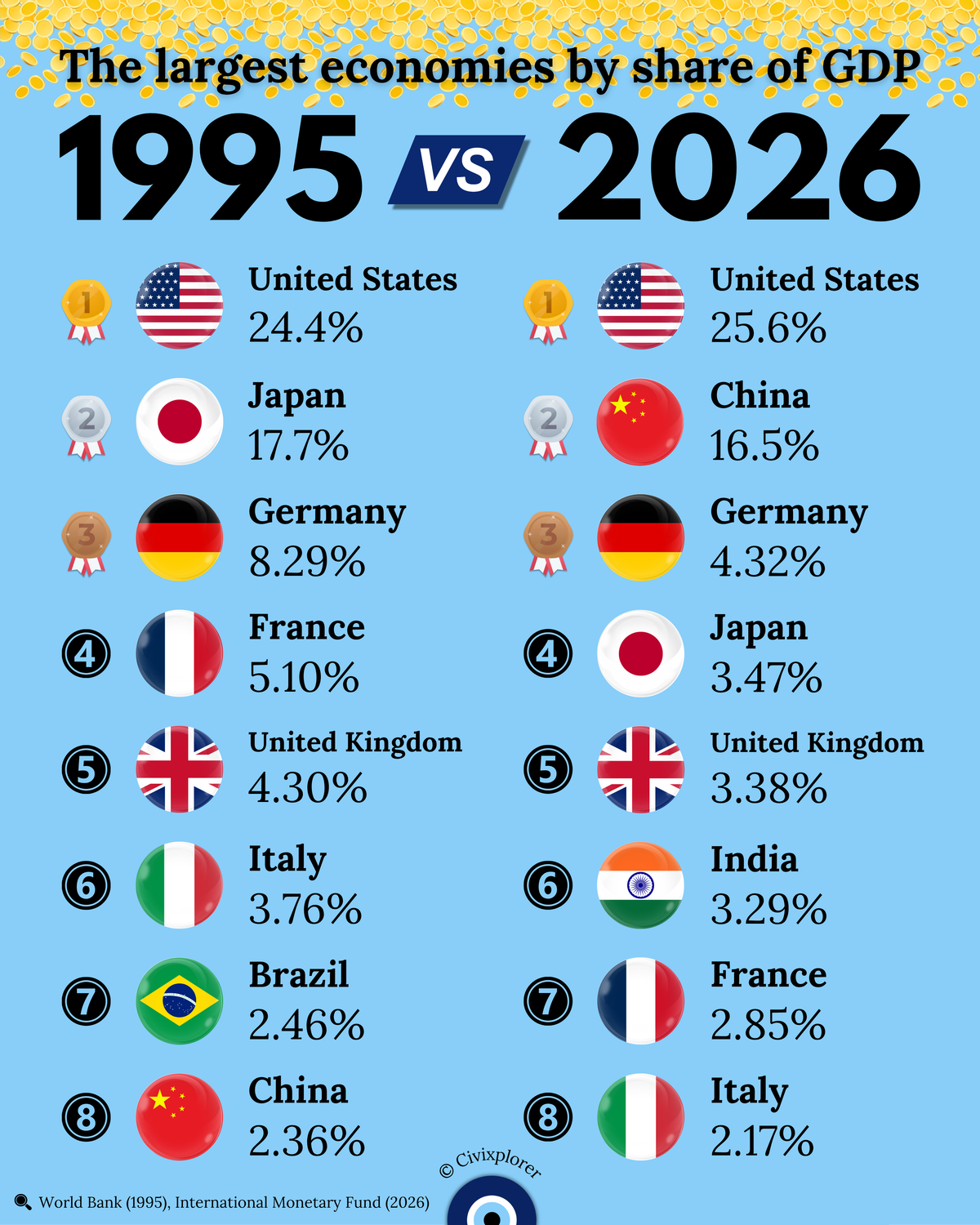
The global economic landscape has undergone a profound transformation over the last three decades. By comparing nominal Gross Domestic Product (GDP) data from the World Bank in 1995 with International Monetary Fund (IMF) projections for 2026, we can visualize a significant reordering of economic weight. This era marks the transition from a post-Cold War world dominated by Western powers and Japan to a multipolar landscape driven largely by Asian industrialization and technological shifts.
The Resilience of the United States
One of the most remarkable aspects of this data is the stability of the United States. In 1995, the U.S. held a 24.4% share of the global economy; by 2026, that figure is projected to edge up slightly to 25.6%. Despite the rapid rise of emerging markets, the American economy has maintained its central pillar status through technological dominance in sectors like software, artificial intelligence, and finance. The U.S. has benefited from a flexible labor market, consistent immigration that refreshes its working-age population, and the enduring status of the U.S. Dollar as the world’s primary reserve currency.
China’s Historic Transformation
The most striking change depicted is the unprecedented ascendance of China. In 1995, China was a minor player in nominal terms, holding only a 2.36% share of global GDP. By 2026, it is projected to command 16.5%, ranking as the second-largest economy in the world. This sevenfold increase was catalyzed by China’s entry into the World Trade Organization (WTO) in 2001, which integrated its massive labor force into global supply chains. Through export-led industrialization and massive infrastructure investment, China effectively became the "world's factory," though it now faces new challenges such as demographic aging and a slowing property sector.
The Relative Decline of Japan and Europe
In 1995, Japan was an industrial titan, accounting for a staggering 17.7% of global GDP. However, by 2026, its share is expected to fall to approximately 3.47%. This shift represents the end of the "Japanese economic miracle" and the onset of the "Lost Decades," characterized by a collapsed asset bubble, stagnant growth, and a severe demographic crisis.
A similar pattern of relative contraction is visible across Europe. Major powers like Germany, France, the UK, and Italy have seen their global footprints shrink significantly. Germany’s share is projected to drop from 8.29% to 4.32%, while Italy may fall from 3.76% to 2.17%. While these nations remain wealthy and technologically advanced, they have grown more slowly than the global average, hindered by aging populations, higher energy costs, and a smaller presence in the emerging global technology sectors compared to the U.S. and China.
The Emergence of India
A new force has entered the top tier: India. While not among the largest economies in the 1995 snapshot, by 2026, India is projected to rank 6th globally with a 3.29% share. Unlike China’s manufacturing-heavy rise, India’s growth has been fueled by information technology, digital services, and a massive, young domestic market. In 2023, India became the world’s most populous country, providing a demographic tailwind that many other major economies currently lack.
A Multipolar Future
In 1995, the global economy was largely centered around the Atlantic and Japan. By 2026, the center of gravity has shifted decisively toward Asia. This rebalancing does not signify the disappearance of Western economic power, but rather the end of an era of overwhelming dominance by a small group of nations. The world is now more multipolar, defined by a U.S.-China bipolarity and the steady rise of new regional powers.

Comments (0)
Join the Conversation
Login to share your thoughts with the community.
Login to Comment