
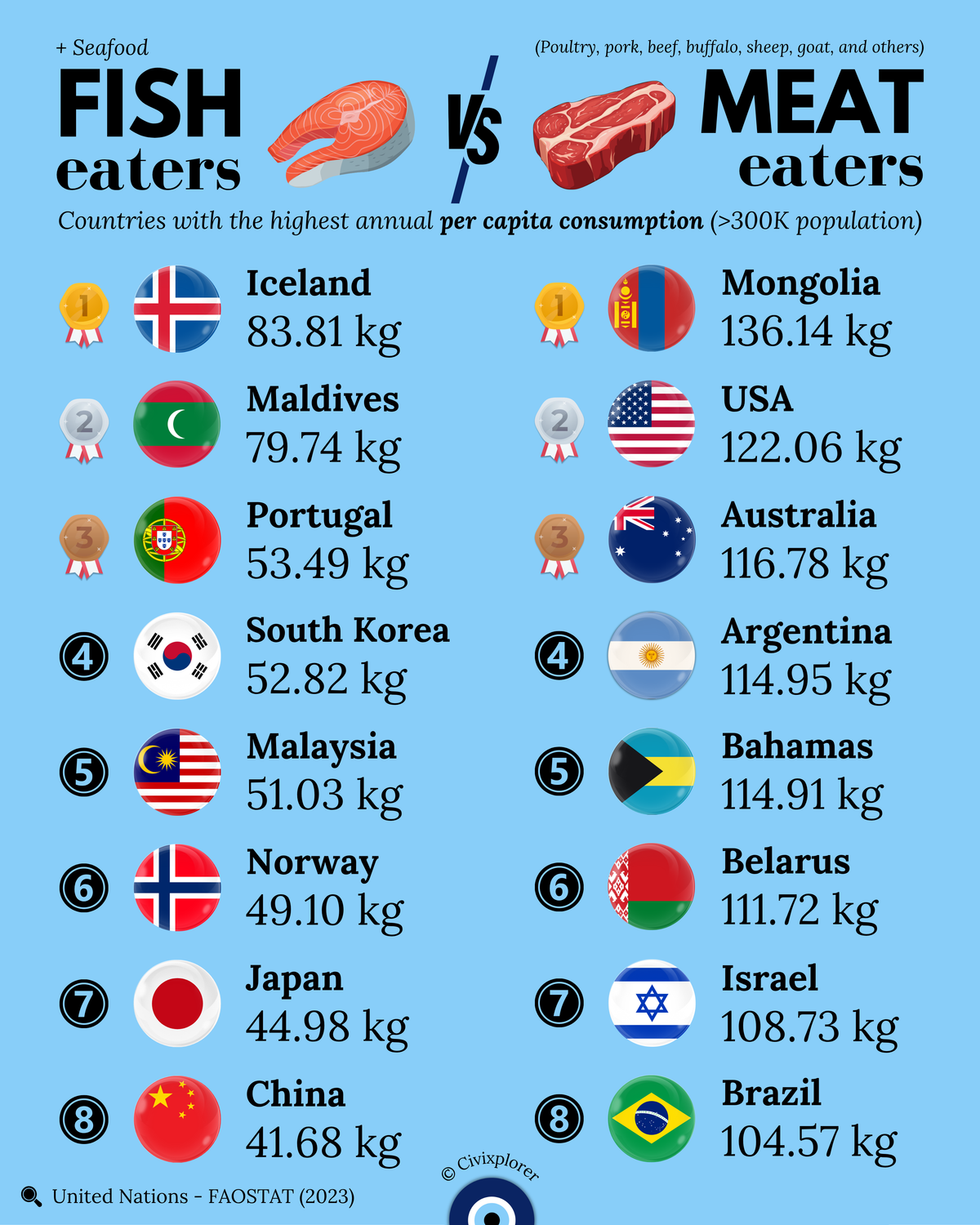
Understanding global protein consumption begins with examining apparent food supply data rather than simple household ingestion surveys. Based on FAOSTAT figures for nations with populations over 300,000, these metrics measure the total quantity of food available per capita after factoring in local production, imports, exports, and non-food uses. Worldwide baseline averages sit at roughly 21 kilograms per person for aquatic foods and 45 kilograms per person for terrestrial meat. However, the leading nations on both sides of the dietary spectrum consume two to three times these global averages, driven by structural environmental conditions rather than mere individual choice.
The world's top seafood consumers are overwhelmingly defined by maritime geography and historical necessity. Leading the list are island nations like Iceland at 83.81 kilograms per capita and the Maldives at 79.74 kilograms per capita. Volcanic terrain and harsh northern climates historically forced Iceland to rely on air-dried stockfish, while the Maldivian archipelago has centered its economy and diet around pole-and-line tuna fishing for centuries. In mainland Europe, Portugal stands out at 53.49 kilograms per capita, maintaining its high seafood intake not through immediate coastal catches alone, but through a medieval salt-for-cod trade tradition that turned imported bacalhau into a national staple. Meanwhile, Asian nations like South Korea at 52.82 kilograms per capita and China at 41.68 kilograms per capita demonstrate how deep marine culinary traditions are now backed by massive aquaculture expansion, with China now producing over half of the world's farmed aquatic animals.
On the other side of the spectrum, meat-heavy diets reveal an entirely different ecological and agricultural story. Mongolia leads global meat availability at an astounding 136.14 kilograms per capita. In a country where the freezing climate of the arid steppe makes crop farming nearly impossible, mobile pastoralism of sheep, goats, cattle, and horses provides the caloric density necessary for survival. In contrast, Western industrial powerhouses like the United States at 122.06 kilograms per capita and Australia at 116.78 kilograms per capita achieve high numbers through vast grain supplies and feed-efficient livestock systems, where poultry has gradually overtaken beef as the primary affordable staple.
Cultural heritage, trade policy, and land structures further reinforce these national eating habits over time. In South America, Argentina at 114.95 kilograms per capita and Brazil at 104.57 kilograms per capita reflect vast grazing lands across the Pampas that fostered deep-rooted asado and churrasco traditions. Unique institutional factors also shape regional consumption, such as in Israel at 108.73 kilograms per capita, where strict Kosher dietary laws and the high cost of beef imports have created a massive domestic poultry industry. Similarly, the Bahamas reaches 114.91 kilograms per capita due to limited arable land requiring heavy food imports combined with a high volume of tourism.
Ultimately, contrasting global fish and meat consumption shows that national diets are structural reflections of physical landscape, trade history, and production efficiency. Whether rooted in northern cod preservation, vast pastoral steppes, or modern industrial aquaculture, human populations continue to consume what their geography and historical trade networks have made most accessible.

Comments (0)
Join the Conversation
Login to share your thoughts with the community.
Login to Comment