
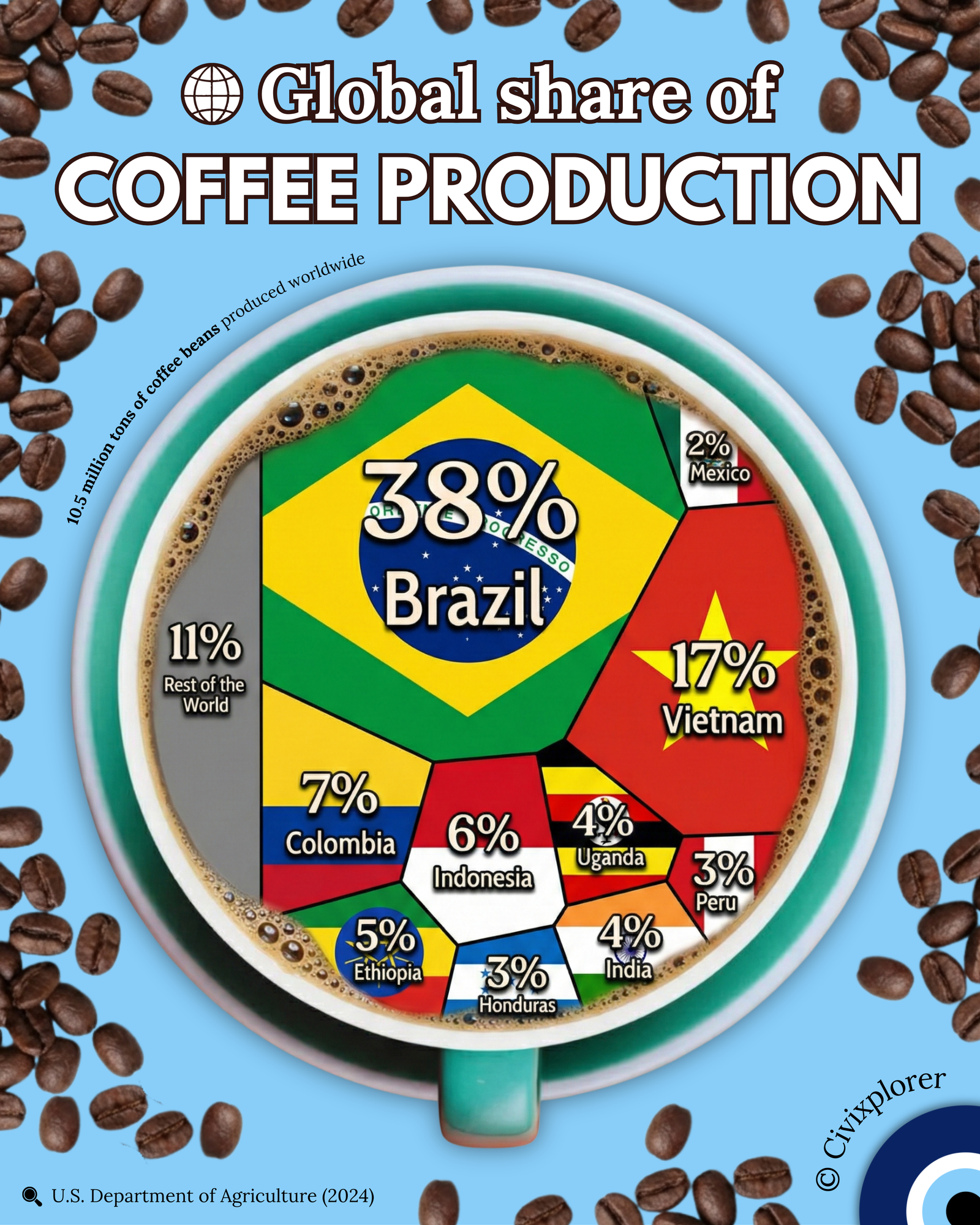
The world produces approximately 10.5 million tons of coffee beans annually, yet this massive industry is highly concentrated within a specific geographic lottery. Using 2024 data from the U.S. Department of Agriculture, we can see that production is dominated by a handful of tropical nations located within the "Coffee Belt"—the equatorial band between the Tropics of Cancer and Capricorn.
Brazil remains the undisputed king of coffee, accounting for 38% of global production. Its dominance is driven by its unique geography; unlike the steep mountainsides of other regions, Brazil possesses vast, high-altitude plateaus that allow for highly mechanized and efficient large-scale farming. This scale, combined with fertile volcanic soils, enables Brazil to successfully cultivate both premium Arabica and hardy Robusta beans.
In second place, Vietnam has seen a meteoric rise, now providing 17% of the world's coffee. This transformation began with the 1986 Đổi mới economic reforms, which encouraged agricultural expansion. Vietnam hyper-focused on the Robusta bean, which is more disease-resistant and offers higher yields per hectare, making the country the global backbone for instant coffee and commercial blends.
While Brazil and Vietnam focus on volume, countries like Colombia (7%) and Ethiopia (5%) hold significant sway in the specialty coffee market. Colombia utilizes its Andean volcanic soil to produce mild, high-quality Arabica beans, while Ethiopia, the historical birthplace of coffee, relies on thousands of smallholder farmers to produce complex and fruity flavor profiles.
Despite the growth in demand—up about 4% between 2023 and 2024—the industry faces challenges. Because coffee is a finicky crop requiring specific temperatures and rainy seasons, the global supply remains heavily dependent on the climate stability of these few developing nations.
Comments (0)
Join the Conversation
Login to share your thoughts with the community.
Login to Comment