
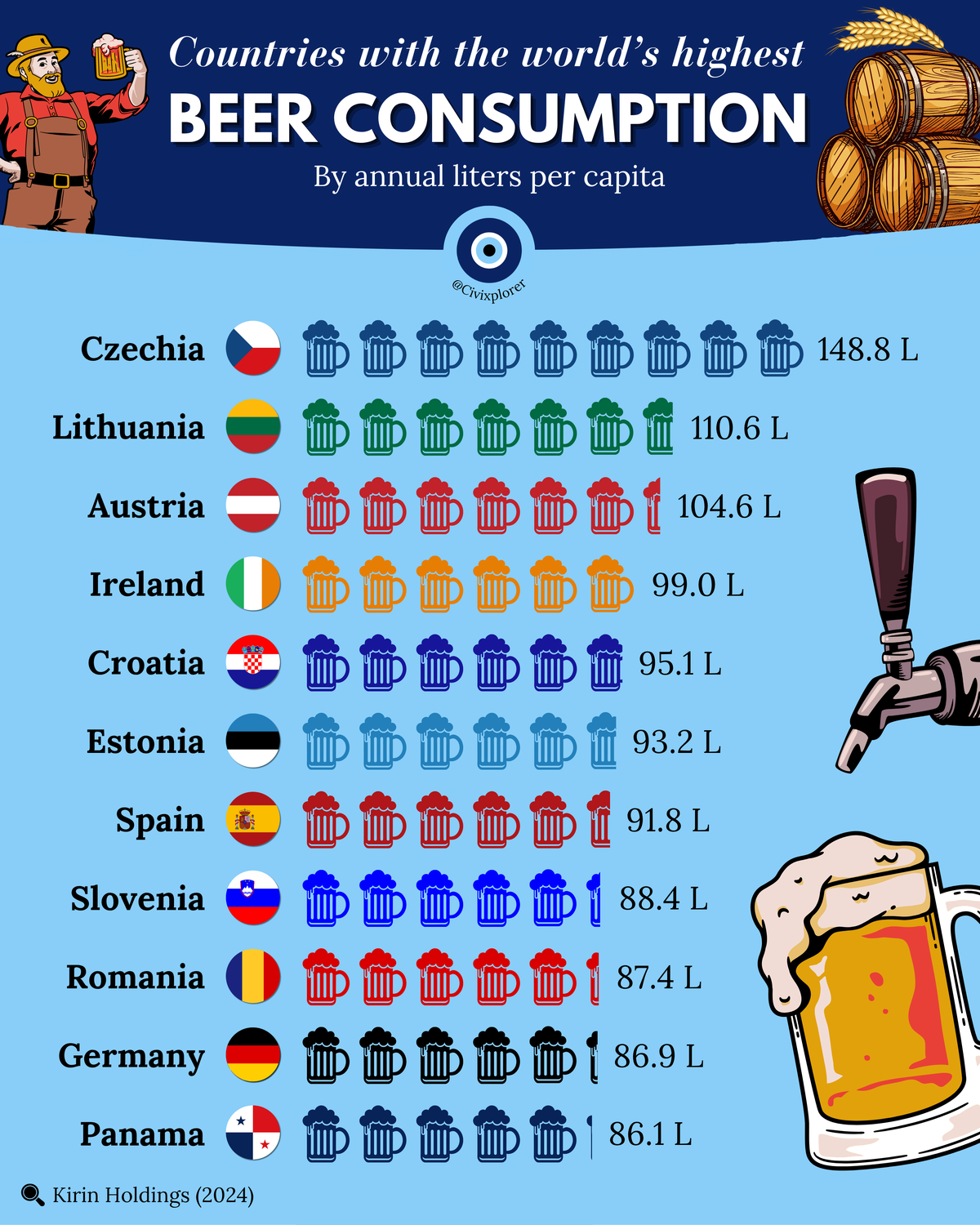
The global landscape of alcohol consumption is rarely uniform, and when it comes to beer, a distinct geographical pattern emerges. According to the 2024 Global Beer Consumption Report published by Kirin Holdings, the world’s thirst for lager and ale is heavily concentrated in a specific region of the Northern Hemisphere. This "beer belt" stretches across Central and Eastern Europe, where brewing is not just an industry but a cornerstone of national identity and social infrastructure.
The Undisputed King: Czechia
For 32 consecutive years, Czechia has maintained its position as the world leader in beer consumption per capita. With an average of 148.8 liters consumed per person annually, the Czech population outpaces its nearest competitor by nearly 40 liters. This dominance is structurally reinforced by several factors. Historically, Czechia is the birthplace of the pilsner style, created in 1842 in the city of Plzeň. Today, beer remains deeply integrated into daily life, often functioning as the default social beverage. In many traditional Czech pubs, or hospody, beer has historically been cheaper than bottled water, making it the most accessible commercial drink for the general population.
The Central and Eastern European Beer Belt
Beyond Czechia, a coherent regional cluster dominates the top rankings. Countries like Lithuania (110.6 L), Austria (104.6 L), and Croatia (95.1 L) form a "beer belt" shaped by shared history and climate suitability for hops and barley. In these nations, beer is the primary social lubricant. While the Baltic states like Estonia (93.2 L) have implemented stricter alcohol policies in recent years, their historical consumption remains high. This region reflects a culture where the pub serves as a community hub, and beer is viewed as a routine accompaniment to meals rather than a drink reserved for special occasions.
The Surprising Decline of Germany
Perhaps the most notable revelation in recent data is the position of Germany. Despite its global reputation for the Reinheitsgebot (purity law) and world-famous festivals like Oktoberfest, Germany has slipped to 10th place with 86.9 liters per capita. This represents a significant long-term decline from the country’s peak in 1980, when consumption hovered around 145.9 liters. Analysts attribute this 40% drop to an aging demographic, a rising cultural emphasis on health awareness, and a growing market for non-alcoholic alternatives. While Germany remains a brewing powerhouse, its citizens are diversifying their palates toward wine, cocktails, and moderation.
Cultural Outliers: Spain and Panama
The rankings also present fascinating anomalies that defy regional stereotypes. Spain (91.8 L) sits in 7th place, contradicting the assumption that Southern Europe is strictly wine-oriented. In reality, beer has overtaken wine in everyday Spanish consumption, driven by a vibrant tapas and terrace culture where a cold caña is the preferred refreshment for the hot climate.
On the other side of the Atlantic, Panama (86.1 L) stands as the sole non-European representative in the top 11. Panama’s high ranking is driven by a tropical climate that favors cold, low-alcohol lagers and a robust domestic market. It serves as a prime example of how market structure and environment can override cultural lineage, placing it ahead of many traditionally "beer-heavy" European nations.
Institutionalized Drinking Systems
Ultimately, these rankings illustrate that high beer consumption is less about random preference and more about institutionalized drinking systems. Whether it is the affordable pub culture of Prague, the social dining habits of Madrid, or the tropical necessity of Panama City, beer remains the world’s most socially normalized alcoholic beverage. While health trends and economic shifts are slowly altering these figures, the "beer belt" remains a testament to the enduring link between geography and local tradition.
Global Beer Consumption Rankings
| Rank | Country | Annual Consumption (L/Capita) |
|---|---|---|
| 1 | Czechia | 148.8 |
| 2 | Lithuania | 110.6 |
| 3 | Austria | 104.6 |
| 4 | Ireland | 99.0 |
| 5 | Croatia | 95.1 |
| 6 | Estonia | 93.2 |
| 7 | Spain | 91.8 |
| 8 | Slovenia | 88.4 |
| 9 | Romania | 87.4 |
| 10 | Germany | 86.9 |
| 11 | Panama | 86.1 |
| 12 | Mexico | 83.4 |
| 13 | Poland | 83.2 |
| 14 | Bulgaria | 81.4 |
| 15 | Slovakia | 81.0 |
| 16 | Gabon | 80.9 |
| 17 | Latvia | 79.1 |
| 18 | South Africa | 75.2 |
| 19 | Hungary | 74.1 |
| 20 | Bosnia and Herzegovina | 71.4 |
| 21 | Brazil | 70.3 |
| 22 | Finland | 68.7 |
| 23 | Portugal | 66.9 |
| 24 | United Kingdom | 66.3 |
| 25 | Netherlands | 66.2 |
| 26 | Namibia | 66.1 |
| 27 | Russia | 66.1 |
| 28 | Serbia | 65.5 |
| 29 | United States | 65.4 |
| 30 | Australia | 65.0 |
| 31 | Puerto Rico | 61.8 |
| 32 | Denmark | 60.8 |
| 33 | Belgium | 57.4 |
| 34 | Norway | 55.8 |
| 35 | Laos | 55.2 |

Comments (0)
Join the Conversation
Login to share your thoughts with the community.
Login to Comment