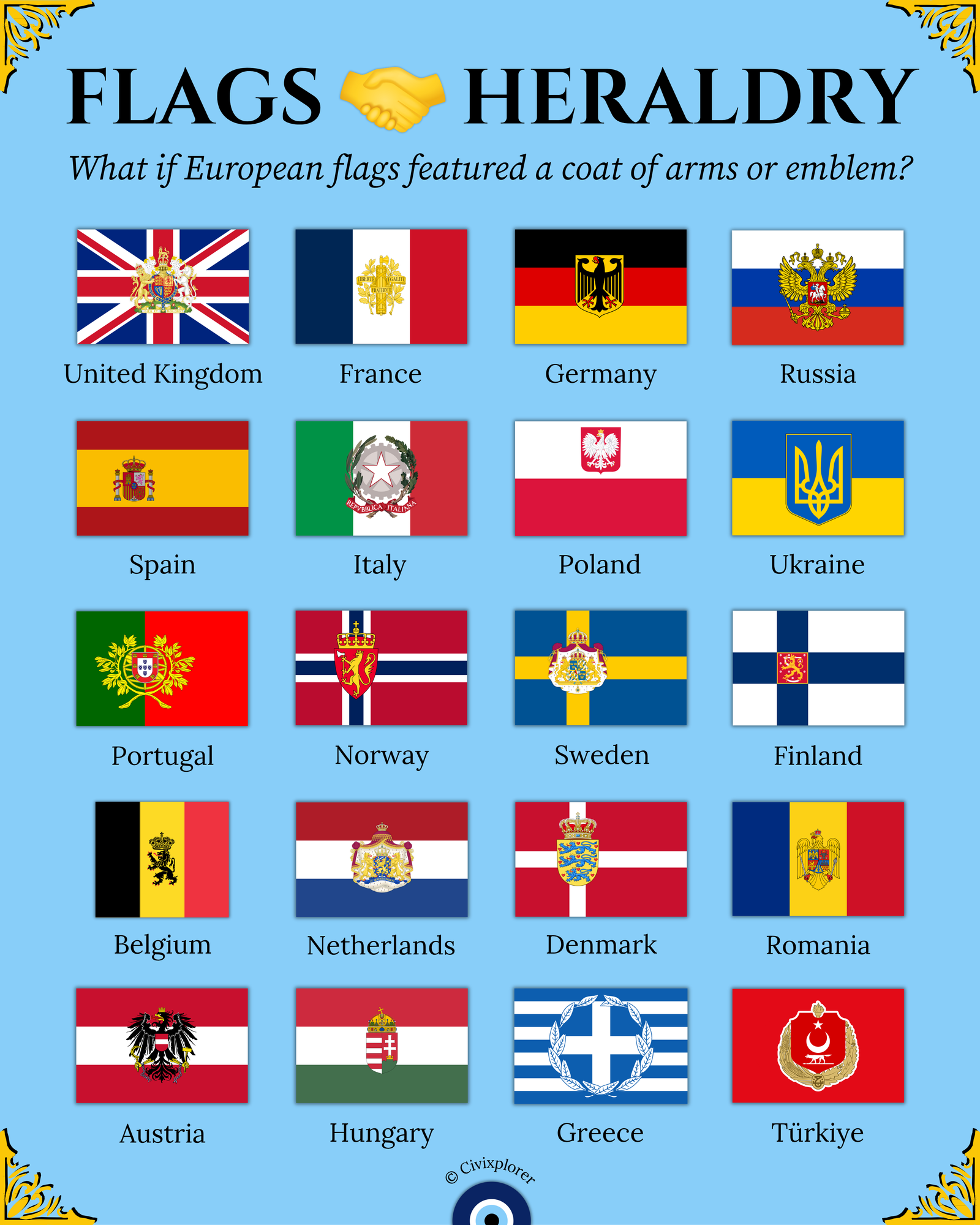
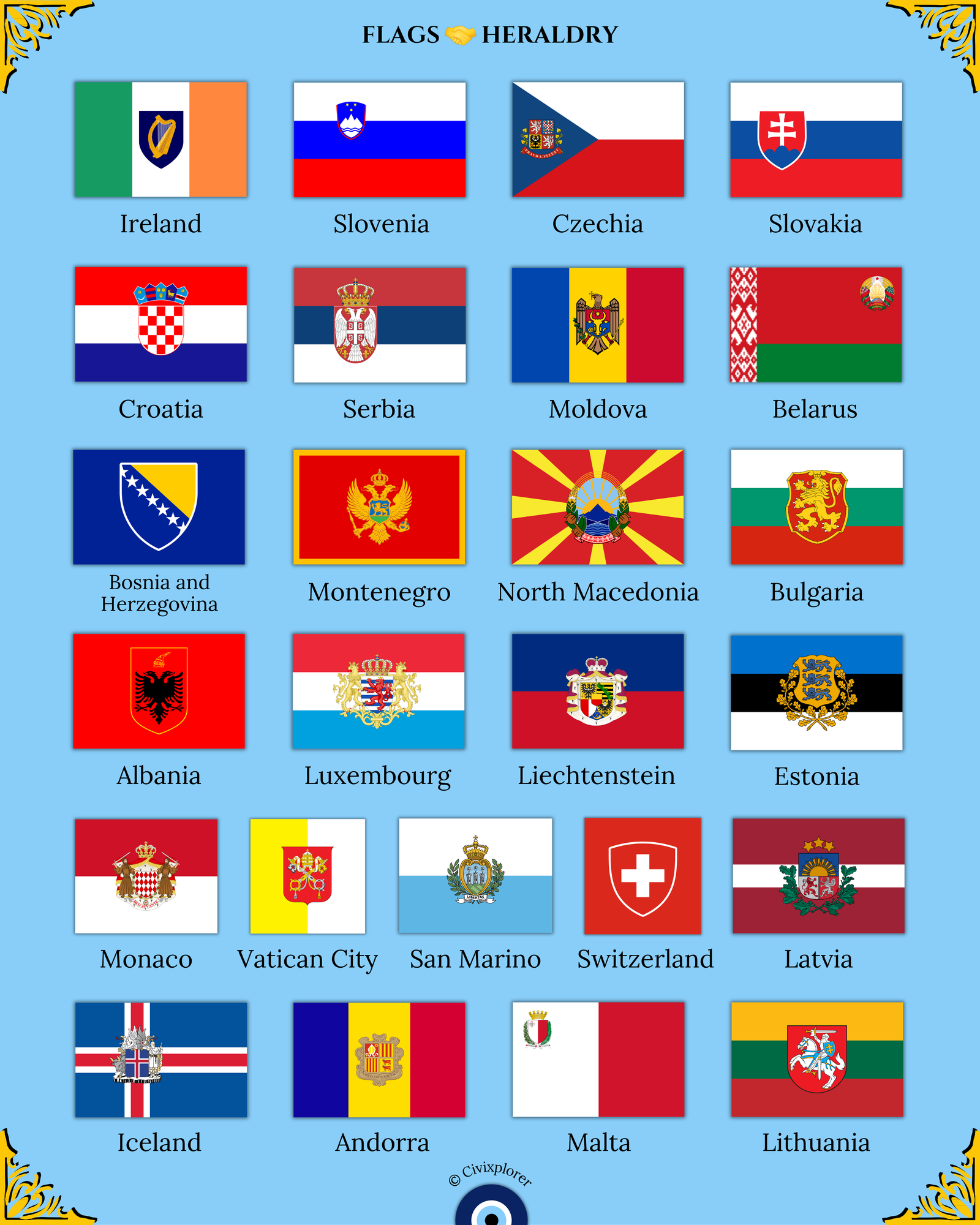
The visual landscape of Europe is a tapestry of bold stripes and vibrant crosses, yet beneath these modern designs lies a medieval language of power: heraldry. This project serves as a fascinating vexillological and heraldic experiment, superimposing national coats of arms directly onto the flags of European nations. While it presents a hypothetical "What if?" scenario, it highlights a profound aesthetic and symbolic tension between modern simplicity and historical depth.
The Functional Divide: Heraldry vs. Vexillology
To understand why most European flags today appear minimalist, one must look at their original purposes. Heraldry, originating in the 12th century, was designed for shields and seals. These intricate designs—featuring lions, eagles, and castles—were meant to be read up close to convey complex lineage and territorial claims.
In contrast, Vexillology (the study of flags) evolved for maritime and battlefield communication. A flag must be identifiable from a distance, even when hanging limp or flapping in high winds. This functional need led many nations to abandon heraldic complexity in favor of bold, geometric patterns like tricolors.
The Reality of State Flags
Interestingly, many of the "fictional" designs in this collection actually exist as State Flags (or Dienstflagge). Many nations maintain a "Civil Flag" for everyday use by citizens and a more ornate "State Flag" used exclusively by the government and military.
- Germany, Austria, Finland, and Poland: The versions depicted here are nearly identical to their official state flags, featuring shields like the German federal eagle (Bundesschild).
- The Historistic Exceptions: Countries such as Spain, Portugal, Serbia, and Moldova already incorporate their heraldry into their primary national flags for all purposes.
Dominant European Heraldic Traditions
The symbols featured in this infographic reveal the "ghosts" of past empires and cultural shifts that still define European identity.
1. The Imperial Eagles
The eagle is perhaps the most durable heraldic creature in Europe, symbolizing power, courage, and sovereignty.
- Single-Headed Eagles: Seen in Germany, Austria, and Poland, these trace back to the Roman and Holy Roman Empires. Austria’s eagle is particularly unique, holding a hammer and sickle to represent workers and peasants, with broken chains added in 1945 to symbolize liberation from National Socialism.
- Double-Headed Eagles: Used by Russia, Serbia, and Albania, this was the hallmark of the Byzantine Empire, representing dominion over both the East and the West.
2. The Royal Lions
Lions dominate the heraldry of Western and Northern Europe, serving as the "king of beasts" and a symbol of bravery. Norway’s lion holds the axe of St. Olaf, while Finland’s lion famously tramples a curved scimitar, representing a historical struggle between Western and Eastern influences.
3. Republican and Socialist Shifts
Nations that underwent total revolutions often abandoned traditional shields. Italy uses a white star over a cogwheel to represent labor, while France utilizes the fasces, an ancient Roman symbol of republican authority. Meanwhile, nations like Belarus reflect "Socialist Heraldry," replacing shields with wreaths of agriculture and rising suns.
4. Unique National Identifiers
Some countries bypass standard motifs for deeply personal symbols. Ireland remains the only nation in the world with a musical instrument—the Celtic harp—as its national emblem. Ukraine features the Tryzub (trident), an ancient symbol from the 10th-century Kievan Rus' that asserts a distinct historical identity.
Conclusion: A Reflection on Identity
While adding central emblems makes flags harder to recognize from a distance, it provides a brilliant visual shorthand for a continent's history. By looking at the flags, we see modern borders; by looking at the emblems, we see the enduring legacy of medieval roots, revolutionary choices, and national resilience.

Comments (0)
Join the Conversation
Login to share your thoughts with the community.
Login to Comment