
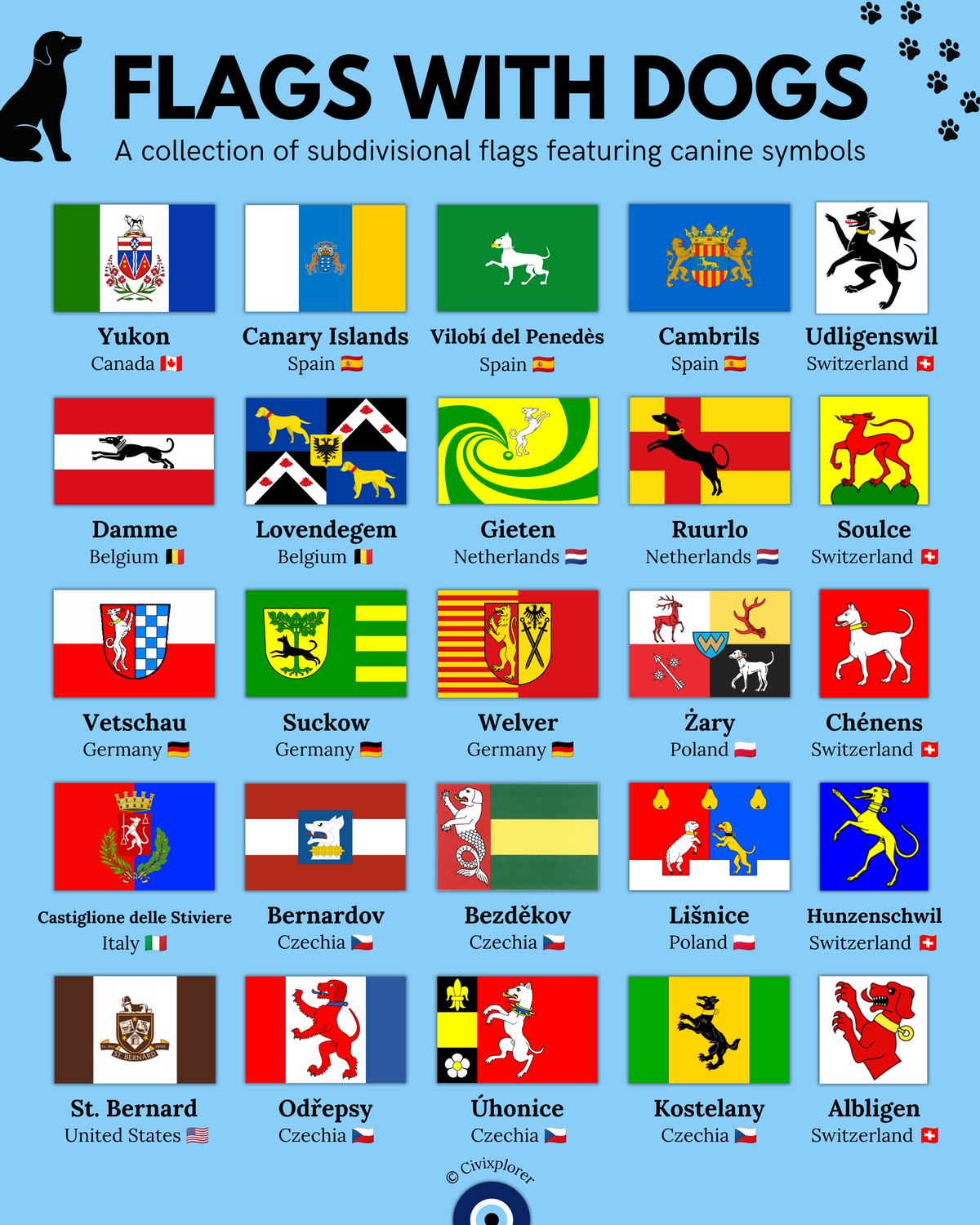
While national flags often favor the ferocity of lions or the majesty of eagles, a closer look at subnational and municipal vexillology reveals a much friendlier, yet equally significant, animal: the dog. Across the globe, from the snow-covered trails of the Arctic to the sun-drenched Mediterranean, canine figures have been woven into the fabric of local identities for centuries. These are not merely decorative choices; they are deeply rooted symbols of loyalty, vigilance, and historical heritage.
The Symbolic Power of Hounds and Guardians
In traditional heraldry, the dog represents the core virtue of fidelity (Fides). Unlike wild animals, a dog depicted with a collar—as seen in many European municipal flags—signifies allegiance and domesticated service. Beyond loyalty, they serve as symbols of vigilance. Historically placed on town walls or shield borders, they acted as eternal protectors of a community’s boundaries.
Furthermore, many of these flags reflect the aristocratic hunting culture of medieval Europe. The presence of greyhounds or sighthounds on flags like those of Ruurlo (Netherlands) or Bernardov (Czechia) often indicates historical hunting rights. When modern municipalities adopted their flags, they frequently inherited these symbols from the coats of arms of the noble dynasties that once governed their lands.
Geographic Hotspots: Why Central Europe Leads the Pack
A striking pattern in canine vexillology is the heavy concentration of examples in Switzerland and Czechia. This is largely due to the highly decentralized administrative structures of these nations, where thousands of tiny, independent municipalities maintain a fierce pride in their local hyper-identity. In Switzerland, communal flags are a living tradition, flown constantly outside homes and town halls. In Czechia, a dedicated parliamentary subcommittee even reviews and approves these heraldic designs, ensuring that centuries-old parish symbols, such as a gamekeeper's hound, remain in active use.
Iconic Case Studies: From Etymology to Arctic Survival
One of the most famous examples is the flag of the Canary Islands. The name "Canary" is actually derived from the Latin Canariae Insulae, meaning "Islands of the Dogs." Roman historians reported "vast multitudes of dogs of very large size" on the islands, leading to the two large hounds that now support the regional coat of arms.
In contrast, the flag of the Yukon territory in Canada features a modern working dog: the Alaskan Malamute. Standing atop a mound of snow, this dog honors the vital role sled dogs played in sub-Arctic survival during the Klondike Gold Rush. It is a powerful tribute to the working partnership between humans and canines in the world's harshest environments.
Visual Puns and Modern Design
Heraldry also has a whimsical side known as canting arms, or visual puns. Vilobí del Penedès in Spain features a white dog because of a phonetic similarity between the town's name and the Catalan word for dog (ca). Similarly, St. Bernard, Ohio, features the iconic rescue dog of the same name, complete with its famous Alpine brandy barrel, tying the village’s identity to its German Catholic heritage and the legacy of Saint Bernard of Clairvaux.
In more modern designs, such as the flag of Gieten in the Netherlands, we see a white greyhound leaping through a psychedelic green and yellow spiral. This design reflects a 20th-century trend of transforming traditional heraldry into bold, graphic art that symbolizes both historical roots and geographical position.
The Persistence of Medieval Language
Ultimately, the prevalence of dogs in subnational flags demonstrates the extraordinary continuity of medieval symbolic language. While national flags often move toward political abstraction, local government identities preserve these figurative traditions. Whether representing a "sea dog" hybrid in Bezděkov or a noble greyhound in Udligenswil, these flags remind us that our oldest animal companions remain a stable signifier of institutional identity across borders and centuries.

Comments (0)
Join the Conversation
Login to share your thoughts with the community.
Login to Comment