
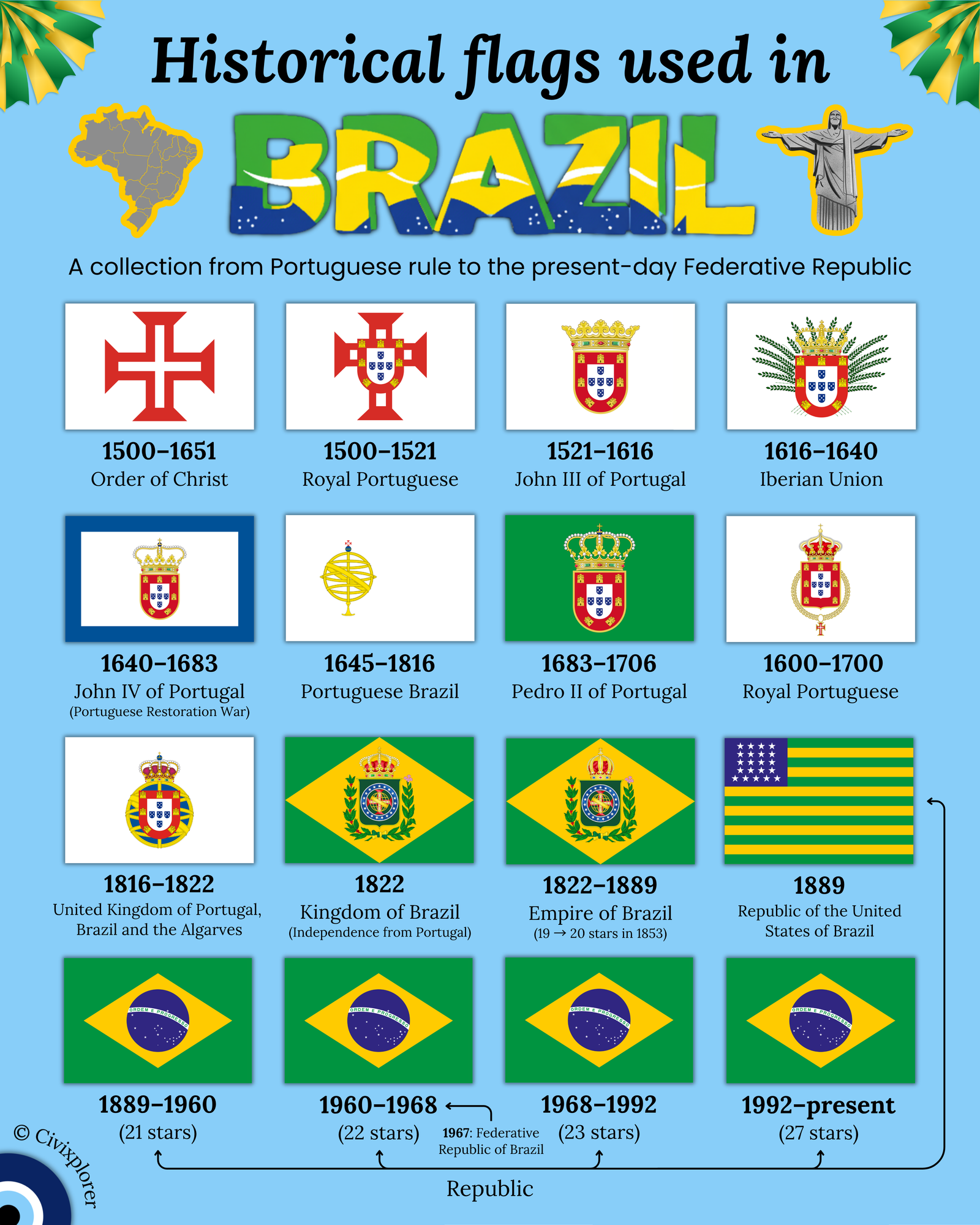
The visual history of Brazil is a vivid tapestry of exploration, dynastic politics, and national transformation. While many recognize the modern green and yellow banner as a symbol of the Amazon and gold, the true story encoded in these designs is far more complex and fascinating. By tracing the evolution of the flags used in Brazil from 1500 to the present, we can see the literal shifts in sovereignty and the birth of a unique national identity.
The Era of Discovery and the Cross (1500–1640)
In the early days of Portuguese colonization, Brazil did not have its own distinct flag. Instead, the territory was marked by the banners of the Portuguese Empire. The very first European symbol planted on Brazilian soil was the Cross of the Order of Christ. This red cross was more than a religious symbol; it represented the military-religious order that financed the Portuguese Age of Discovery. It famously adorned the sails of Pedro Álvares Cabral’s fleet when he reached Brazil in 1500. During this era, flags evolved through the reigns of Manuel I and John III, increasingly layering the Portuguese royal coat of arms onto white fields to assert direct royal authority. A notable shift occurred during the Iberian Union (1580–1640), where Spanish and Portuguese symbols merged under the Habsburg monarchy, signaling a period of dual governance.
Colonial Consolidation and the Armillary Sphere (1640–1822)
As Brazil became the economic powerhouse of the Portuguese Empire, it began to acquire its own heraldic identity. The armillary sphere—a gold astronomical navigation device—appeared on the 1645 "Portuguese Brazil" flag. Originally a personal emblem of King Manuel I, the sphere represented maritime mastery and scientific precision. By the late 17th century, it was the unofficial ensign for merchant vessels on the Brazil route.
A massive geopolitical pivot occurred in 1808 when the Portuguese Royal Family fled Napoleon and relocated their court to Rio de Janeiro. This transformed Brazil from a colony into a co-kingdom. The 1816 flag of the United Kingdom of Portugal, Brazil, and the Algarves reflected this parity, placing the Portuguese royal shield squarely on top of the golden Brazilian armillary sphere.
The Empire: Busting the Green and Yellow Myth (1822–1889)
When Prince Dom Pedro I declared independence in 1822, he introduced the iconic green rectangle and yellow rhombus. While modern education often links these colors to nature and wealth, their origins are strictly dynastic. The green field represented the House of Braganza (Pedro I’s lineage), while the yellow rhombus represented the House of Habsburg (the lineage of Empress Maria Leopoldina). This flag marked the birth of a sovereign empire, featuring a central coat of arms with branches of coffee and tobacco—the drivers of the Brazilian economy.
The Birth of the Republic and the Night Sky (1889–Present)
The transition from monarchy to republic in 1889 brought a short-lived "four-day flag" that heavily mimicked the United States' stripes. However, this was quickly rejected in favor of maintaining national continuity. The new republicans kept the green and yellow layout but replaced the imperial arms with a blue celestial globe.
This globe features the motto "Ordem e Progresso" (Order and Progress), inspired by the French philosopher Auguste Comte and the Positivist movement. Perhaps most remarkable is the arrangement of the stars: they depict the exact position of the constellations over Rio de Janeiro at 8:30 AM on November 15, 1889, the moment the Republic was proclaimed. As Brazil grew, the star count was updated to reflect its federal structure, moving from 21 stars to the 27 stars we see today, representing each state and the Federal District.

Comments (0)
Join the Conversation
Login to share your thoughts with the community.
Login to Comment