
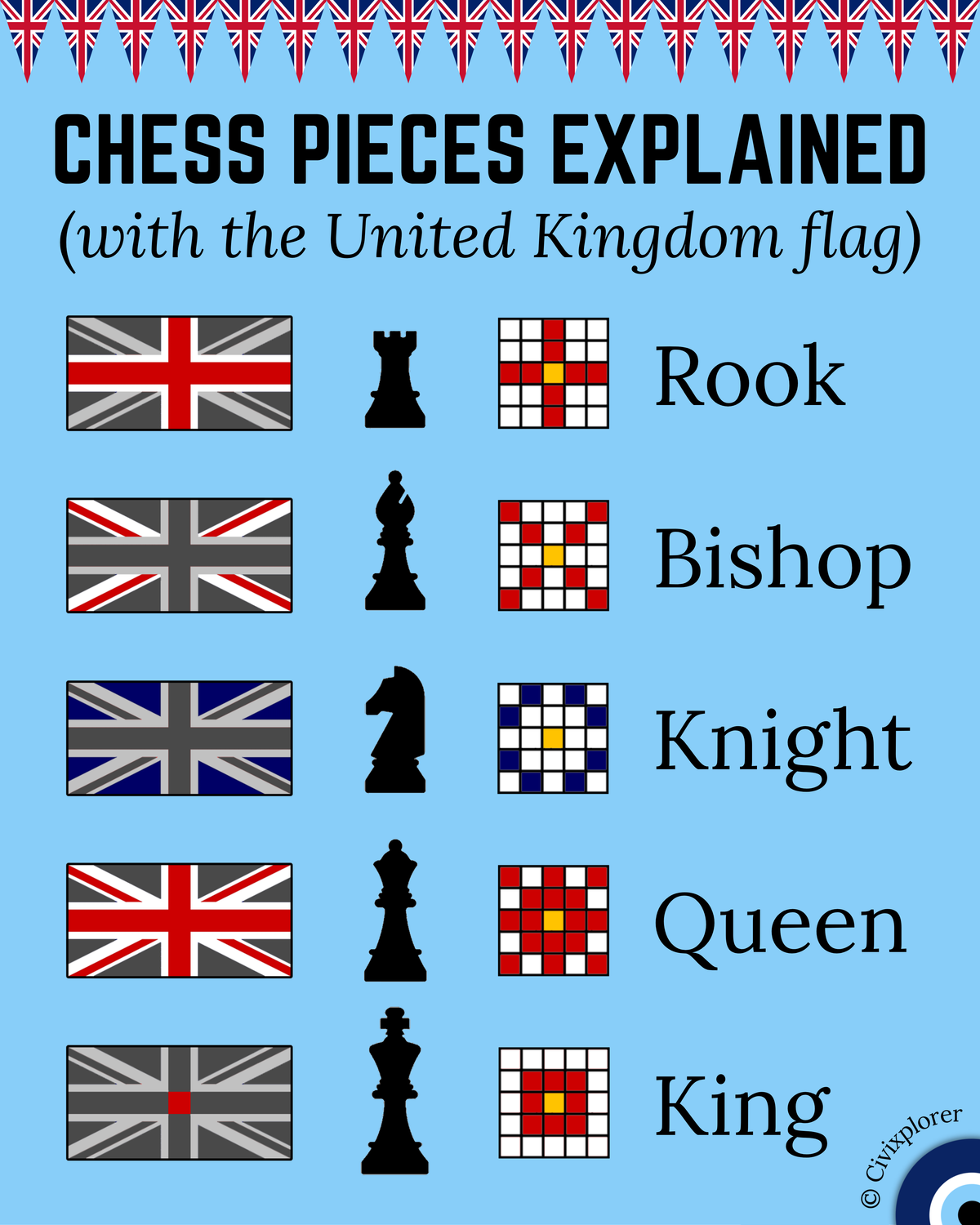
The world of vexillology and game theory collide in a brilliant visual metaphor. By stripping the United Kingdom's national flag down to its geometric bones, we can unlock a surprisingly perfect movement map for the game of chess. The Union Jack is not just a symbol of history; its unique combination of overlapping heraldic crosses serves as an intuitive mathematical diagram to explain how every major piece navigates the board.
To understand why this works, we must look at the composition of the flag itself. The Union Jack is a superposition of three historic crosses: the upright red Cross of St. George, the white diagonal saltire of St. Andrew, and the red diagonal saltire of St. Patrick. This intersecting network of vertical, horizontal, and diagonal lines mirrors the radial paths of modern chess pieces. For instance, the rook’s orthogonal movements align flawlessly with the horizontal and vertical lines of St. George's Cross. Conversely, the bishop's diagonal paths are mapped onto the diagonal saltires of St. Andrew and St. Patrick. When these two systems combine, they represent the supreme, omnidirectional power of the queen, while a single restricted point at the very center of these axes symbolizes the limited, one-square-at-a-time mobility of the king.
The most clever geometric coincidence belongs to the knight. Because the knight leaps in an asymmetrical L-shape, it cannot be tracked along simple straight lines. Instead, the graphic highlights the eight blue triangular fields of the flag, which perfectly correspond to the eight potential landing squares a knight can reach from a central position on a grid.
While this visual system is a modern educational design, the pieces themselves carry a rich history of global cultural exchange. Long before Britain popularized the globally standard Staunton chess set in the nineteenth century, the game evolved from chaturanga, an ancient Indian strategy game. In this original version, the pieces represented active branches of an Indian army, including chariots and war elephants. As the game migrated through Persia and medieval Europe, the Persian rukh or chariot became the castle tower we know as the rook. The war elephant, known in Arabic as al-fil, was reimagined by Europeans who mistook its split-topped design for a bishop's mitre, transforming a battlefield beast into a church official. Even the queen was once a weak, single-square counselor before transforming in Spain and Italy during the late fifteenth century into the powerhouse of "Mad Queen Chess."
By overlaying these deep historical transformations onto a familiar national icon, this infographic demonstrates how ancient rules and modern design can beautifully converge. The next time you look at the Union Jack, you might just see a grandmaster's battlefield waiting to be played.

Comments (0)
Join the Conversation
Login to share your thoughts with the community.
Login to Comment