
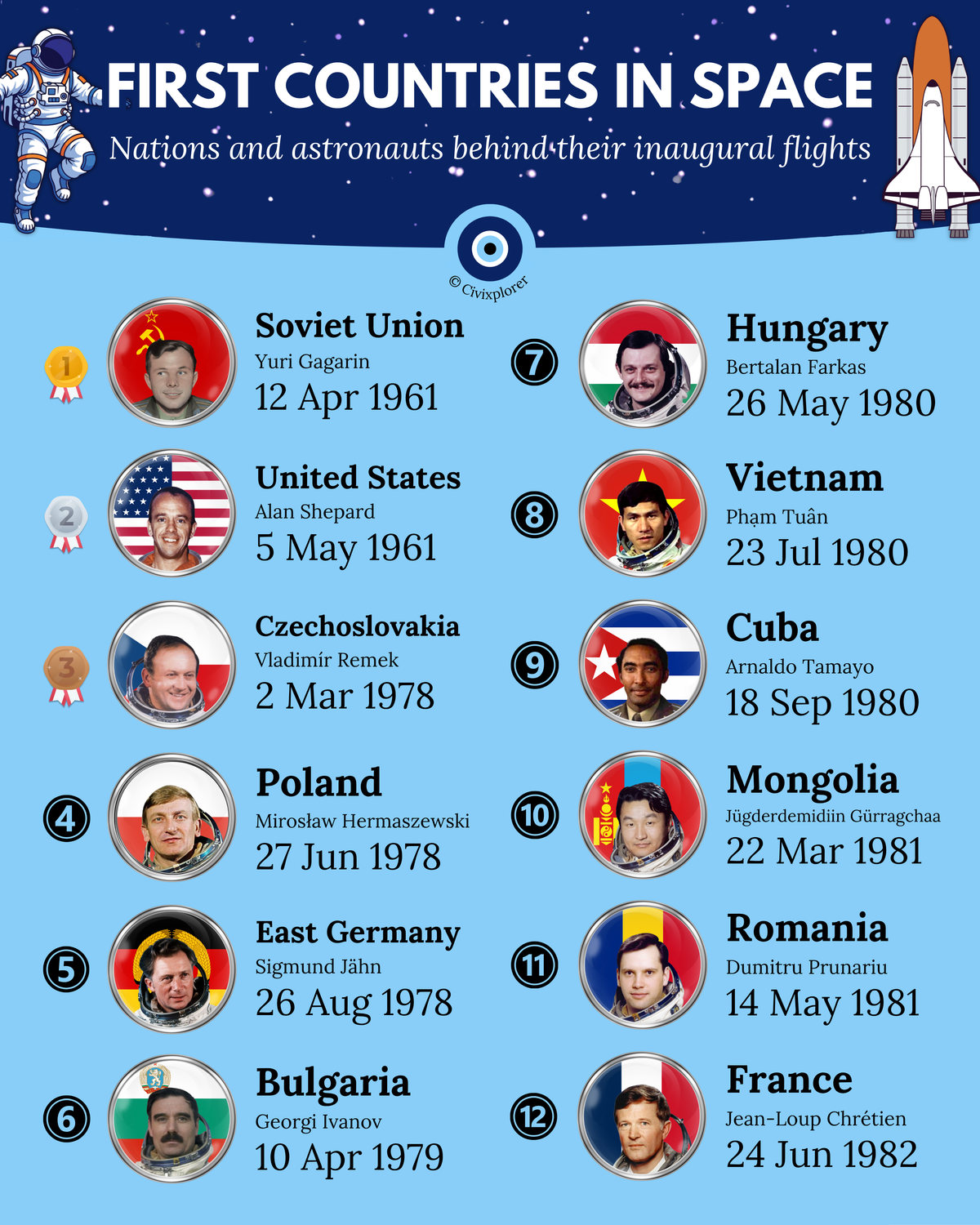
The dawn of human spaceflight is often remembered as a binary race between two superpowers, but the reality of how the stars were reached is a far more complex and international narrative. While the Soviet Union and the United States undoubtedly led the way, the subsequent expansion of space travel serves as a fascinating visual map of Cold War geopolitics and diplomatic maneuvering.
The journey began in 1961 with a 23-day gap that defined a generation. On April 12, 1961, Yuri Gagarin became the first human in orbit, a monumental propaganda victory for the USSR. The United States followed closely on May 5, 1961, with Alan Shepard’s suborbital flight. For the next 17 years, these two nations held an exclusive duopoly on the cosmos, as the immense cost and technical complexity of rocketry remained out of reach for the rest of the world.
The silence was finally broken in 1978, not through a new independent launch, but through the Soviet Interkosmos program. This initiative was designed to provide socialist allies with access to space, transforming allied pilots into national heroes and projecting Soviet soft power across the globe. Vladimír Remek of Czechoslovakia became the first person from a third country to enter space in March 1978, marking the beginning of a rapid wave of international participation.
This era saw a series of remarkable demographic milestones. In 1980 alone, Phạm Tuân of Vietnam became the first Asian in space, while Arnaldo Tamayo Méndez of Cuba made history as the first Latin American and the first person of African descent to reach Earth orbit. These missions were symbolic "guest" visits to the Salyut space stations, yet they represented a massive shift in how humanity viewed its place in the universe.
The first wave of pioneers concluded in 1982 with an interesting geopolitical anomaly: France. As a Western, NATO-aligned nation, France’s inclusion in the Soviet-led sequence was a masterstroke of diplomatic bridging. Jean-Loup Chrétien became the first Western European to travel to space, flying aboard a Soviet Soyuz spacecraft. This marked the beginning of a more collaborative, albeit still highly political, era of exploration.
Understanding these first 12 nations is about more than just dates and names; it is about recognizing how science and diplomacy intertwined to open the final frontier. While the technology was revolutionary, the path to the stars was paved by the political realities of the 20th century.
| Rank | Country | Pioneer | Launch Date |
|---|---|---|---|
| 1 | Soviet Union | Yuri Gagarin | 12 Apr 1961 |
| 2 | United States | Alan Shepard | 5 May 1961 |
| 3 | Czechoslovakia | Vladimír Remek | 2 Mar 1978 |
| 4 | Poland | Mirosław Hermaszewski | 27 Jun 1978 |
| 5 | East Germany | Sigmund Jähn | 26 Aug 1978 |
| 6 | Bulgaria | Georgi Ivanov | 10 Apr 1979 |
| 7 | Hungary | Bertalan Farkas | 26 May 1980 |
| 8 | Vietnam | Phạm Tuân | 23 Jul 1980 |
| 9 | Cuba | Arnaldo Tamayo | 18 Sep 1980 |
| 10 | Mongolia | Jügderdemidiin Gürragchaa | 22 Mar 1981 |
| 11 | Romania | Dumitru Prunariu | 14 May 1981 |
| 12 | France | Jean-Loup Chrétien | 24 Jun 1982 |

Comments (0)
Join the Conversation
Login to share your thoughts with the community.
Login to Comment