
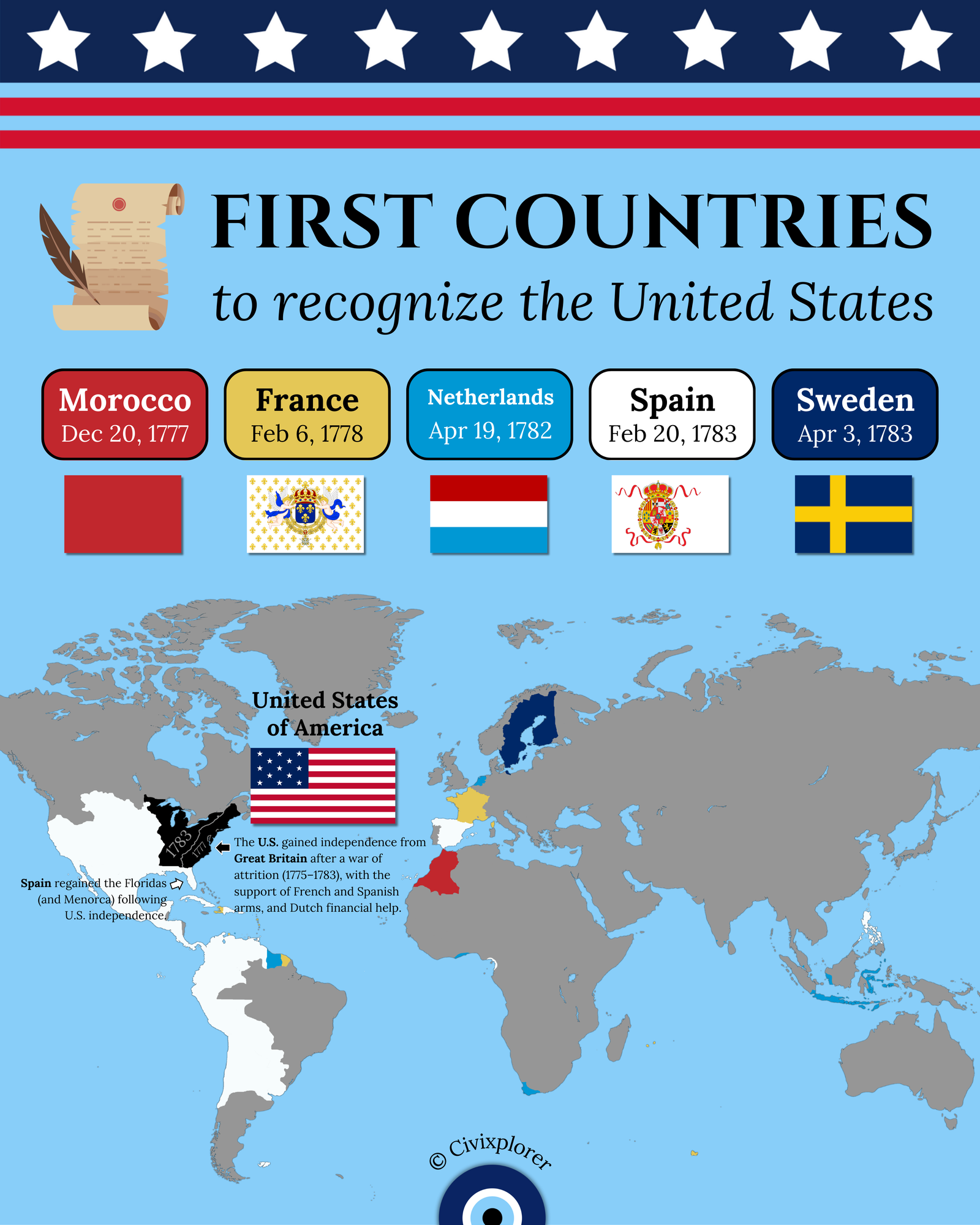
The American Revolution was far more than a localized struggle for liberty; it was a pivotal moment in a global chess game. Between 1777 and 1783, a mix of monarchies and republics became the first to officially recognize the United States, viewing the nascent nation as a strategic tool to dismantle British hegemony following the Seven Years' War.
Morocco became the first to extend de facto recognition in December 1777. Driven by trade pragmatism rather than political ideology, Sultan Mohammed ben Abdallah opened Moroccan ports to American ships, seeking to break European trade monopolies and establish an independent foreign policy.
France followed in February 1778 with a formal Treaty of Alliance. For King Louis XVI, supporting the American rebels was an opportunity for revenge against Britain for prior colonial losses. French military muscle and funding proved decisive, though the massive debt incurred would eventually contribute to France's own revolution in 1789.
The Netherlands played the role of the global banker, recognizing the U.S. in April 1782. Dutch merchants and bankers provided the essential loans that kept the American government solvent, seeing the new nation as a lucrative market previously blocked by British restrictions.
Spain’s involvement in early 1783 was fueled by territorial ambition, specifically the desire to recover Florida and Menorca. While they feared that supporting a revolution might inspire their own American colonies to rebel, they provided critical secret aid to weaken their British rivals.
Finally, Sweden signed a Treaty of Amity and Commerce in April 1783. As a neutral power, Sweden aimed to secure commercial advantages and shipping rights before other major powers could monopolize trade with the new republic.
While this international support ensured the survival of the United States, it often came at a high price for the recognizing powers. From the financial collapse in France to the economic retaliation faced by the Dutch, the decision to back American independence reshaped the world map and the internal stability of the old European empires forever.
Comments (0)
Join the Conversation
Login to share your thoughts with the community.
Login to Comment