
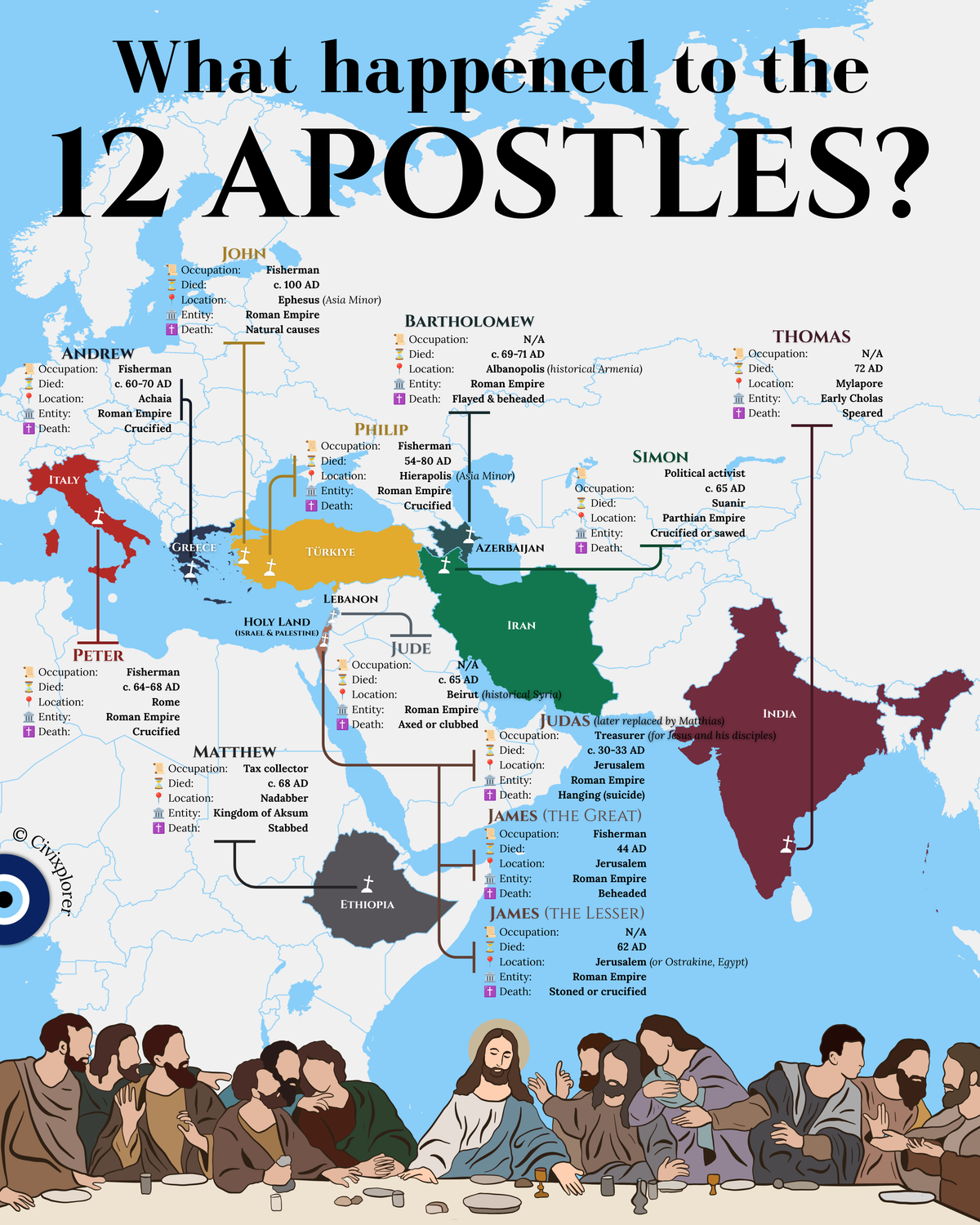
The transition from a small group of Jesus Christ followers in Galilee to a global religion is one of the most compelling chapters in human history. While the New Testament provides the foundation for their ministry, the ultimate fates of the 12 Apostles are often shrouded in a blend of historical record, early Church tradition, and hagiographic legend. By mapping these journeys, we can visualize the "Great Commission" in action, as these individuals traveled from the heart of the Roman Empire to the distant shores of India and the highlands of Ethiopia.
The Scriptural Foundation vs. Tradition
It is important to distinguish between what is biblically recorded and what stems from later tradition. Only two apostolic deaths are explicitly documented in the New Testament. James the Greater was beheaded in Jerusalem around 44 AD by order of Herod Agrippa I, a fact corroborated by contemporary historical contexts. Judas Iscariot, the original twelfth member, died by suicide shortly after the crucifixion of Jesus and was later replaced by Matthias to preserve the symbolic number of the twelve.
For the remaining apostles, we rely on the "Apocryphal Acts" and writings from early Church Fathers like Eusebius. These accounts, while often written centuries later, reflect a deep, enduring memory of the apostles' roles as the foundational "rocks" of local churches across the Mediterranean and the Near East.
To the Ends of the Earth: Geographic Reach
The missions of the apostles followed the established trade routes of the 1st century, utilizing Roman roads and maritime spice routes.
- Peter, the fisherman, is traditionally held to have been crucified upside down in Rome under Emperor Nero. His presence in the capital of the empire made his martyrdom a powerful symbol of the new faith’s resilience.
- Thomas, often remembered for his doubt, traveled perhaps the furthest. Strong traditions, particularly among the Saint Thomas Christians of Kerala, place him in Mylapore, India, within the Early Cholas region. Historical evidence shows that maritime trade between the Roman Empire and India was frequent, making this long-distance journey entirely plausible.
- Matthew, the former tax collector, is linked by tradition to the Kingdom of Aksum in modern-day Ethiopia. This connection highlights the very early roots of African Christianity in a sophisticated trading empire.
- Bartholomew is associated with Albanopolis in historical Armenia, where he was reportedly flayed and beheaded. This legacy is why the Armenian Apostolic Church claims a direct apostolic lineage.
The Anomaly of John
Among the stories of violent martyrdom, John stands as a unique outlier. He is the only apostle traditionally believed to have died of natural causes in Ephesus around 100 AD. While legends suggest he survived several execution attempts, including being boiled in oil, his longevity allowed him to serve as a bridge between the apostolic age and the burgeoning early Church.
The Power of the Martyrdom Narrative
The fact that nearly all the apostles are remembered for suffering violent deaths—whether by crucifixion, stoning, or spearing—became a cornerstone of early Christian identity. The "blood of the martyrs" was seen as the seed of the Church. These stories were not just about death; they were about voluntary witness (martyria). The unanimity across diverse sources that none of the original followers recanted their beliefs, even under the threat of gruesome execution, remains one of the most powerful arguments used by theologians to defend the sincerity of the early Christian movement.
While many specifics of these journeys remain in the realm of tradition rather than academic history, they effectively convey how a small group turned a personal encounter into a global movement that reshaped the world's spiritual landscape.
The following data visualizes the global reach of the apostles, tracking their traditional occupations and mapping their final locations to both ancient geopolitical entities and modern-day nations.
| Apostle | Traditional Occupation | Year of Death (Approx.) | Place of Death | 1st-Century Region | Present-day Country | Reported Fate |
|---|---|---|---|---|---|---|
| Andrew | Fisherman | 60–70 AD | Achaia | Roman Empire | Greece | Crucified |
| Bartholomew | N/A | c. 69–71 AD | Albanopolis | Roman Empire | Azerbaijan | Flayed & beheaded |
| James (The Great) | Fisherman | 44 AD | Jerusalem | Roman Empire | Israel / Palestine | Beheaded |
| James (The Lesser) | N/A | 62 AD | Jerusalem / Ostrakine | Roman Empire | Israel / Palestine | Stoned or crucified |
| John | Fisherman | c. 100 AD | Ephesus | Roman Empire | Türkiye | Natural causes |
| Judas Iscariot | Treasurer | 30–33 AD | Jerusalem | Roman Empire | Israel / Palestine | Hanging (Suicide) |
| Jude | N/A | c. 65 AD | Beirut | Roman Empire | Lebanon | Axed or clubbed |
| Matthew | Tax collector | c. 68 AD | Nadabber | Kingdom of Aksum | Ethiopia | Stabbed |
| Peter | Fisherman | 64–68 AD | Rome | Roman Empire | Italy | Crucified |
| Philip | Fisherman | 54–80 AD | Hierapolis | Roman Empire | Türkiye | Crucified |
| Simon | Political activist | c. 65 AD | Suanir | Parthian Empire | Iran | Crucified or sawed |
| Thomas | N/A | 72 AD | Mylapore | Early Cholas | India | Speared |

Comments (0)
Join the Conversation
Login to share your thoughts with the community.
Login to Comment