
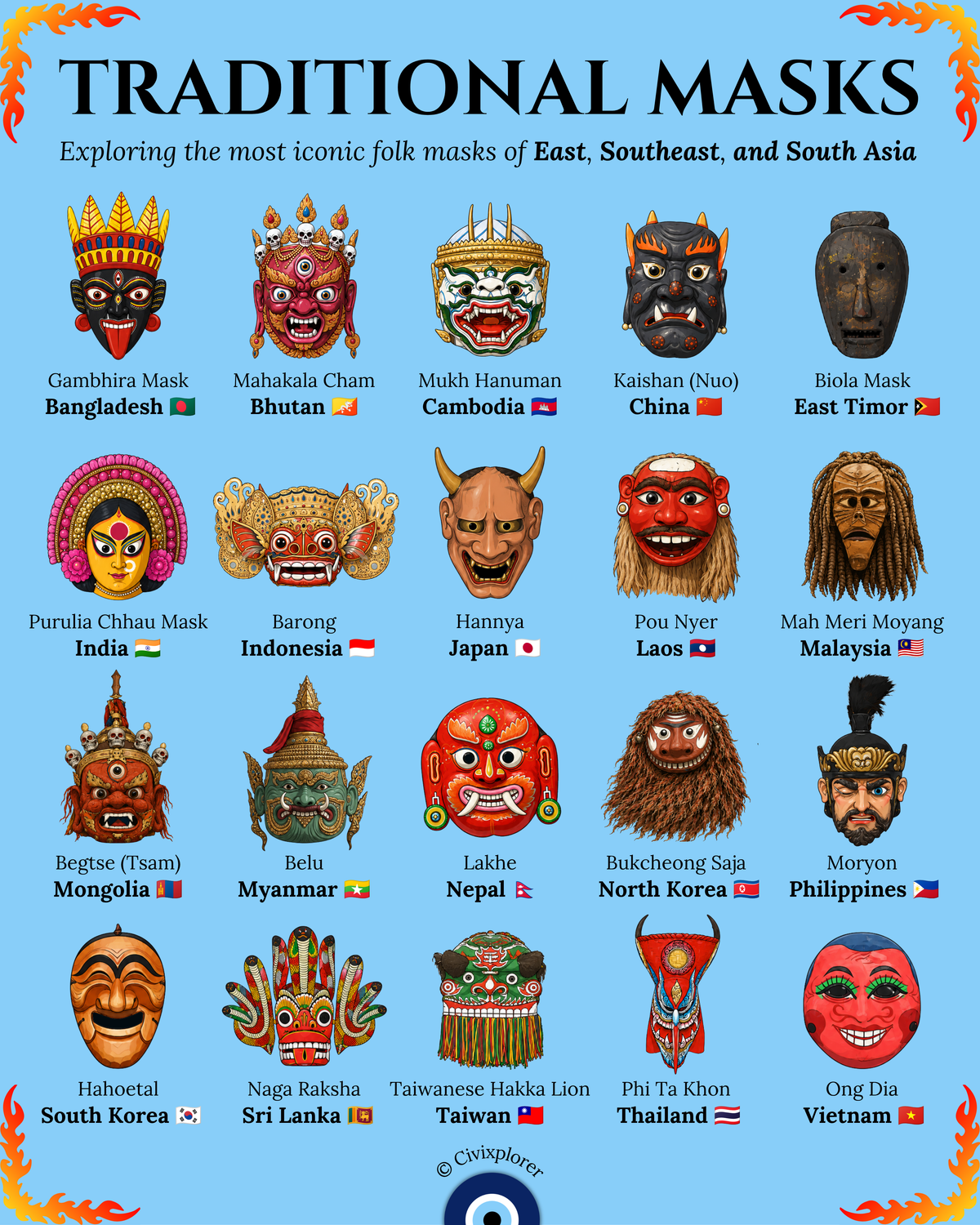
Across the vast landscapes of East, Southeast, and South Asia, masks serve as far more than mere decorative artifacts. They are performative interfaces between the human and supernatural realms, acting as living cultural agents that embody ancestors, gods, and demons. This curated survey of folk masks highlights a rich tapestry of spiritual, theatrical, and protective traditions that have endured for centuries, reflecting the moral and cosmological worldviews of diverse societies.
The Architecture of Spiritual Balance
In many Asian cultures, the mask is a tool for maintaining cosmic order. In Indonesia, the Barong mask represents the king of good spirits and a sacred guardian. Used in ritualistic dances, it engages in an eternal struggle with the demon queen Rangda, illustrating the philosophical concept of Rwa Bhineda—the necessity of balance between opposing forces. Similarly, the Begtse mask from Mongolia portrays a wrathful deity adorned with skulls. While terrifying in appearance, this mask represents fierce compassion, intended to cut through ignorance and protect the spiritual path of practitioners.
The Theater of Emotion and Satire
Theatrical traditions often use masks to convey complex psychological narratives. Japan’s Hannya mask is a masterclass in nuanced design; it depicts a woman transformed into a demon by jealousy and sorrow. The mask is carved so that its expression shifts with the light—appearing enraged when viewed straight on, but weeping in profound grief when tilted downward. In South Korea, the Hahoetal masks serve a different purpose, moving away from the divine toward social commentary. These masks were historically used in village plays to satirize the aristocracy and scholars, providing a safe theatrical space for the lower classes to mock the elite.
Rituals of Physicality and Resistance
Some traditions blend the spiritual with the martial. The Purulia Chhau masks of India are rigid, clay-and-paper composites that cover the entire face, forcing performers to use explosive, acrobatic movements derived from ancient combat training to tell epic Hindu stories. In the Philippines, the Moryon mask represents a unique synthesis of indigenous craft and Christian devotion. Worn during Holy Week, these heavy wooden masks depict Roman soldiers. Wearing them is not merely a performance but a panata—a solemn vow of physical penance and spiritual devotion performed under the tropical sun.
Animism and the Living Heritage
Many masks remain deeply rooted in the natural world and agricultural cycles. Thailand’s Phi Ta Khon masks, crafted from sticky-rice steamers and coconut leaves, are central to fertility rites meant to ensure bountiful rains. In Malaysia, the Mah Meri Moyang masks represent specific ancestral or elemental spirits from an animistic cosmology, used to invoke blessings and maintain communal harmony. Whether through the Nuo opera of China or the Cham dances of Bhutan, these masks continue to function as micro-maps of the cultural soul, preserving intangible heritage through the power of drama, dance, and public ritual.

Comments (0)
Join the Conversation
Login to share your thoughts with the community.
Login to Comment