
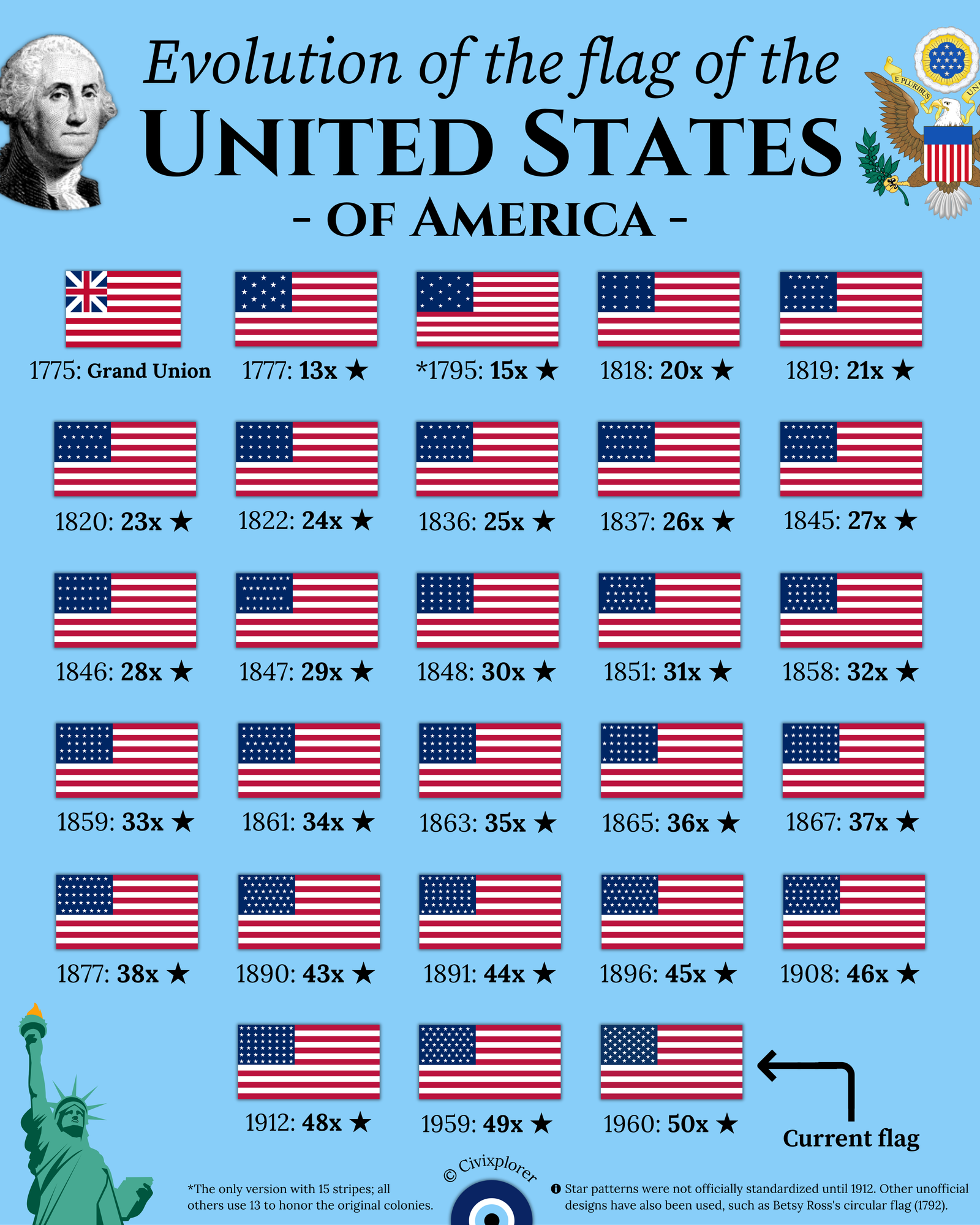
The flag of the United States is far more than a static emblem; it is a "living banner" that has grown and adapted alongside the nation it represents. Since its inception during the Revolutionary War, the flag has undergone dozens of transformations, each reflecting the shifting political geography and the westward expansion of a burgeoning superpower.
To understand the flag, one must first understand its core symbolism. The 13 horizontal stripes (alternating red and white) serve as a permanent tribute to the original thirteen colonies that declared independence from Great Britain. The white stars on the blue field—the "canton"—represent the individual states of the Union. As the nation expanded, this "new constellation" grew, creating a visual timeline of American history.
The journey began in 1775 with the Grand Union Flag. Interestingly, this first national flag featured the British Union Jack in the corner, reflecting a time when the colonies were in armed conflict with the Crown but had not yet embraced total separation. This changed in 1777 when the Continental Congress resolved that the flag would feature 13 stars and 13 stripes, officially severing symbolic ties with Britain.
One of the most fascinating anomalies in this evolution occurred in 1795. Following the admission of Vermont and Kentucky, Congress passed the Flag Act of 1794, which increased the flag to 15 stars and 15 stripes. This specific design is famous as the "Star-Spangled Banner" that inspired Francis Scott Key at Fort McHenry. However, as more states joined, leadership realized that adding stripes indefinitely would ruin the flag's proportions.
The Flag Act of 1818 established the permanent formula we use today: the flag reverted to 13 stripes to honor the founding colonies, and one star would be added for each new state on the 4th of July following its admission.
For much of the 19th century, the arrangement of those stars was a "Wild West" of design. Because Congress did not specify a pattern, flag makers created circles, diamonds, and even massive star shapes. It wasn't until 1912, under President William Howard Taft, that the star patterns were officially standardized into the rectangular grid we recognize today.
The current 50-star flag, which has been in use since 1960, is the longest-running design in American history. Remarkably, this version was designed by Robert G. Heft, a 17-year-old high school student, for a class project. Despite receiving a B-minus from his teacher initially, his design was selected by President Eisenhower, proving that the evolution of national symbols can sometimes come from the most unexpected places.

Comments (0)
Join the Conversation
Login to share your thoughts with the community.
Login to Comment