
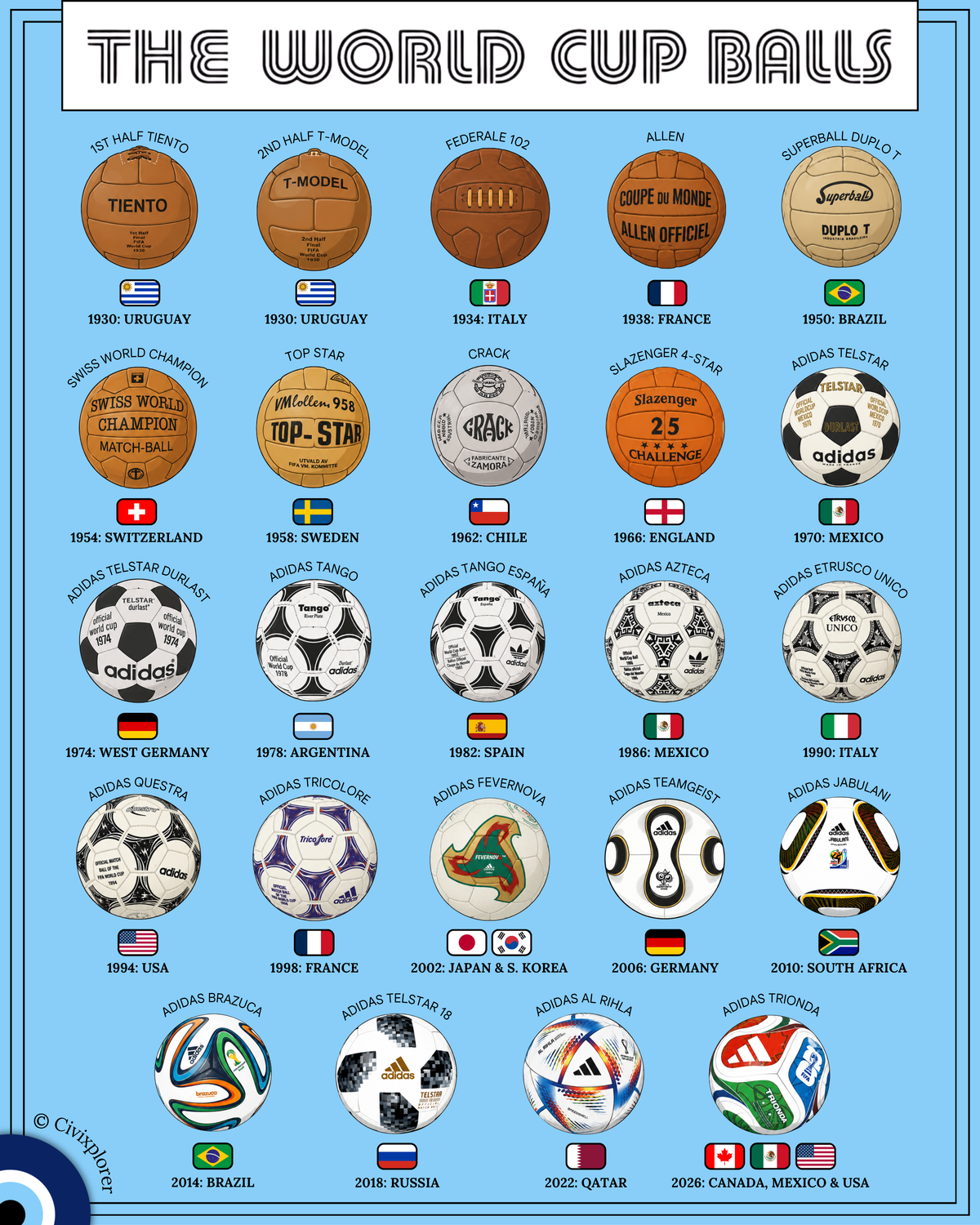
The official FIFA World Cup match ball is more than just a piece of equipment; it is a technological marvel that reflects the history of global broadcasting, materials science, and the ever-changing nature of the beautiful game. From the heavy, lace-up leather spheres of the 1930s to the data-capturing "smart" balls of today, the evolution of the ball tells the story of football’s modernization.
The 1930 Anomaly and the Early Leather Era
The history begins in 1930 with a unique dispute. During the inaugural final between Argentina and Uruguay, both teams insisted on using their own ball. This led to a legendary compromise: Argentina's Tiento was used in the first half, and Uruguay's T-Model in the second. These early balls were handcrafted leather with external laces, which made them notoriously difficult—and heavy—to play with, especially in the rain.
Revolutionizing Player Safety: 1950
A major milestone occurred in 1950 with the Superball Duplo T in Brazil. This was the first World Cup ball to eliminate external laces, featuring a hidden inflation valve. This change was crucial for player safety, as heading a wet, laced leather ball often resulted in injuries or concussions.
The Television Revolution and the Adidas Monopoly
The most iconic design in history, the Adidas Telstar, arrived in 1970. Named after a satellite, its 32-panel black-and-white pattern was specifically engineered to be visible on black-and-white television broadcasts. This tournament also marked the start of an unbroken partnership, as Adidas has supplied every official match ball since. By 1986, the Azteca became the first fully synthetic ball, finally solving the problem of water absorption and ensuring the ball maintained a consistent weight throughout the match.
The Quest for Perfection and the Aerodynamic Crisis
In the 2000s, designers began reducing panel counts to create a rounder ball. This led to the Teamgeist in 2006 and the infamous Jabulani in 2010. The Jabulani became one of the most controversial objects in sports history; its eight panels made it "too smooth," causing an unpredictable knuckleball effect that frustrated goalkeepers and strikers alike. Subsequent designs, like the 2014 Brazuca, re-engineered the seams to restore aerodynamic stability.
The Digital Age: Sensors and the 2026 Trionda
Today, the ball is a computational tool. Starting with the Al Rihla in 2022, match balls now contain inertial measurement units (IMUs) that send data 500 times per second to VAR officials to assist with offside decisions. Looking ahead to 2026, the Trionda—named for the "three waves" representing Canada, Mexico, and the USA—features only four panels, the lowest number ever. Despite its minimal construction, it utilizes deep seams and state-of-the-art sensors to ensure it remains the most stable and high-tech ball in the history of the tournament.
| Year & Host | Official Match Ball | Key Innovation & Historical Context |
|---|---|---|
| 1930 (Uruguay) | Tiento / T-Model | The "War of the Balls." Two different balls were used in the final to settle a dispute. |
| 1934 (Italy) | Federale 102 | Traditional brown leather with cotton laces. |
| 1938 (France) | Allen | Continued the use of hand-stitched leather panels. |
| 1950 (Brazil) | Superball Duplo T | Revolutionary: First ball without external laces, introducing the hidden valve. |
| 1954 (Switzerland) | Swiss World Champion | Standardized 18-panel construction. |
| 1958 (Sweden) | Top Star | Selected via a blind test of 102 different designs. |
| 1962 (Chile) | Crack | Introduced octagonal panels; suffered from quality inconsistencies. |
| 1966 (England) | Slazenger 4-Star | The last tournament ball provided by a non-Adidas manufacturer. |
| 1970 (Mexico) | Adidas Telstar | Broadcast Icon: 32-panel black-and-white design for TV visibility. |
| 1974 (W. Germany) | Telstar Durlast | Added a polyurethane coating, making it the first waterproof ball. |
| 1978 (Argentina) | Adidas Tango | Introduced the "triad" design; the blueprint for balls for the next 20 years. |
| 1982 (Spain) | Tango España | The final all-leather ball; improved water resistance via rubber seams. |
| 1986 (Mexico) | Adidas Azteca | Synthetic Era: First fully synthetic ball; eliminated water absorption. |
| 1990 (Italy) | Etrusco Unico | Featured internal foam layers for speed; cultural motifs inspired by Etruscan art. |
| 1994 (USA) | Adidas Questra | Designed with high-tech foam for a softer touch and greater control. |
| 1998 (France) | Adidas Tricolore | Color Revolution: The first multi-colored ball in World Cup history. |
| 2002 (Japan/S. Korea) | Adidas Fevernova | Departed from the Tango design; featured a larger, vibrant visual profile. |
| 2006 (Germany) | Adidas +Teamgeist | Reduced to 14 panels for a smoother, rounder aerodynamic surface. |
| 2010 (South Africa) | Adidas Jabulani | Controversial: 8 panels. Criticized for unpredictable "knuckleball" flight. |
| 2014 (Brazil) | Adidas Brazuca | 6 panels; intentionally deep seams to restore flight stability. |
| 2018 (Russia) | Telstar 18 | Reimagined the 1970 classic; first ball to feature an integrated NFC chip. |
| 2022 (Qatar) | Al Rihla | Connected Ball: Internal sensors provided real-time data for offside VAR. |
| 2026 (North America) | Adidas Trionda | Peak Tech: Just 4 panels. Features a 500Hz motion sensor for ultra-accurate data. |

Comments (0)
Join the Conversation
Login to share your thoughts with the community.
Login to Comment