
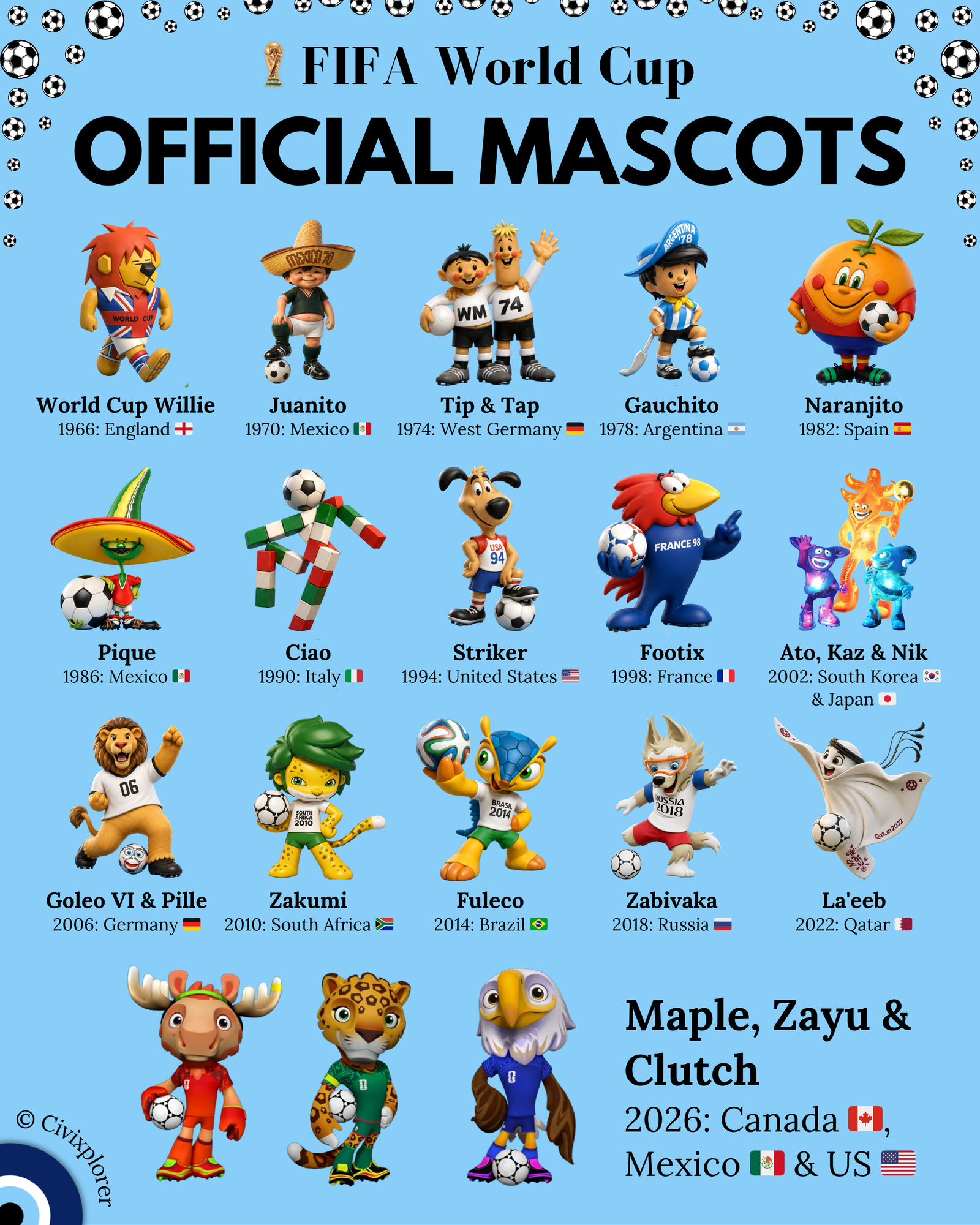
The tradition of the official FIFA World Cup mascot began in 1966 with World Cup Willie, a lion wearing a Union Jack jersey. Designed by Reg Hoye, Willie was a commercial experiment that proved a recognizable character could drive unprecedented merchandise sales and effectively brand a global tournament. Since that British pioneer, mascots have served as highly engineered cultural ambassadors, reflecting the geopolitical climate, design trends, and marketing strategies of their era.
Following Willie’s success, the 1970s saw a shift toward the "Little Boys" era. Host nations like Mexico (1970) and Argentina (1978) used characters like Juanito and Gauchito to project hospitality and cultural heritage through traditional attire like the sombrero and the gaucho neckerchief. In a more politically charged move, West Germany’s 1974 duo, Tip & Tap, were designed to symbolize unity and friendship during the height of the Cold War.
Creative departures defined the 1980s and early 90s. Spain (1982) introduced Naranjito, an anthropomorphic orange, to present a fresh and modern face for a country newly emerging into democracy. Perhaps the most controversial was Italy’s 1990 mascot, Ciao. As a faceless, abstract stick figure in the colors of the Italian Tricolore, Ciao reflected Italy’s status as a hub for avant-garde design and high fashion, moving away from "cuddly" caricatures entirely.
As the tournament entered the digital age, mascots became more sophisticated media properties. The United States (1994) partnered with Warner Bros. Animation to create Striker, a dog designed to appeal to domestic audiences. By 2002, South Korea and Japan introduced the Spheriks, computer-generated fictional creatures reflecting the East Asian tech boom. More recently, mascots have taken on social roles; for instance, Brazil’s 2014 mascot, Fuleco, was a three-banded armadillo used to highlight biodiversity and environmental conservation.
The most recent evolution showcases a move toward cultural pride and multinational unity. Qatar’s 2022 mascot, La’eeb, was inspired by the traditional ghutra headdress, making a bold statement of Arab identity. Looking ahead to 2026, the introduction of a trio—Maple the Moose, Zayu the Jaguar, and Clutch the Bald Eagle—marks a historic first. Representing Canada, Mexico, and the United States, this group symbolizes the unity and diversity of the first 48-team, three-nation tournament in history.
| Mascot Name | Year | Host Nation(s) |
|---|---|---|
| World Cup Willie | 1966 | England |
| Juanito | 1970 | Mexico |
| Tip & Tap | 1974 | West Germany |
| Gauchito | 1978 | Argentina |
| Naranjito | 1982 | Spain |
| Pique | 1986 | Mexico |
| Ciao | 1990 | Italy |
| Striker | 1994 | United States |
| Footix | 1998 | France |
| Ato, Kaz & Nik | 2002 | South Korea & Japan |
| Goleo VI & Pille | 2006 | Germany |
| Zakumi | 2010 | South Africa |
| Fuleco | 2014 | Brazil |
| Zabivaka | 2018 | Russia |
| La'eeb | 2022 | Qatar |
| Maple, Zayu & Clutch | 2026 | Canada, Mexico & United States |

Comments (0)
Join the Conversation
Login to share your thoughts with the community.
Login to Comment