
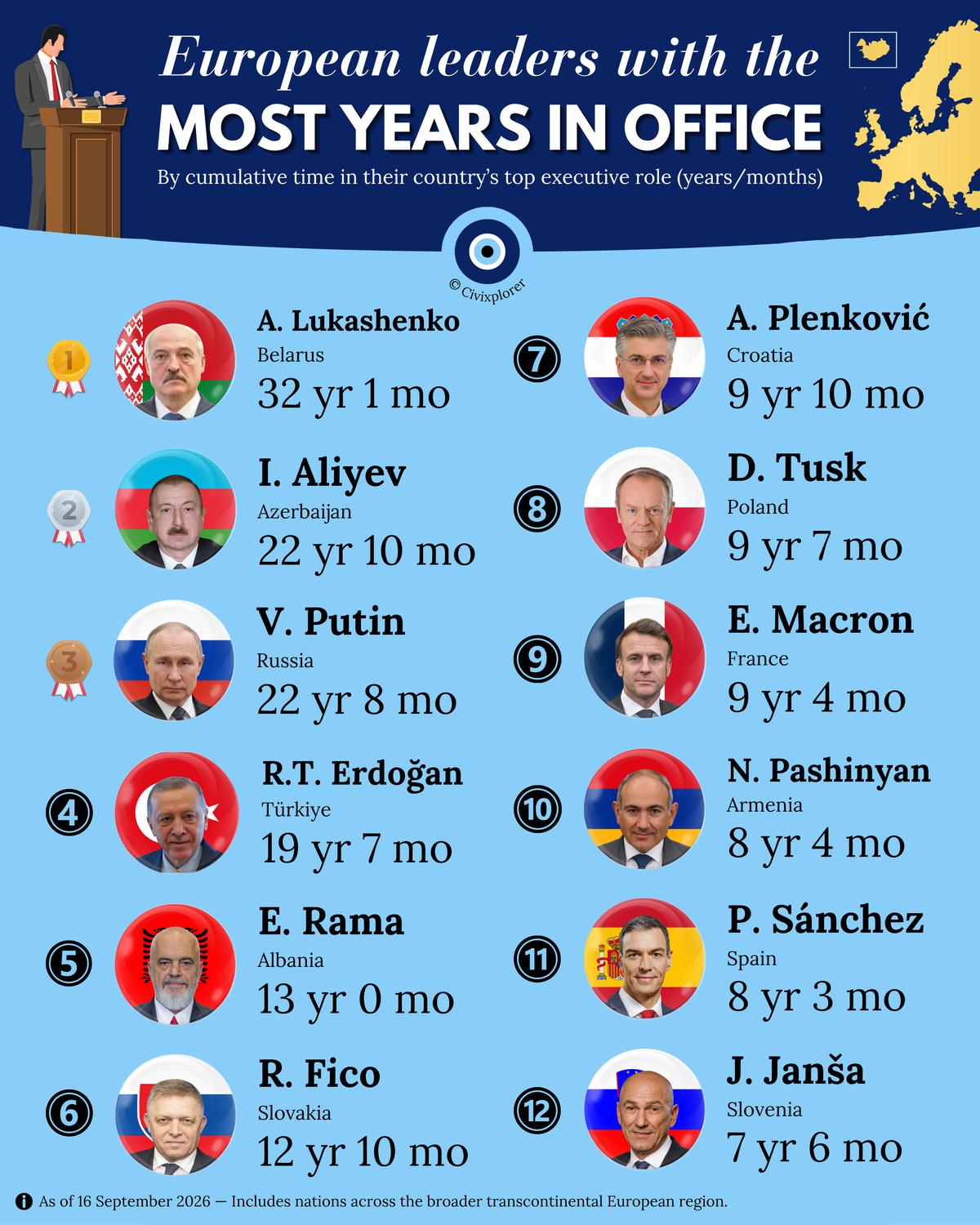
nderstanding political tenure across the transcontinental European landscape requires examining who holds actual executive authority rather than mere political influence. Our recent infographic ranks sitting European heads of state and government based strictly on their cumulative time spent in their nation's primary executive office as of September 2026. By focusing on constitutionally defined top executive roles rather than total political careers, this methodology distinguishes formal head-of-government duties from ceremonial positions. Consequently, periods such as Vladimir Putin's premiership between 2008 and 2012 are excluded because Russia's constitution vested principal executive authority in the presidency during those years. Similarly, Recep Tayyip Erdoğan's total excludes his tenure from 2014 to 2018 when the Turkish presidency remained largely ceremonial prior to the 2018 transition to an executive presidential system. This precise criteria also explains why former long-serving leaders like Viktor Orbán do not appear, as he stepped down in May 2026 before the snapshot was taken.
The data reveals a stark bifurcation in tenure length between centralized authoritarian regimes and competitive parliamentary democracies across the continent. Sitting at the very top of the ranking are Alexander Lukashenko of Belarus with over thirty-two years of continuous rule since 1994, Ilham Aliyev of Azerbaijan with nearly twenty-three years, Vladimir Putin with twenty-two years and eight months, and Recep Tayyip Erdoğan with nineteen years and seven months. In these systems, extensive political longevity is achieved through the systematic consolidation of power, the elimination of constitutional term limits, and tight control over state institutions. These unbroken tenures illustrate how executive stability in Eastern Europe and the transcontinental boundary rests heavily on resource rents, institutional capture, and electoral administration control.
In sharp contrast to unbroken authoritarian reigns, European parliamentary democracies demonstrate a distinct phenomenon known as interrupted cumulative longevity. In these open political environments, crossing a decade in office represents a rare feat of political survival accomplished through separate stints in power separated by years in opposition. Leaders such as Robert Fico of Slovakia have accumulated twelve years and ten months across four distinct terms, while Donald Tusk of Poland has amassed nine years and seven months across two separate eras in office. Likewise, Janez Janša of Slovenia returned to the premiership in June 2026 to bring his cumulative total to seven years and six months across four separate cabinets. These cyclical mandates highlight the resilience and volatility of democratic elections, where experienced party leaders repeatedly return to executive power following voter realignments.
Beyond democratic comebacks, a small subset of democratic leaders has managed extended continuous tenures within parliamentary or semi-presidential frameworks. Edi Rama of Albania has sustained thirteen years of uninterrupted premiership through successive electoral victories, while Andrej Plenković of Croatia has achieved nearly ten continuous years in office as the default choice of coalition governments. In Western Europe, Emmanuel Macron of France has utilized the full two-term presidential limit to reach nine years and four months, while Pedro Sánchez of Spain has navigated parliamentary alliances for over eight years after initially taking office through a vote of no confidence. Ultimately, mapping cumulative executive tenure exposes two coexisting political dynamics across Europe: one defined by institutional capture and unbroken autocracy, and another shaped by electoral rotation and strategic comebacks.

Comments (0)
Join the Conversation
Login to share your thoughts with the community.
Login to Comment