
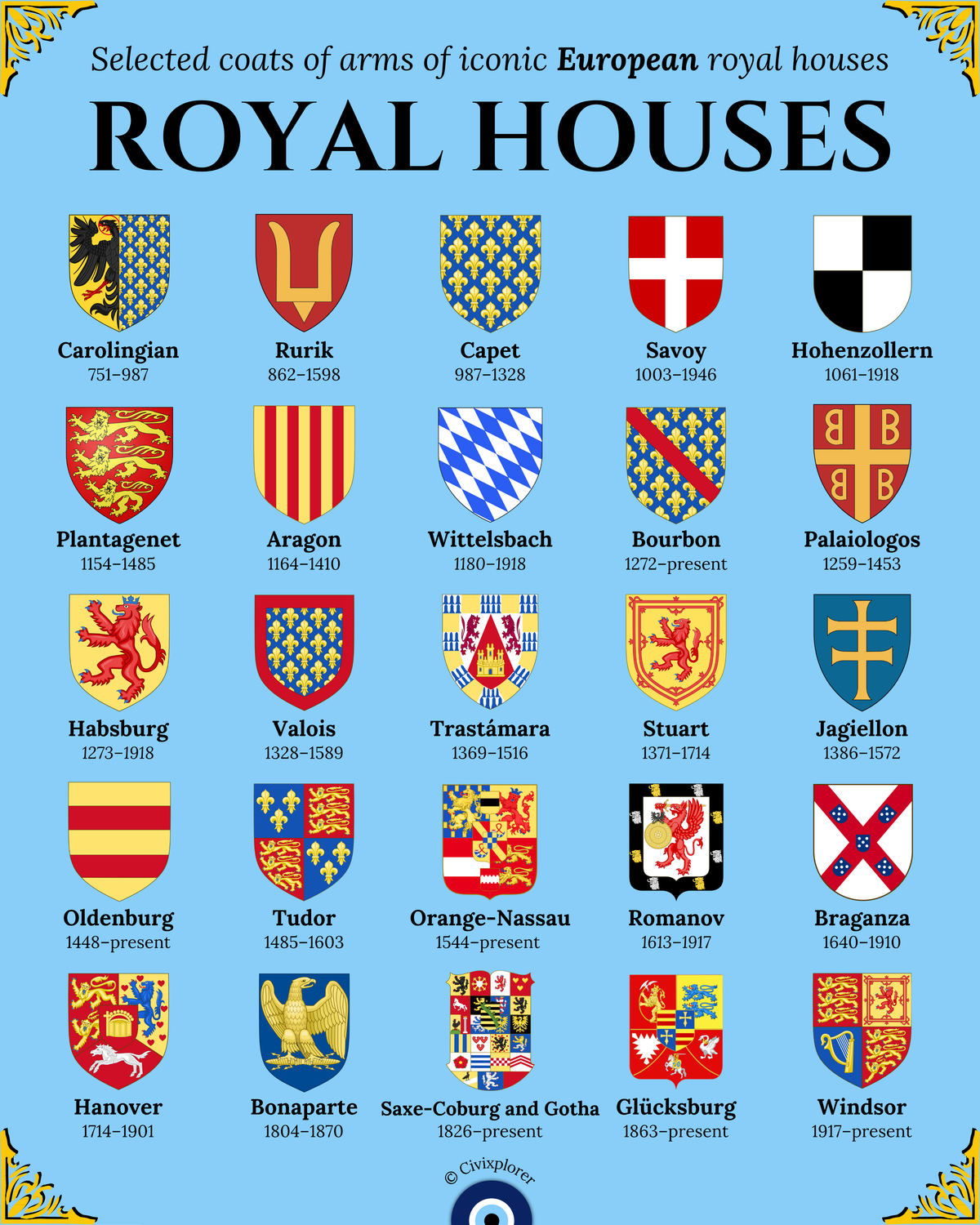
European royal history is often remembered through grand battles and territorial treaties, yet some of its most compelling legal and geopolitical arguments were written directly onto heraldic shields. Across centuries of monarchical rule, royal coats of arms functioned far beyond simple family emblems. Instead, they served as visual propaganda, markers of political legitimacy, and dynamic genealogical records that evolved alongside shifts in continental power. From medieval dynasties like the Capetians to modern constitutional houses like Windsor, these heraldic symbols offer a fascinating lens into how European sovereignty was organized, contested, and transformed.
A closer examination of early royal symbols reveals a curious historical paradox known as retrospective heraldry. While visual timelines often display coats of arms for ancient lines like the Carolingians or the early Rurikids, hereditary European heraldry did not actually emerge until the mid-12th century. Consequently, the shield attributed to Charlemagne and the Carolingians—combining the black imperial eagle with the golden French fleurs-de-lis—is a later medieval invention meant to retrospectively bridge French and Holy Roman imperial legacies. Similarly, the red shield bearing a golden bident associated with the Rurikids represents a modern adaptation of a personal princely seal, or tamga, used on early Rus' coinage rather than a traditional Western heraldic coat.
As formal heraldry standardized across Western Europe, monarchs began using the practice of shield quartering to project legal claims over foreign territories and assert dynastic ambition. During the Hundred Years' War, Edward III of England famously quartered the three golden lions of England with the French fleurs-de-lis to visually proclaim his claim to the French throne. This quartered design persisted through the Tudor line and remained part of the official royal arms until 1801. Furthermore, heraldic charges elegantly recorded family branches through cadency marks, such as the red border added to the Valois shield or the red diagonal band on the Bourbon shield, illustrating how junior cadet lines differentiated themselves before ascending to the crown.
When political turmoil or ideological shifts threatened monarchical survival, ruling families frequently weaponized heraldry to execute dynastic rebranding. Following the French Revolution, Napoleon Bonaparte rejected the Bourbon fleur-de-lis due to its ties to the overthrown monarchy, opting instead for a golden Roman-style eagle grasping a thunderbolt to align his empire with classical military glory. A century later, amidst the anti-German fervor of World War I, King George V executed a masterclass in political maneuvering. In 1917, he formally changed the British royal house name from Saxe-Coburg and Gotha to Windsor while removing the central Saxon inescutcheon from the royal shield to sever visual ties with German heritage.
Beyond warfare, strategic marriages served as the ultimate vehicle for European expansion, inspiring the famous historical maxim that while others waged war, fortunate Austria married. Through matrimonial alliances, the House of Habsburg assembled a colossal empire spanning Austria, Spain, Burgundy, Bohemia, and Hungary. Similar marital unions reshaped Iberia when Isabella of Castile and Ferdinand of Aragon joined their crowns under the House of Trastámara. By the 19th century, houses like Oldenburg and its cadet branch Glücksburg created an intensely interlinked network through King Christian IX of Denmark, whose descendants occupied or inherited thrones across Britain, Russia, Greece, and Norway.
Ultimately, while revolutions, world wars, and republican movements dismantled many of Europe's imperial structures in the 20th century, the visual symbols of these sovereign families remain remarkably durable. The progression from early medieval kingships to modern constitutional monarchies demonstrates that while empires fade, heraldic design preserves the political memory of the continent. These iconic shields stand not merely as decorative art, but as enduring visual archives of how power, diplomacy, and family heritage shaped the modern world.

Comments (0)
Join the Conversation
Login to share your thoughts with the community.
Login to Comment