
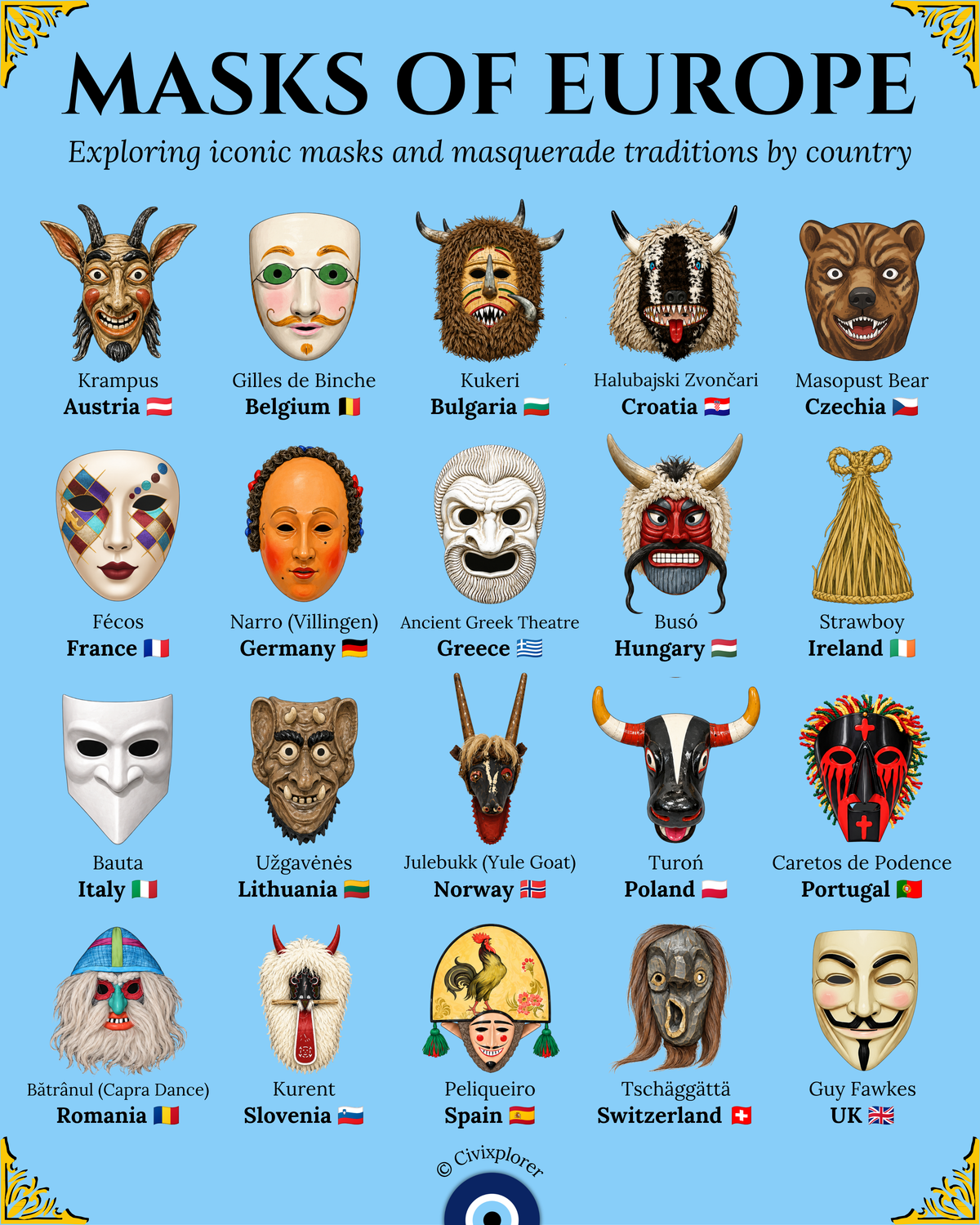
Across the European continent, traditional masquerades represent far more than vibrant festival costumes; they serve as a visual map of ancient seasonal transitions, social inversion, and communal heritage. While many casual observers view these disguise traditions as mere tourist spectacles or simple street celebrations, an exploration of their deeper origins reveals three distinct cultural frameworks that have shaped European masking for centuries. From loud midwinter agrarian rites designed to banish cold weather to sophisticated theatrical disguises engineered for social equality and modern symbols of digital protest, masks have continually reflected humanity’s evolving relationship with ritual, authority, and identity.
The vast majority of traditional masks depicted across Europe—such as the Kukeri of Bulgaria, the Kurent of Slovenia, the Halubajski Zvončari of Croatia, and the Busó of Hungary—share striking visual characteristics defined by horned wooden faces, heavy animal pelts, and massive waist-bound bells. Tied directly to the midwinter and pre-Lenten Carnival calendar, these figures participate in energetic village processions intended to create deafening noise. Ritualistic bell-ringing and frightening visages are designed to scare away malevolent winter spirits, awaken the earth, and ensure agrarian fertility and bountiful spring harvests. Similar seasonal symbolism appears in the fringed costumes and iron masks of Portugal’s Caretos de Podence, who symbolically rattle onlookers to release post-winter energy, as well as the grotesque wooden carvings of the Swiss Tschäggättä and the straw-stuffed linen attire of Belgium’s Gilles de Binche, who sweep away winter with willow sticks and throw oranges to crowds. Although popular local lore often attributes these rituals to ancient pre-Christian origins or romantic legends—such as the famous Hungarian tale of Busó masks frightening away Ottoman forces—historical analysis indicates many of these continuous customs were shaped during early modern periods or syncretized with Christian celebrations.
Beyond agrarian fertility rites, European disguises evolved into powerful instruments for social anonymity and theatrical expression. The iconic Bauta mask of Venice represents the pinnacle of functional disguise design, featuring a stark white porcelain surface with a prominent, beak-like chin protruding forward. This architectural structure distorted the wearer's voice while allowing them to speak, eat, and drink freely without ever exposing their identity, thereby leveling strict class hierarchies and facilitating discreet political discourse across the Venetian Republic. Similarly, the Peliqueiro of Laza in Galicia operates as a stylized festival enforcer wearing a wooden face mask topped by a decorative animal-painted mitre, wielding a whip to parody ecclesiastical and civil authority during Entroido. In theatrical contexts, classical Greek drama utilized exaggerated tragedy and comedy masks for vocal projection and character embodiment, while mummers like the Irish Strawboys wore conical plaited straw headpieces at weddings to bring luck and dance anonymously with the bride.
While most European disguise customs remain deeply rooted in agrarian cycles or historical theater, modern society has adapted the power of masking for global political commentary. The Guy Fawkes mask stands as a unique anomaly within continental tradition, tracing its origin not to ancient village folklore, but to the failed 1605 Gunpowder Plot in England. Originally burned in effigy on Bonfire Night, the stylized smiling mask was reimagined by artist David Lloyd for the 1980s graphic novel V for Vendetta. Following its 2005 film adaptation and subsequent adoption by the hacktivist group Anonymous in 2008, the mask transformed into a globally recognized symbol of anti-surveillance, digital privacy, and political protest. This transition from ancient agrarian magic to modern political activism demonstrates how European masking continues to adapt, proving that the human impulse to assume a new identity remains as potent today as it was centuries ago.

Comments (0)
Join the Conversation
Login to share your thoughts with the community.
Login to Comment