
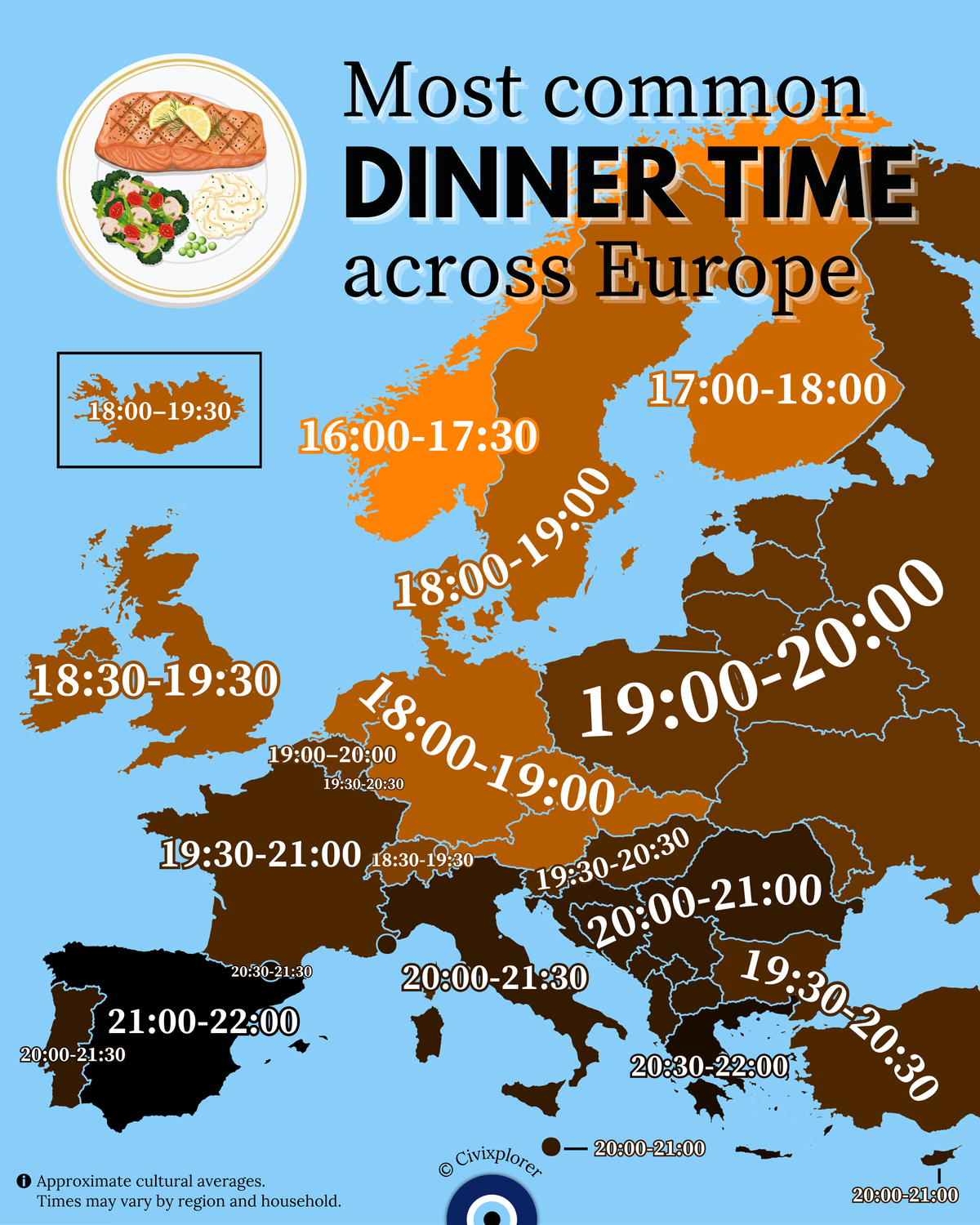
Across the European continent, one of the most striking cultural markers isn't just what people eat, but when they eat it. A geographical analysis of evening meal habits reveals a distinct North-to-South gradient, where dinner times progressively shift later as one moves toward the Mediterranean. This spatial pattern is not random; it is the result of centuries of climatic adaptation, industrial history, and political decisions.
The Nordic Early Birds
The earliest dinner times are found in Northern Europe, particularly in Norway, where the main hot meal of the day (middag) often occurs between 16:00 and 17:30. This schedule is deeply tied to a work-life balance that prioritizes an early end to the workday, allowing families to gather shortly after school or office hours. Because this meal happens so early, many Scandinavians incorporate a light fourth meal called kveldsmat later in the evening to bridge the gap until breakfast.
The Central European Baseline
In countries like Germany, the United Kingdom, and Poland, dinner typically falls between 18:00 and 19:30. These times are largely a legacy of the Industrial Revolution, which standardized the "9-to-5" workday and placed the evening meal shortly after the commute home. In Germany, the traditional Abendbrot (evening bread) emphasizes practicality—a cold meal of bread, cheeses, and meats that requires minimal preparation.
The Mediterranean Night Owls
As we move into Southern Europe, the clock shifts significantly later. In Italy, Greece, and Portugal, dinner rarely begins before 20:00. This is a necessary response to the intense summer heat, where heavy cooking and eating are physically uncomfortable during peak afternoon temperatures. In these cultures, lunch remains the anchor of the day, often being a larger, multi-course affair, which naturally pushes the lighter evening meal into the cooler night hours.
The Spanish Anomaly
Spain stands as the ultimate outlier, with dinner commonly served between 21:00 and 22:00. While often attributed to a relaxed lifestyle, this is actually driven by a historical time zone misalignment. In 1940, Francisco Franco's Spain moved its clocks forward to align with Nazi Germany’s Central European Time (CET), despite geographically belonging in the same zone as the UK and Portugal. This means Spaniards are living roughly one hour ahead of solar time, causing their entire daily rhythm—from work schedules to television primetime—to be pushed later on the clock.
Ultimately, these dinner times are more than just a preference; they are a visualization of Europe’s cultural diversity. Whether it is the structured efficiency of the North or the late-night social vibrancy of the South, when a culture sits down to eat tells us everything about their relationship with time, family, and the environment.

Comments (0)
Join the Conversation
Login to share your thoughts with the community.
Login to Comment