
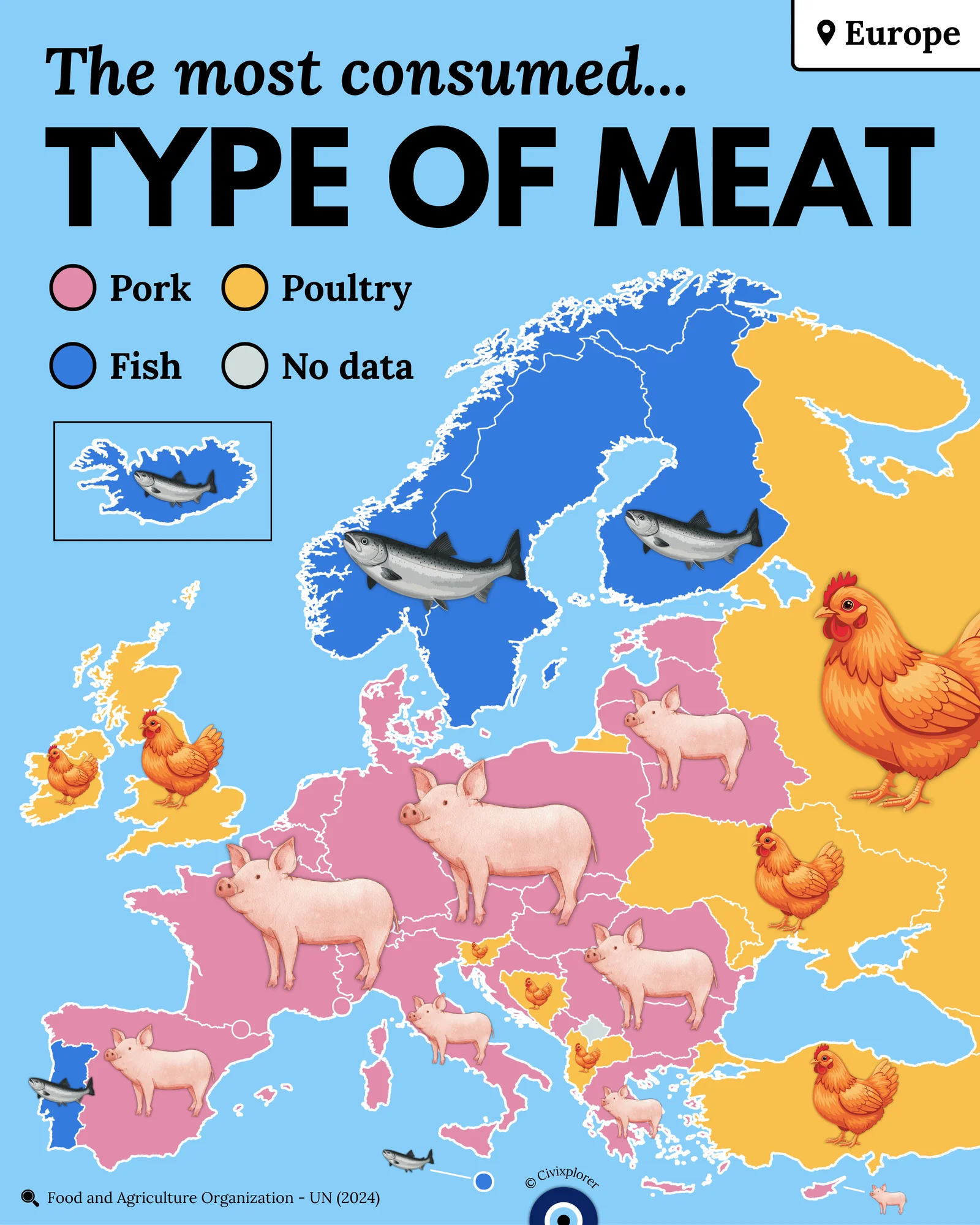
The culinary landscape of Europe is a complex tapestry woven from centuries of tradition, geographic necessity, and shifting economic realities. Using 2024 data from the UN’s Food and Agriculture Organization (FAO), we can visualize a continent clearly divided into three primary protein zones: the "Pork Belt," the "Poultry Rise," and the "Maritime Outliers."
The Central European Pork Belt: A massive swathe of Central and Western Europe, including heavyweights like Germany, France, Spain, and Poland, remains firmly dominated by pork. This preference is deeply rooted in European agricultural history. Historically, pigs were the most efficient livestock for small-scale farmers because they reach maturity quickly and can thrive on various food scraps. This efficiency birthed legendary culinary staples that define national identities today, from German wurst and Spanish jamón ibérico to French charcuterie.
The Coastal Outliers: A Legacy of the Sea While land-based meat dominates most of the continent, geography dictates a different diet for the North Atlantic and the Mediterranean fringe. Norway, Iceland, and Portugal stand out as the primary regions where fish is the preferred protein. For the Nordic giants, the cold Atlantic waters provide a sustainable and plentiful food source that has historically been more accessible than large-scale farming.
Portugal remains a fascinating exception in Southern Europe. Despite sharing the Iberian Peninsula with pork-loving Spain, Portugal has one of the highest seafood consumption rates in the world. This is driven by a deep maritime tradition and the cultural importance of staples like salted cod (bacalhau) and sardines, which push their per capita intake far beyond their neighbors.
The Economic Rise of Poultry: In the United Kingdom, Ireland, and across Eastern Europe including Ukraine and Türkiye, poultry has taken the lead. This trend is largely fueled by modern economic and health factors. Chicken has become the "inflation-proof" meat of the 21st century, offering the most affordable animal protein produced at scale. Additionally, a global shift toward "white meat" for cardiovascular health has allowed poultry to overtake traditional red meats in several major economies.
Cultural vs. Geographic Borders: One of the most striking insights from the data is how dietary borders often align more closely with cultural and religious history than with simple proximity. This is most evident in the Eastern Mediterranean; while many neighboring regions avoid pork for religious reasons, the high consumption of pork in Cyprus stands in stark contrast to the poultry dominance in Türkiye. These "geographic anomalies" remind us that what we put on our plates is a reflection of our history just as much as our environment.
Comments (0)
Join the Conversation
Login to share your thoughts with the community.
Login to Comment