
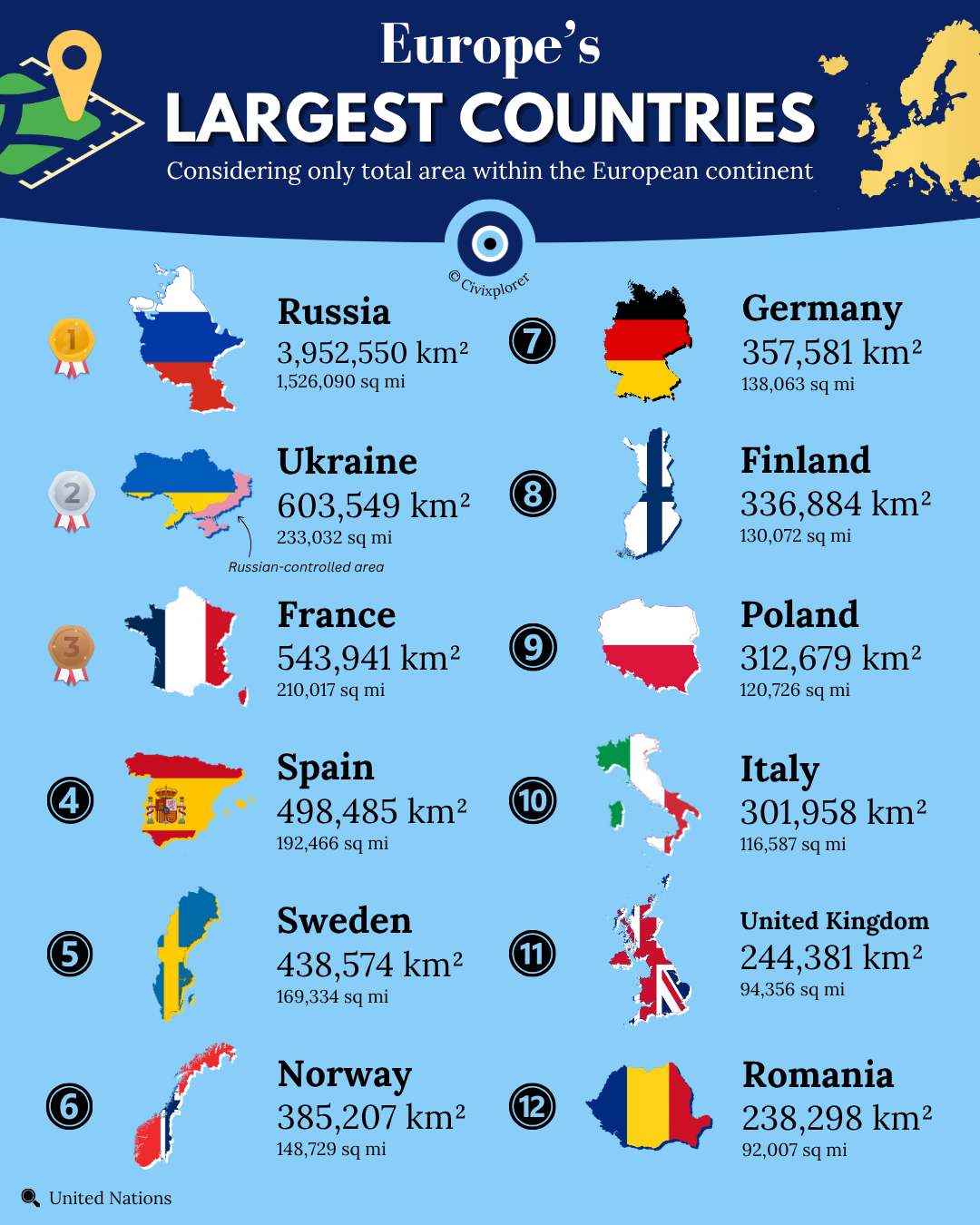
The geography of Europe is often defined by its political boundaries, but when viewed through a strictly physical lens, the statistical landscape of the continent shifts dramatically. This analysis explores the ranking of Europe’s 12 largest countries by total area, utilizing a methodology aligned with United Nations figures that considers only the territory located within the geographical boundaries of the European continent.
The Defining Metric: Strict Continental Borders
The most critical factor in this data is the exclusion of all territories outside the European continent. This "continental rule" impacts several transcontinental nations, stripping away overseas departments, colonies, and Asian regions to provide a localized comparison. For instance, countries like Turkey are absent from the top 12 because the vast majority of their area lies in Asia, with only a small portion (East Thrace) remaining in Europe.
The Geographic Dominance of Russia
Russia secures the top position with 3,952,550 km². While it is the largest country globally, this figure represents only its European portion—the land west of the Ural Mountains and the Ural River. Remarkably, even after losing over 75% of its total landmass in this calculation, Russia’s European territory still accounts for nearly 40% of the entire continent. This area alone is larger than the combined European territories of the next five countries on the list.
Ukraine: De Jure Integrity vs. De Facto Reality
Ukraine ranks second with 603,549 km², making it the largest country located entirely within Europe. The data follows United Nations standards, which recognize Ukraine’s international borders as they stood prior to 2014. However, the analysis visually acknowledges the present-day political reality by noting "Russian-controlled areas" in the east and south, representing approximately 19–20% of the total territory under current occupation.
The "Metropolitan" Factor for France and Spain The rankings for France and Spain are significantly altered by the continental restriction.
- France (3rd place, 543,941 km²): This figure represents only Metropolitan France. It purposefully excludes overseas regions like French Guiana in South America or islands in the Indian Ocean, despite them being integral parts of the French state.
- Spain (4th place, 498,485 km²): Spain’s total area is reduced by excluding the Canary Islands and the cities of Ceuta and Melilla, which geographically belong to the African continent.
Northern Expanses and Peninsula Consolidation
The middle of the ranking is dominated by Northern European nations. Sweden (5th, 438,574 km²) and Norway (6th, 385,207 km²) hold high positions due to their vast northern forests and, in Norway’s case, the inclusion of the Svalbard archipelago as European sovereign territory.
Further down the list, geography relies on continental shelves to define size. Italy (10th, 301,958 km²) includes its major Mediterranean islands, Sicily and Sardinia, as they sit on the European shelf. Similarly, the United Kingdom (11th, 244,381 km²) combines Great Britain and Northern Ireland while excluding off-continent overseas territories.
Conclusion
These rankings illustrate how history and geography shape the size of nations. From the expansive, flat plains of the east to the fragmented peninsulas of the south, the way we define "European" territory remains as much a matter of geographic convention as it does political recognition
| Rank | Country | Continental Area (km²) | Continental Area (sq mi) |
|---|---|---|---|
| 1 | Russia | 3,952,550 | 1,526,090 |
| 2 | Ukraine | 603,549 | 233,032 |
| 3 | France | 543,941 | 210,017 |
| 4 | Spain | 498,485 | 192,466 |
| 5 | Sweden | 438,574 | 169,334 |
| 6 | Norway | 385,207 | 148,729 |
| 7 | Germany | 357,581 | 138,063 |
| 8 | Finland | 336,884 | 130,072 |
| 9 | Poland | 312,679 | 120,726 |
| 10 | Italy | 301,958 | 116,587 |
| 11 | United Kingdom | 244,381 | 94,356 |
| 12 | Romania | 238,298 | 92,007 |
| 13 | Belarus | 207,600 | 80,154 |
| 14 | Kazakhstan | 148,000 | 57,143 |
| 15 | Greece | 131,957 | 50,948 |
| 16 | Bulgaria | 110,372 | 42,614 |
| 17 | Iceland | 103,000 | 39,768 |
| 18 | Hungary | 93,025 | 35,917 |
| 19 | Portugal | 91,424 | 35,299 |
| 20 | Austria | 83,878 | 32,385 |
| 21 | Czechia | 78,871 | 30,452 |
| 22 | Serbia | 77,589 | 29,957 |
| 23 | Ireland | 69,825 | 26,959 |
| 24 | Lithuania | 65,286 | 25,207 |
| 25 | Latvia | 64,594 | 24,939 |
| 26 | Croatia | 56,594 | 21,851 |
| 27 | Bosnia & Herz. | 51,209 | 19,771 |
| 28 | Slovakia | 49,035 | 18,932 |
| 29 | Estonia | 45,399 | 17,528 |
| 30 | Denmark | 42,947 | 16,581 |

Comments (0)
Join the Conversation
Login to share your thoughts with the community.
Login to Comment