
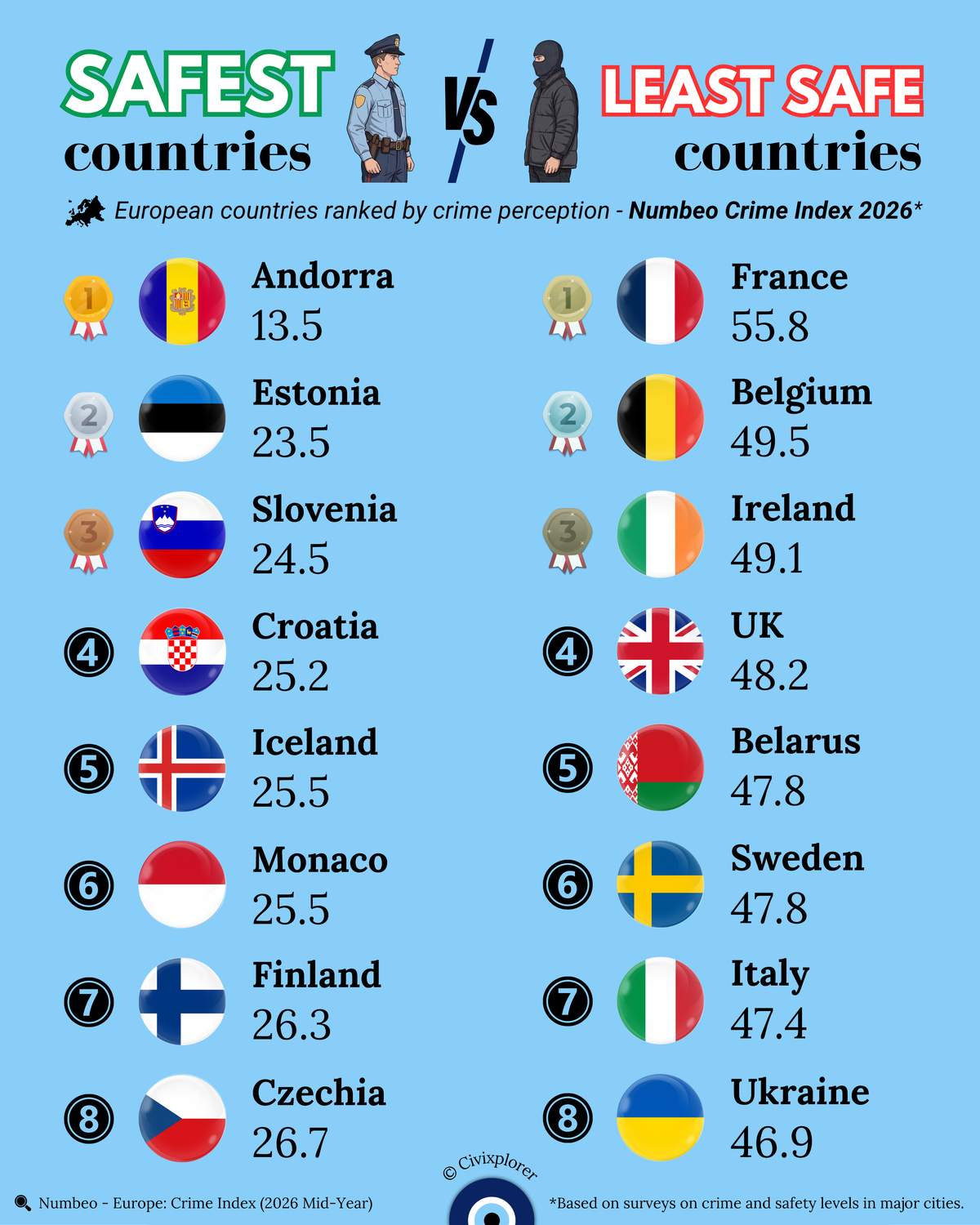
When evaluating public security across the continent, the Numbeo 2026 Mid-Year Europe Crime Index presents a striking comparison of how safe European nations feel to residents and visitors. Unlike official police records or homicide statistics, this index measures perceived crime levels based on crowdsourced surveys evaluating concerns over theft, violent crime, corruption, and nighttime safety on a 0 to 100 scale. Because public perception is heavily influenced by media coverage, visible street disorder, and high-profile incidents, the resulting ranking reflects everyday civilian sentiments rather than direct per-capita crime counts.
At the top of the unsafest list, France takes the leading position with a crime perception score of 55.8, followed closely by Belgium at 49.5 and Ireland at 49.1. This high level of public concern in Western Europe is predominantly driven by intense urban concentration, where specific metropolitan centers deal with visible drug markets, property crimes, and localized unrest. A particularly notable case is Sweden, which ranks sixth with a score of 47.8. While Scandinavia has historically held a reputation for exceptional safety, recent years have seen heightened anxiety stemming from publicized gang violence, shootings, and bombings in select urban neighborhoods. Meanwhile, countries like Italy score 47.4 despite maintaining one of Europe's lowest homicide rates, proving that fear of corruption, property theft, and drug trade can elevate a country's overall index score.
On the opposite end of the spectrum, European microstates and Central European nations dominate the safest rankings. Andorra secures the top spot with an exceptionally low score of 13.5, benefiting from a small, affluent population, tightly controlled borders, and a high police-to-population ratio. Beyond microstates like Andorra and Monaco (25.5), Eastern and Central European countries demonstrate high levels of social cohesion and low street-level crime. Estonia ranks second overall with 23.5, joined by Slovenia at 24.5, Croatia at 25.2, and Czechia at 26.7. In Northern Europe, a stark contrast emerges between neighbors: while Sweden scores among the highest in perception of crime, Iceland (25.5) and Finland (26.3) rank among the safest, illustrating that public security dynamics vary significantly even within the Nordic region.
Interpreting these figures requires understanding that a high perception score does not automatically make a nation dangerous, nor does a low score mean an absence of crime. For instance, Ukraine records a perception score of 46.9, which reflects street-level security perceptions rather than military conflict, placing it lower than several Western European nations. Similarly, Belarus at 47.8 reflects public concern over political corruption and state repression rather than violent street assault. Ultimately, the index highlights a shifting geographical paradigm across Europe, where public feelings of safety are increasingly concentrated in Central and Eastern Europe while Western metropolitan hubs face growing challenges with urban security perceptions.


Comments (0)
Join the Conversation
Login to share your thoughts with the community.
Login to Comment