
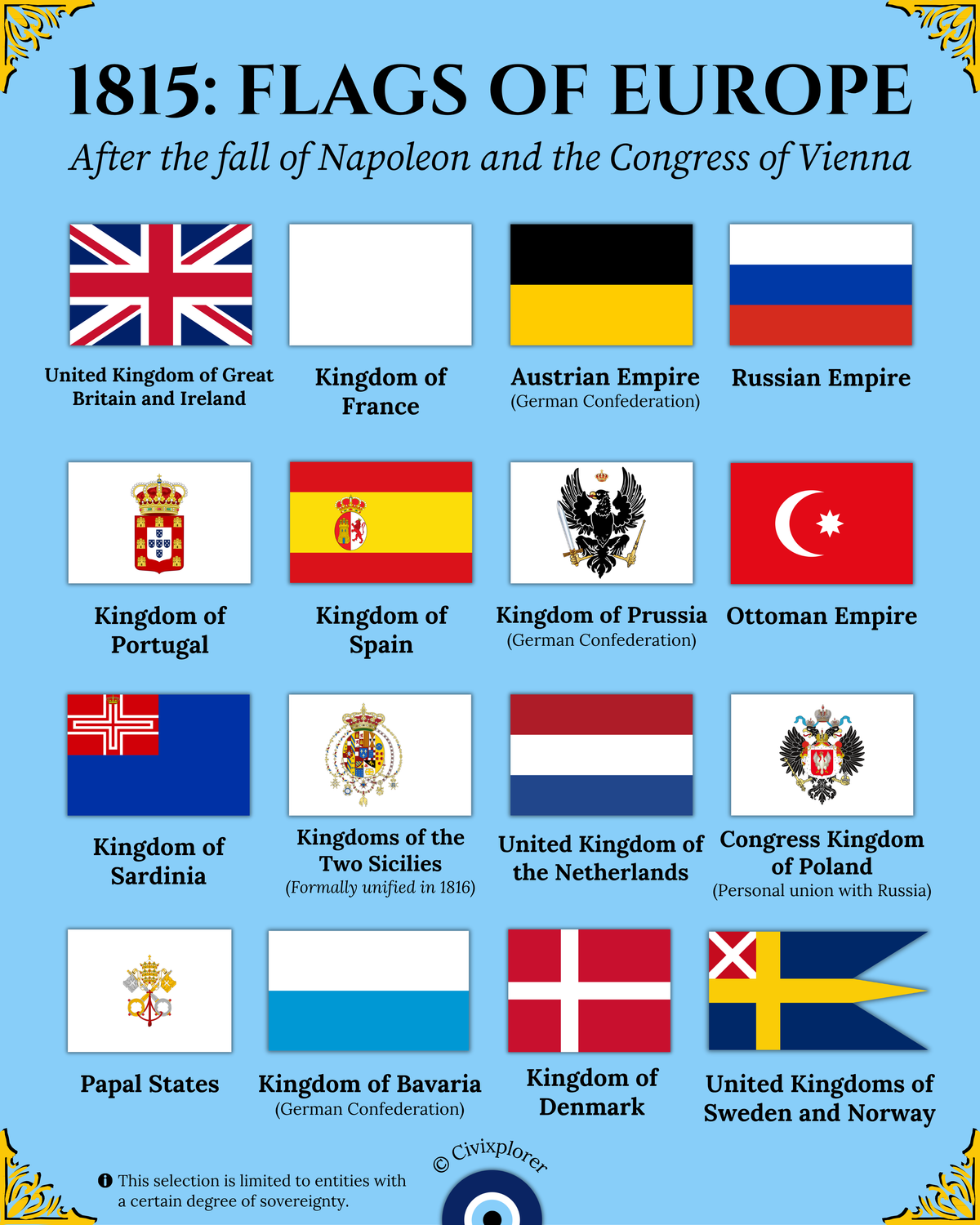
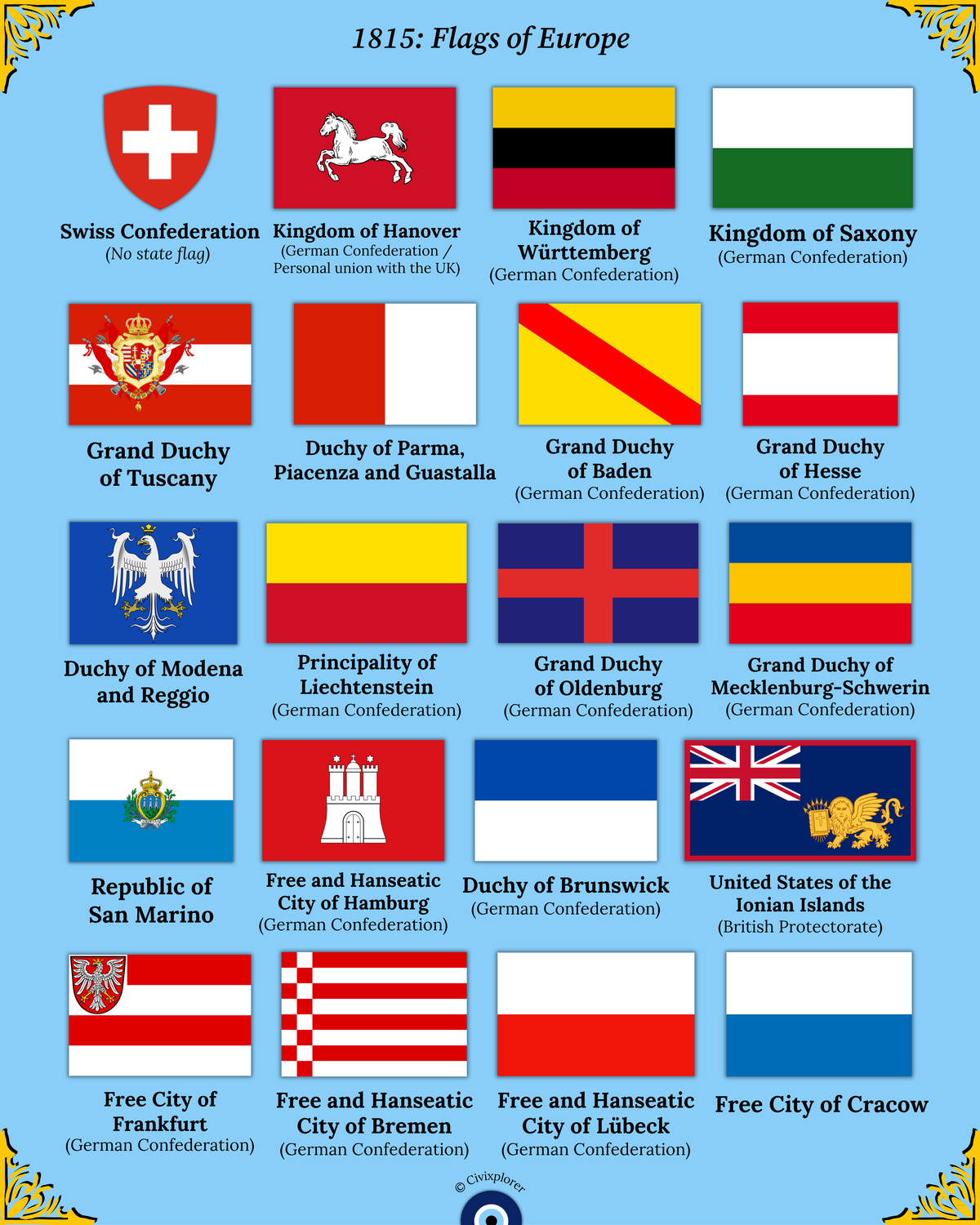
The year 1815 represents one of the most significant geopolitical resets in human history. Following the final defeat of Napoleon Bonaparte at the Battle of Waterloo, the victorious powers gathered at the Congress of Vienna to redraw the map of Europe. Their goal was simple yet ambitious: to restore the "Balance of Power" and reinstate the conservative monarchies that had been toppled by a decade of revolutionary fervor. The flags of this era are a fascinating window into a continent caught between the old feudal order and the rising tide of nationalism.
One of the most visually striking symbols from this period is the white flag of the Kingdom of France. While white is often associated with surrender today, in 1815 it represented the Bourbon Restoration. King Louis XVIII abolished the famous blue, white, and red Tricolor—viewed as a symbol of regicide and revolution—and returned to the pure white dynastic color of the House of Bourbon to signal a return to the "divine right of kings."
Central Europe was a complex patchwork known as the German Confederation. Replacing the thousand-year-old Holy Roman Empire, this loose association of 39 sovereign states acted as a buffer against French expansion. Dominating this landscape were the Austrian Empire, sporting the black and yellow colors of the Habsburgs, and the Kingdom of Prussia with its iconic black eagle. Within this confederation, mid-sized powers like Bavaria, Saxony, and Hanover maintained their own distinct identities, while independent merchant republics like Hamburg and Bremen kept the traditions of the Hanseatic League alive.
This era was also the golden age of Personal Unions, where two distinct nations shared a single monarch. The British King George III was simultaneously the King of Hanover, a union that tied British interests directly to the European mainland. Similarly, the Russian Empire dominated the Congress Kingdom of Poland, creating a puppet state where the Russian imperial eagle loomed over the Polish white eagle. To the north, Sweden and Norway were forced into a union that lasted nearly a century, sharing a monarch and foreign policy while maintaining separate legal institutions.
The Italian Peninsula, famously described as a "geographic expression" rather than a unified nation, was equally fragmented. The Kingdom of Sardinia—which would later lead the charge for Italian unification—stood alongside the Kingdom of the Two Sicilies and the Papal States, where the Pope reigned as a temporal monarch. Many smaller duchies in the region, such as Tuscany and Parma, functioned as satellites for Austrian influence.
Finally, the flags of 1815 reveal intriguing nuances of a world in transition. The Ottoman Empire was already a major European player, though its flag featured an eight-pointed star that had not yet been standardized to the five-pointed version we know today. Meanwhile, the Swiss Confederation utilized the white cross on a red shield as a federal emblem, but it would not adopt a standardized national flag until much later in the 19th century. These symbols remind us that the map of 1815 was not one of modern nation-states, but a carefully constructed order of dynastic legitimacy and strategic stability.

Comments (0)
Join the Conversation
Login to share your thoughts with the community.
Login to Comment