
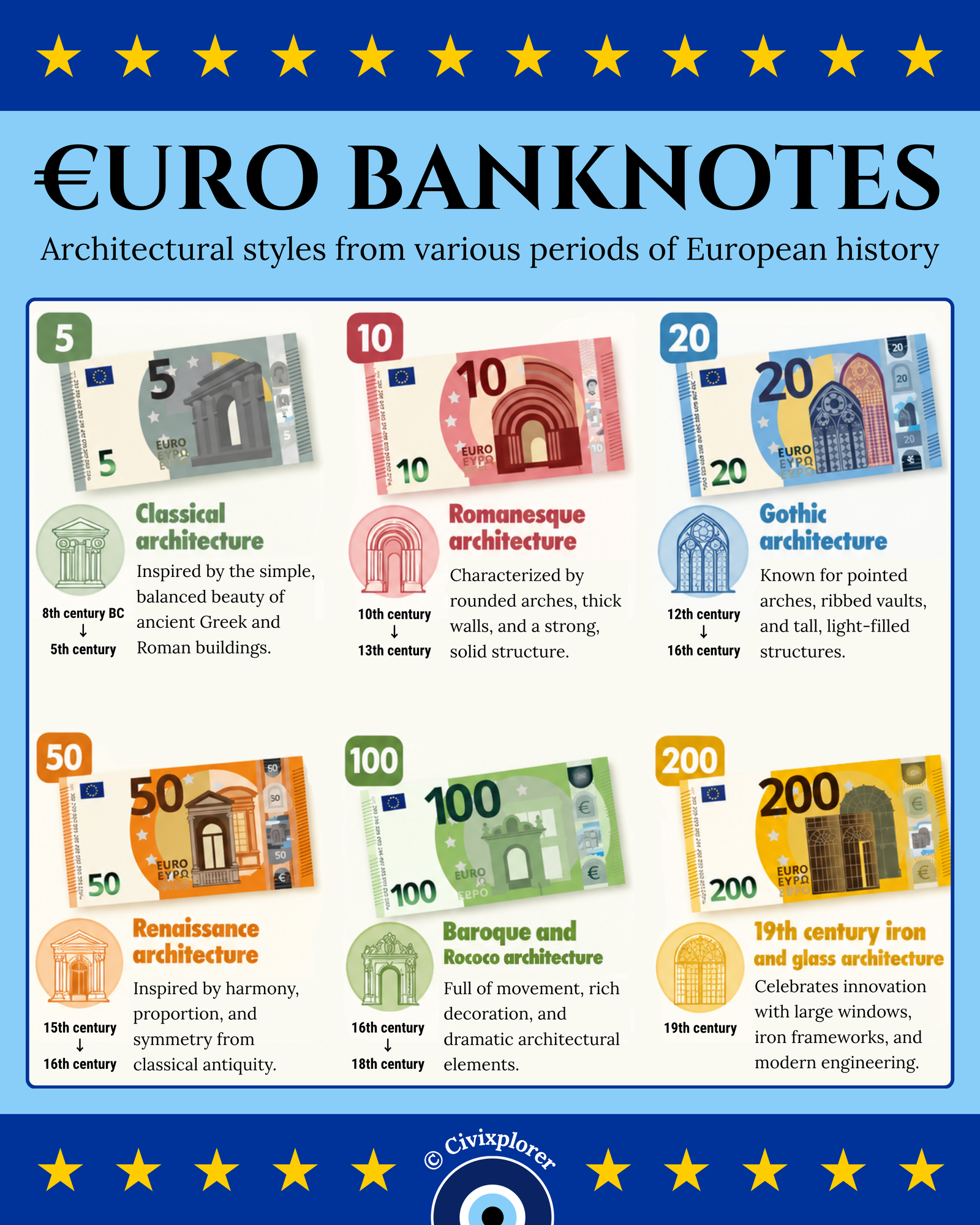
When the Euro was introduced as cash in 2002, the European Central Bank (ECB) faced a unique diplomatic challenge: how to design a currency for multiple sovereign nations without showing favoritism. Featuring specific historical figures or existing monuments could have incited national jealousy. To solve this, Austrian artist Robert Kalina developed a brilliant concept titled "The Ages and Styles of Europe."
The solution was to depict entirely fictional architectural structures. While these gateways and bridges look authentic and recognizable to any European, they do not exist in reality. This ensured that no single member state could claim the monuments as their own, successfully fostering a sense of shared European heritage and "unity in diversity."
The banknotes are designed to progress chronologically through European architectural history as the denominations increase. This creates a narrative of the continent's cultural evolution, from its foundational roots to the industrial age:
- €5 (Grey): Represents Classical architecture (8th century BC – 5th century AD), focusing on the foundations of European civilization through the balanced beauty of ancient Greek and Roman buildings.
- €10 (Red): Showcases Romanesque architecture (10th – 13th century), characterized by thick walls, rounded arches, and a sense of solid, fortress-like stability.
- €20 (Blue): Highlights the Gothic period (12th – 16th century), where pointed arches and ribbed vaults allowed for the tall, light-filled structures seen in iconic cathedrals.
- €50 (Orange): Features Renaissance architecture (15th – 16th century), a period that emphasized harmony, proportion, and the rebirth of classical antiquity.
- €100 (Green): Displays the dramatic movement and rich ornamentation of the Baroque and Rococo styles (16th – 18th century).
- €200 (Yellow-Gold): Celebrates 19th-century iron and glass architecture, reflecting the engineering innovations of the Industrial Revolution.
Beyond the historical eras, the specific elements on the notes carry deep symbolism. Every banknote features a window or gateway on the front, symbolizing the European spirit of openness and cooperation. Conversely, the back of each note depicts a bridge, representing the communication and connection between the people of Europe and their relationship with the rest of the world.
Interestingly, while the bridges were meant to be fictional, life eventually imitated art. In 2011, the Dutch town of Spijkenisse decided to build exact, color-coded replicas of all seven bridges from the banknotes over a local canal. What was designed to belong to "nowhere" now technically belongs to the Netherlands.
One notable absence in modern circulation is the €500 note. Originally representing 20th-century modern architecture, it was phased out by the ECB in 2019. Due to its high value, it had become a preferred tool for illicit activities, earning it the notorious nickname "the Bin Laden note."
As we look to the future, this architectural theme may soon become a part of history itself. The ECB is currently in the process of designing a third series of banknotes, with potential new themes like "rivers and birds" or "European culture" expected to be decided by the end of 2026. For now, however, the current notes remain miniature, portable monuments to the architectural continuum of Europe.

Comments (0)
Join the Conversation
Login to share your thoughts with the community.
Login to Comment