
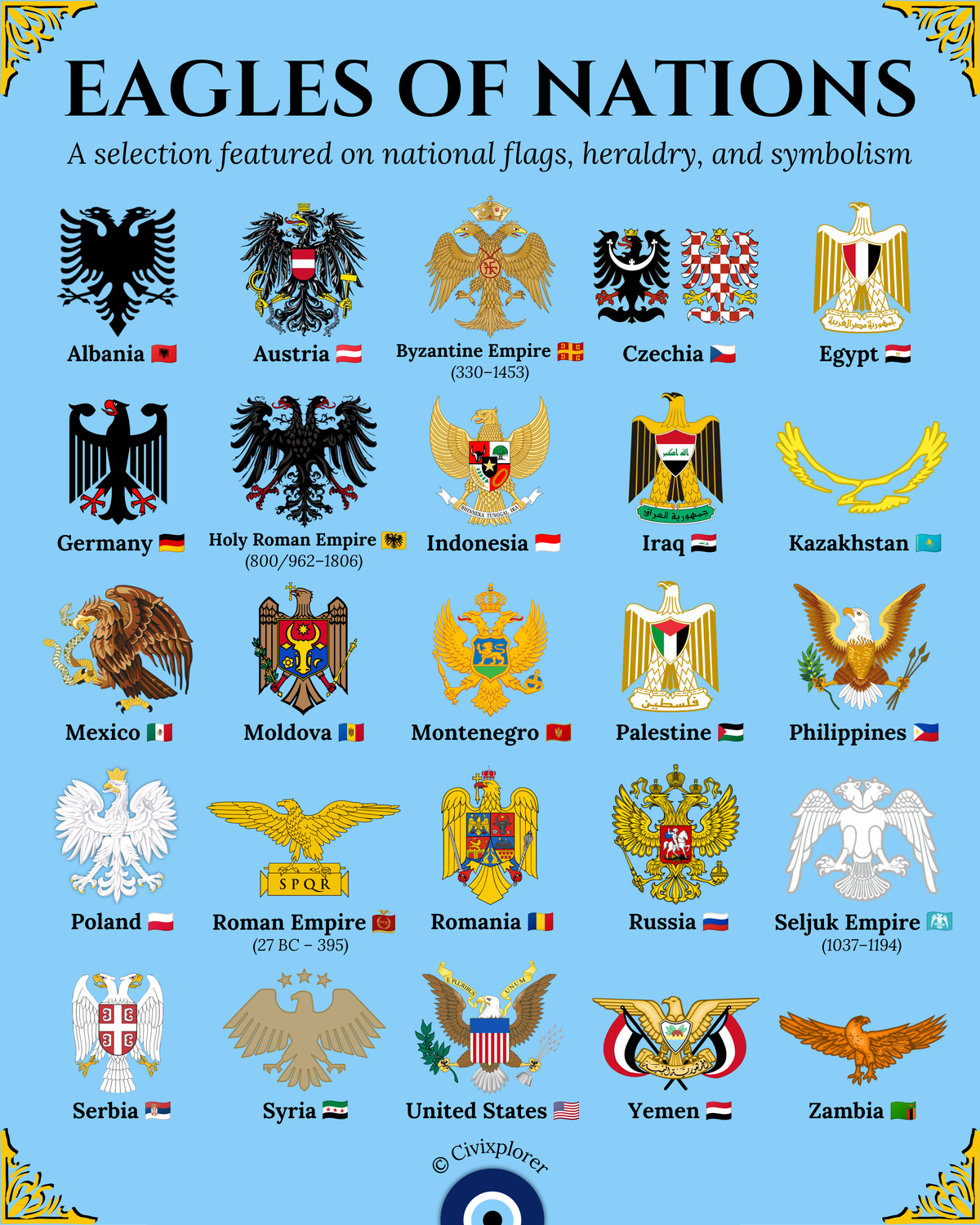
For thousands of years, the eagle has stood as the ultimate avian emblem of sovereignty, strength, and divine authority. From ancient legionary banners carried across the Mediterranean to modern national flags flying across the Americas, Africa, and Asia, this formidable predator has been continuously repurposed by empires, monarchies, and republics alike. While many assume that national symbols are merely artistic choices, the widespread presence of the raptor in heraldry tells a deeper story about political continuity, cultural borrowing, and state legitimacy. A close examination of global vexillology reveals distinct symbolic lineages that explain how a single bird came to dominate state imagery across vastly different civilizations.
The foundation of Western eagle heraldry traces directly back to the Roman Empire, where the golden Aquila served as the sacred military standard of the legions. Following Rome's fall, emerging European states adopted single-headed eagles to assert their own claims to imperial authority and historical prestige. This Roman inheritance is clearly visible in the single-headed black eagle of Germany and the white eagle of Poland, the latter surviving centuries of political turmoil as an enduring symbol of national identity. Similarly, the golden single-headed eagles of Romania and Moldova, holding Orthodox crosses, bridge classical Roman heraldic conventions with Eastern Christian traditions. Even within Czechia's state arms, regional heraldry preserves historical eagles alongside the Bohemian lion, illustrating how classical forms were tailored to express local governance.
Beyond single-headed raptors, the bicephalic or double-headed eagle represents one of history's most powerful heraldic mutations. Popularized during the late Byzantine Empire to signify dual authority over secular and religious realms, as well as dominion over East and West, the double-headed motif was later inherited by successor states seeking to project imperial weight. Russia adopted the golden double-headed eagle to position Moscow as the Third Rome, while the Holy Roman Empire utilized a black bicephalic bird to claim legitimate Roman succession. This imperial lineage lives on across Eastern Europe in the national emblems of Albania, Serbia, and Montenegro. Interestingly, the double-headed motif was not restricted to Christian Europe; the Seljuk Empire also adopted white bicephalic birds, reflecting a shared Eurasian artistic tradition that transcended religious boundaries.
In the Middle East and North Africa, a completely distinct cluster of eagle heraldry emerged during the twentieth century, driven by modern republicanism rather than medieval dynastic lines. Nations such as Egypt, Iraq, Palestine, and Yemen prominently feature the Eagle of Saladin, a golden raptor bearing a national shield that became a foundational symbol of Pan-Arab unity following the 1952 Egyptian Revolution. A recent evolution of this tradition appeared in Syria, where a newly designed golden eagle was unveiled featuring fourteen wing feathers for its governorates and five tail feathers representing its geographic regions. These Middle Eastern eagles demonstrate how historical motifs can be modernized to build contemporary statehood and regional solidarity.
Not all national eagles originate from European or Middle Eastern imperial history. In Mexico, the national emblem stems from the foundational Aztec myth of Tenochtitlan, depicting a golden eagle perched on a cactus devouring a snake, an indigenous narrative entirely independent of Western heraldry. In Central and Southeast Asia, nations drew upon local fauna and spiritual traditions rather than classical heraldic templates. Kazakhstan showcases a soaring steppe eagle beneath a golden sun to celebrate nomadic freedom, while Zambia features the African fish eagle to signify rising above adversity. In Indonesia, the emblem represents the Garuda Pancasila, a mythical avian creature from Hindu and Buddhist traditions adapted to unite a diverse archipelago. Meanwhile, in the Western Hemisphere, the United States deliberately selected the native Bald Eagle clutching arrows and an olive branch to forge a distinctly republican symbol of war and peace, an aesthetic that historically influenced the coat of arms of the Philippines during the American colonial era. Through these varied lineages, the eagle remains a living testament to how nations construct identity through visual history.

Comments (0)
Join the Conversation
Login to share your thoughts with the community.
Login to Comment