
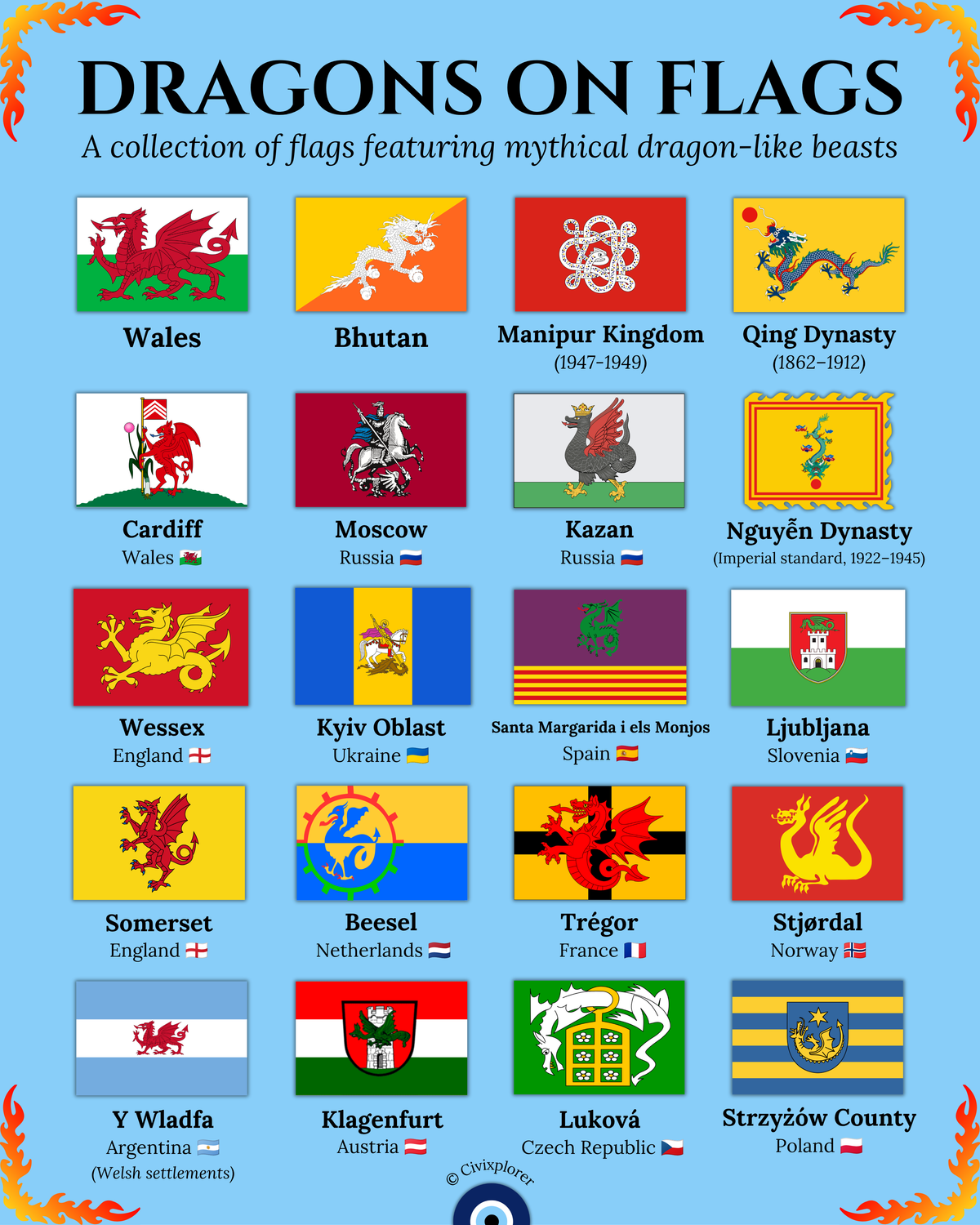
The dragon is one of the most visually striking and mythically resonant symbols in the world of vexillology. While we often group these creatures under the single label of "dragon," a closer look at global flags reveals a profound symbolic divide. From the benevolent rain-bringers of the East to the fierce territorial guardians and defeated beasts of the West, these emblems encode centuries of heritage, authority, and identity.
The Eastern Dragon: Divinity and Statehood
In East and Southeast Asian traditions, the dragon is rarely a monster to be feared. Instead, it represents cosmic authority, legitimacy, and prosperity.
The Qing Dynasty flag (1862–1912) is perhaps the most famous example of imperial state ideology. Its five-clawed "Azure Dragon" was strictly reserved for the Emperor, symbolizing the "Son of Heaven." Similarly, the Nguyễn Dynasty of Vietnam utilized the dragon to signal imperial legitimacy, drawing on local origin myths involving a Dragon Lord.
In Bhutan, the white dragon (Druk) on the national flag gives the country its name: the "Land of the Thunder Dragon." Here, the dragon symbolizes spiritual guardianship and the protective power of the state. Further south, the Manipur Kingdom featured the Pakhangba, a unique serpentine deity from indigenous mythology that represents a non-Chinese-influenced dragon tradition rooted in ancient tribal belief systems.
The Western Dragon: Heraldry and Resistance
In Europe, the dragon’s role shifted toward heraldry and territorial identity. The most iconic example is the Welsh Red Dragon (Y Ddraig Goch). While its roots may lie in Roman military standards, it evolved into a powerful symbol of national resistance and continuity. This symbol is so enduring that it was carried across the Atlantic to Patagonia, where the Y Wladfa settlement in Argentina still features the red dragon over blue and white stripes to preserve Welsh cultural heritage.
English regional history also leans heavily on the dragon motif. The Kingdom of Wessex and Somerset utilize the "wyvern"—a two-legged variant of the dragon—which served as a historic military standard meant to strike fear into enemies on the battlefield.
The Defeated Beast: Order Over Chaos
Not all dragons on flags are celebrated as independent symbols. In Eastern Orthodox traditions, such as those found on the flags of Moscow and Kyiv Oblast, the dragon appears as an adversary. These flags depict Saint George slaying the dragon, a motif where the beast represents chaos or paganism being defeated by state-sanctioned order and Christian faith. In this context, the dragon is a necessary "villain" that highlights the triumph of the protector.
Paleontology and Local Legends
Some of the most intriguing dragon flags are born from local folklore and ancient misunderstandings of the natural world. The Lindwurm of Klagenfurt, Austria, is a perfect example. In 1335, the discovery of an Ice Age woolly rhinoceros skull was mistaken for a dragon’s head, forever cementing the "Lindwurm" as the city’s official emblem.
In Kazan, Russia, the flag features the Zilant, a winged serpent from Tatar folklore. While it once carried negative connotations for Russian conquerors, it has been reclaimed as a symbol of the city's layered identity and Turkic heritage. Meanwhile, in Beesel, Netherlands, the dragon on the flag is tied to "Draaksteken," a traditional festival reenacting the legend of St. George, showing how performative folklore can transform into a modern emblematic identity.
Whether they represent imperial power, national survival, or the victory of order over chaos, dragons remain one of the most versatile tools for human storytelling through flags.

Comments (0)
Join the Conversation
Login to share your thoughts with the community.
Login to Comment