
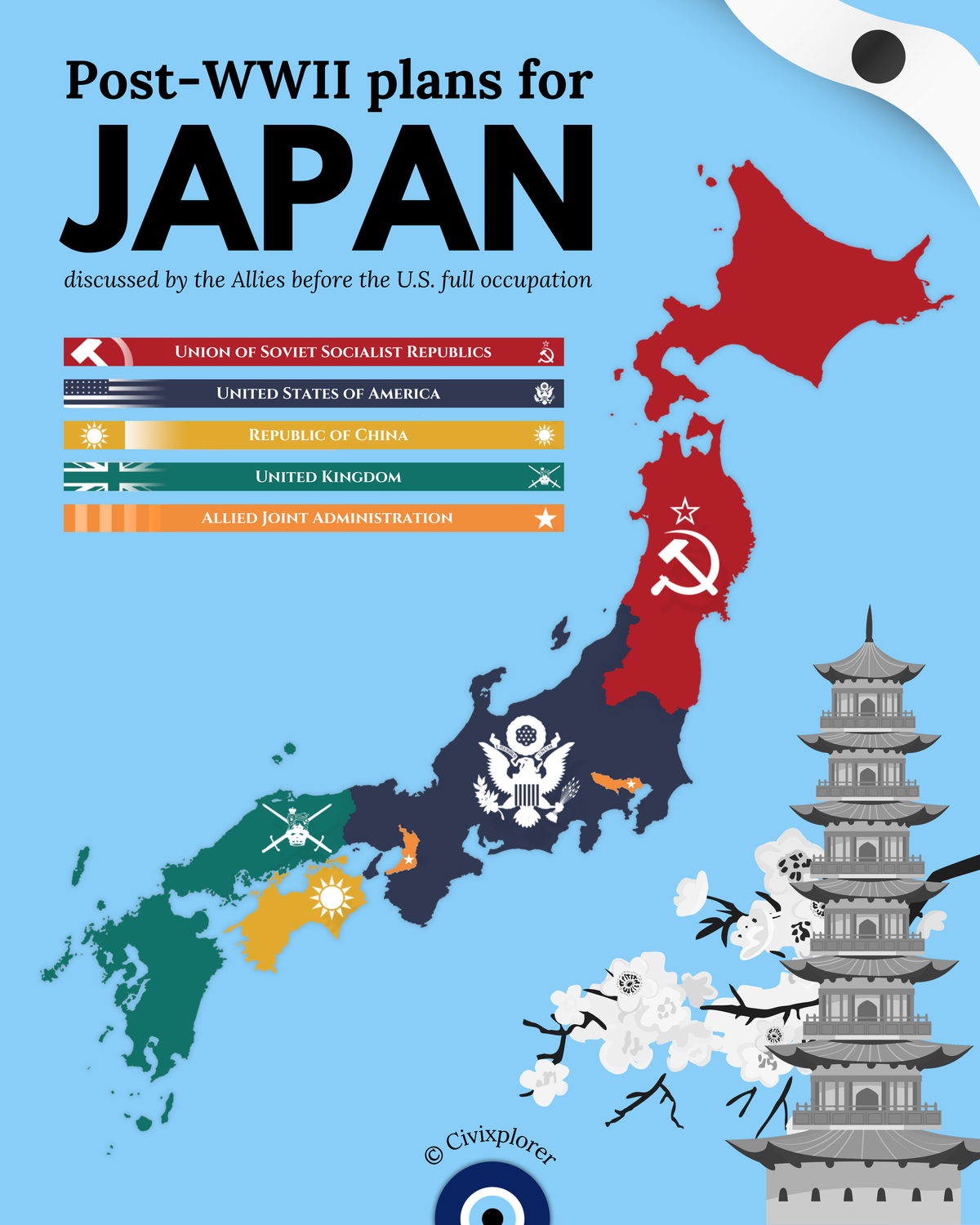
The map of the modern world was nearly defined by a border that never came to be. In the final weeks of World War II, as the Allies prepared for the total defeat of the Japanese Empire, a radical proposal sat on the desks of military planners in Washington. It was a blueprint for the partition of the Japanese home islands, a plan that would have seen the archipelago divided into distinct occupation zones controlled by the four major Allied powers: the United States, the Soviet Union, the United Kingdom, and the Republic of China.
The Blueprint for Partition: JWPC-385/1
The infographic reflects a specific draft produced on August 16, 1945, by the U.S. Pentagon’s Joint War Plans Committee, titled document JWPC-385/1. Heavily inspired by the four-power division of Allied-occupied Germany, this plan aimed to manage the logistical and political burden of governing a defeated nation. Each power was assigned a region based on strategic interests and geographic proximity.
Who Would Have Controlled What?
According to the proposal, the United States was slated to control the industrial and demographic heartland of central Honshu, including the Kanto and Kansai regions. The Soviet Union was assigned the northern island of Hokkaido and the Tohoku region of northern Honshu, reflecting their existing military presence in Manchuria and the Kuril Islands. The United Kingdom would have administered the western portion of Honshu and Kyushu to protect colonial interests in Southeast Asia, while the Republic of China—despite being weakened by internal conflict—was symbolically allocated the island of Shikoku.
The "Berlin" of the East: Joint Administration
Perhaps the most striking detail of the plan was the designation of Allied Joint Administration zones. Similar to the fate of Berlin in Germany, the political capital of Tokyo and the industrial hub of Osaka were envisioned as multinational enclaves. Had this materialized, the city of Tokyo would have been split into four sectors, creating a potential Cold War flashpoint in the heart of East Asia.
Why the Plan Was Scrapped
Despite its detailed preparation, the partition of Japan became a "dead letter" almost as soon as it was drafted. Several factors shifted the course of history:
- The Sudden Surrender: The dropping of the atomic bombs on Hiroshima and Nagasaki, combined with the Soviet entry into the war, led to Japan’s unconditional surrender much sooner than anticipated, eliminating the need for a protracted land invasion.
- Truman’s Firm Stance: President Harry S. Truman, witnessing the emerging friction in a divided Germany, explicitly stated he did not want "divided control or separate zones" for Japan.
- American Hegemony: The U.S. moved decisively to establish unified control through the Supreme Commander for the Allied Powers (SCAP), led by General Douglas MacArthur. By maintaining the Japanese government apparatus and keeping Emperor Hirohito as a figurehead, the U.S. implemented swift reforms without the interference of a Soviet zone.
A Lasting Legacy of Unity
The visual contrast between the proposed colorful Allied banners and the unified Japan we know today underscores a massive historical "near-miss." Had the partition occurred, northern Japan might have evolved into a communist satellite state, fundamentally altering the geopolitical landscape of the Cold War. Instead, unified American control allowed for the "economic miracle" and a stable, democratic recovery that anchored Japan firmly within the Western alliance.

Comments (0)
Join the Conversation
Login to share your thoughts with the community.
Login to Comment