
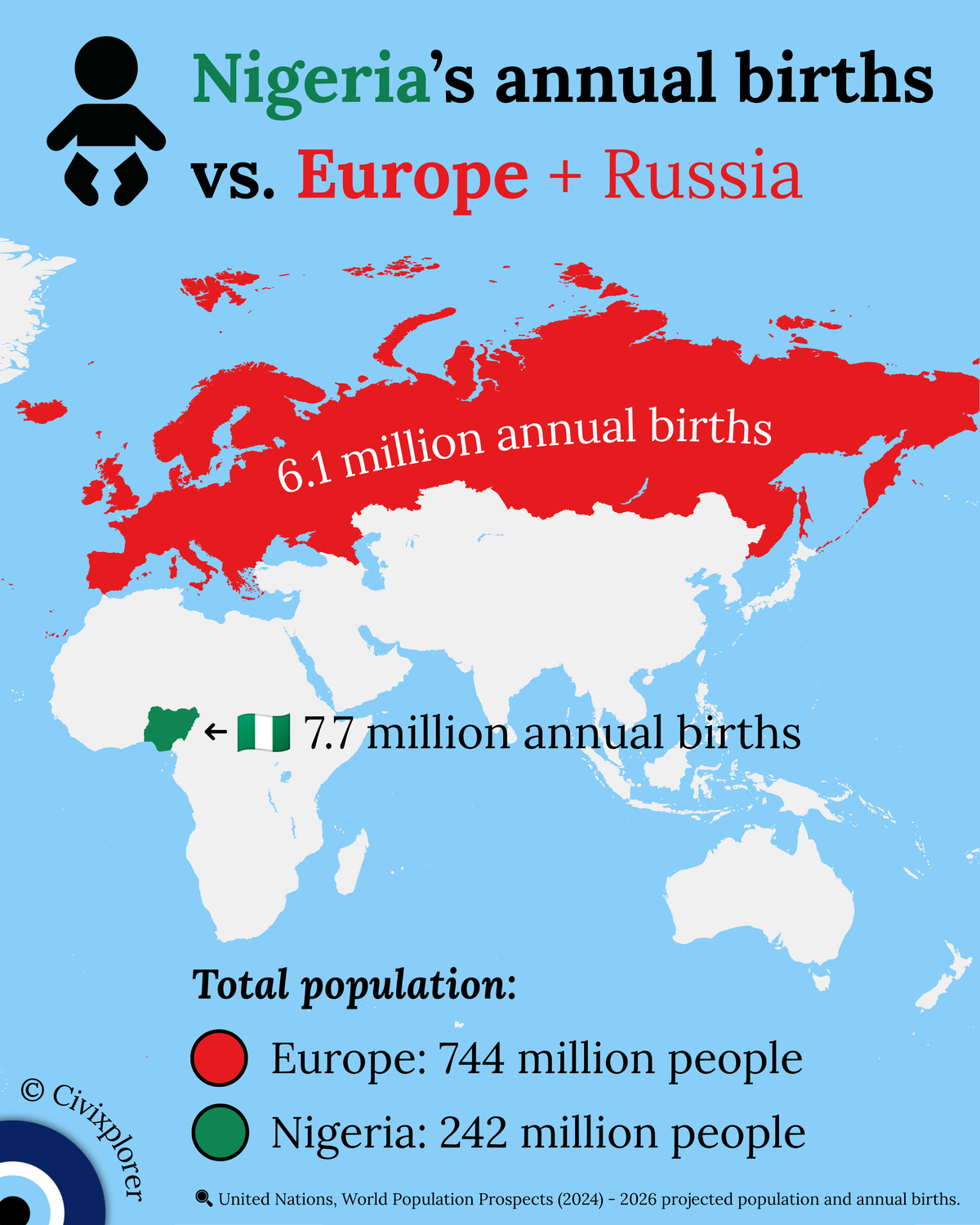
Recent international population data presents one of the most striking contrasts in modern demographics: the single West African nation of Nigeria is projected to welcome 7.7 million newborns per year, eclipsing the 6.1 million annual births projected across the entire continent of Europe and Russia combined. What makes this comparison so remarkable is the sheer difference in overall population size. Europe is home to roughly 744 million residents, whereas Nigeria's populace sits at approximately 242 million. Despite having less than a third of Europe's total population, Nigeria records roughly 1.57 million more births each year, signaling a profound divergence in global demographic trajectories.
At the heart of this divide is a dramatic contrast in fertility rates and overall birth volume. Under United Nations projections, Nigeria's total fertility rate stands at 4.20 children per woman, compared to just 1.41 across Europe. When measuring total output relative to population size through crude birth rates, Nigeria produces 31.8 births per 1,000 people every year, while Europe generates only 8.3 per 1,000. This means Nigeria's per-capita birth rate is nearly four times higher than Europe's, illustrating how deeply regional family formation patterns have diverged over recent decades.
Beyond individual family sizes, the primary engine behind this birth gap is population age structure and demographic momentum. Half of Nigeria's population is younger than the median age of 19.4 years, with 40.0% of the country under age 15. By contrast, Europe has a median age of 44.1 years, and 21.4% of its populace is 65 or older. Because Nigeria possesses a massive youth cohort continually entering their peak reproductive years, its absolute volume of births continues to grow even as national fertility rates gradually decline. Conversely, decades of sub-replacement fertility across Europe have structurally reduced its pool of prospective parents.
These contrasting age dynamics create very distinct long-term economic and societal consequences for both regions. In Europe, sustained low birth rates have resulted in natural population decline where deaths exceed births, placing increased reliance on net migration to stabilize workforces and support aging populations. For Nigeria, a booming youth population offers a powerful opportunity for a demographic dividend if matched with adequate investments in healthcare, education, and productive employment. At the same time, national averages conceal significant internal variation, as urban centers like Abuja report lower fertility rates while rural northern states remain significantly higher.


Comments (0)
Join the Conversation
Login to share your thoughts with the community.
Login to Comment