
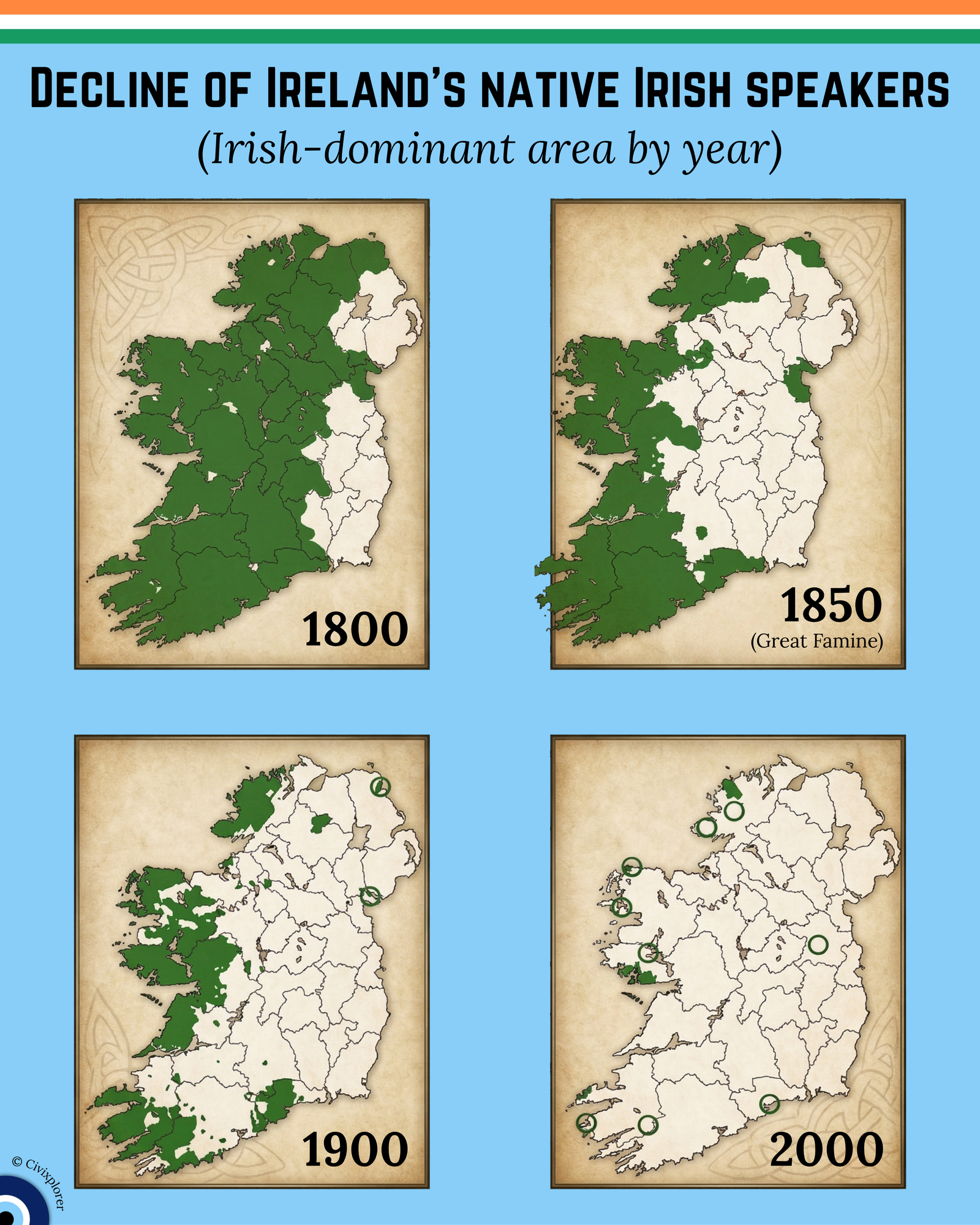
The geographic and demographic retreat of the native Irish language (Gaeilge) over the last two centuries is one of the most striking examples of linguistic transformation in Europe. In 1800, just before the Act of Union, Irish was the vibrant, everyday tongue for roughly two million people, dominating the rural landscapes of the west, south, and north. At this time, it was the primary community language for the majority of the island's population, particularly outside the eastern Leinster region where British administration was centered.
The collapse that followed was swift and devastating, driven by a combination of historical tragedies and institutional suppression. The Great Famine (1845–1852) served as the primary catalyst; it disproportionately affected the rural poor who were the language's core speakers. Within a single decade, over a million speakers died and another million emigrated, physically decimating the native-speaking population.
Institutional pressures further accelerated this shift even before the Famine's full impact. The introduction of the National School System in 1831 enforced an English-only curriculum where children were frequently punished—sometimes using "tally sticks"—for speaking Irish. Over time, English became synonymous with economic progress, social mobility, and survival in destination countries like the U.S., while Irish was stigmatized and associated with poverty and trauma.
By 1900, the language had plummeted to a minority status, held primarily by elderly populations in remote western pockets. Today, the map shows only the Gaeltacht—small, scattered districts along the western coast in places like Donegal, Galway, and Kerry where Irish remains a living community language. While the independent Irish state has made Irish an official language and mandatory in schools since 1922, these tiny enclaves represent the final remnants of a once-dominant cultural identity facing the pressures of a global English-dominated economy.
Comments (0)
Join the Conversation
Login to share your thoughts with the community.
Login to Comment