
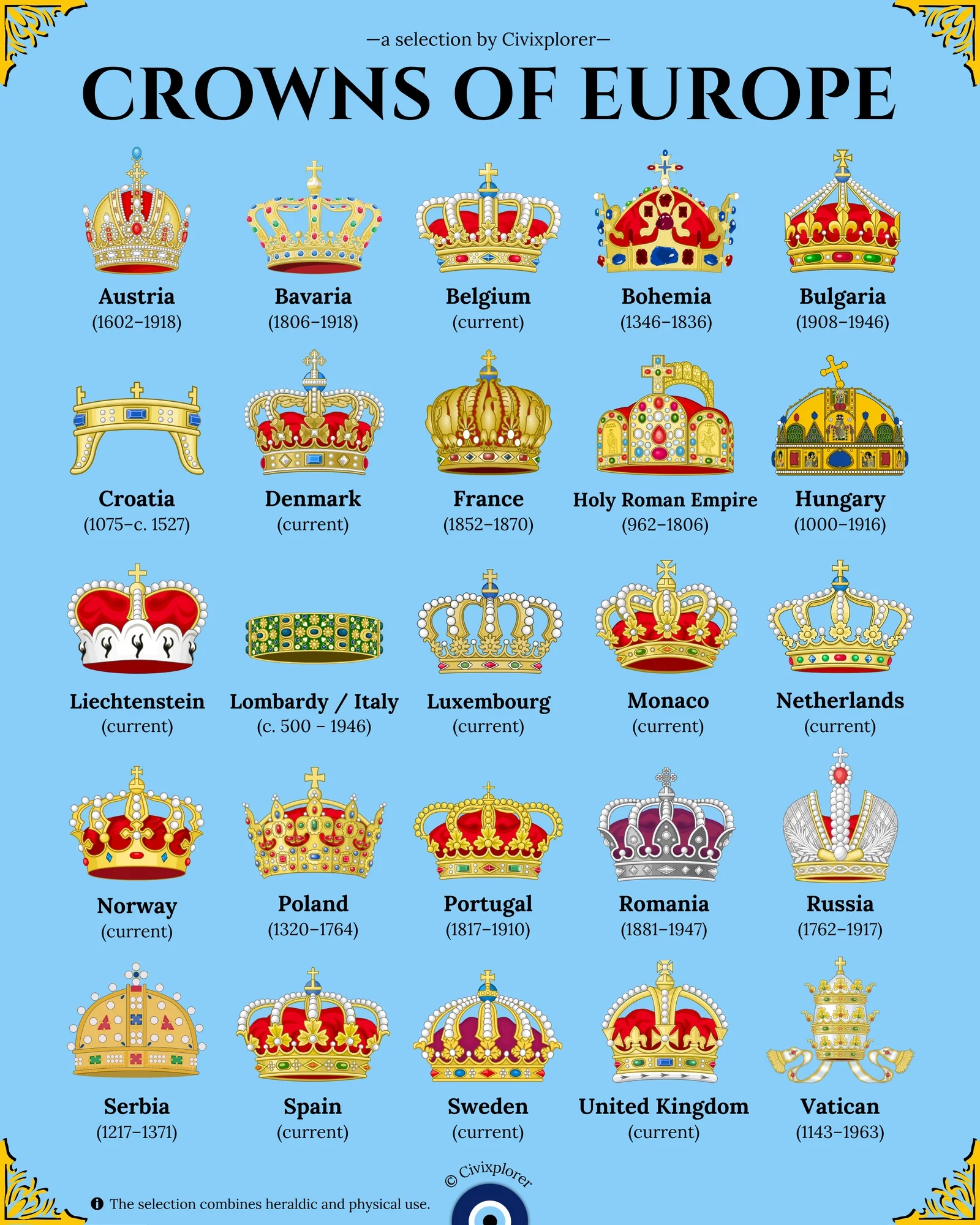
European crowns represent more than just wealth; they are complex symbols of power, divine right, and national identity. For instance, the Iron Crown of Lombardy is one of the world's oldest royal insignias, featuring a band of iron that legend claims was beaten from a Holy Nail of the True Cross. This storied object was used by legendary figures such as Charlemagne and Napoleon Bonaparte. Similarly, the octagonal crown of the Holy Roman Empire was designed with eight plates to evoke the walls of the "New Jerusalem," signaling that the Emperor was the protector of the Church rather than a purely secular ruler.
A fascinating detail in royal history is the distinction between "open" and "closed" crowns. During the Middle Ages, an open crown often implied the ruler was a vassal to a higher power. By the 16th century, kings began "closing" their crowns with arches to signal absolute sovereignty, essentially declaring they answered to no one but God.
The Vatican presents a unique case with the Triregnum, or Triple Tiara. This is not technically a crown but a three-layered symbol of the Pope's powers as Father of Kings, Governor of the World, and Vicar of Christ. It has not been used in a coronation since 1963, when Pope Paul VI set it aside as a gesture of humility.
It is also important to distinguish between heraldic symbols and physical reality. In nations like the Netherlands and Belgium, the crowns are largely heraldic; for example, the Dutch crown is never worn but sits on a cushion during ceremonies. Conversely, the United Kingdom’s St. Edward's Crown is a physical object used for the actual moment of coronation. Finally, the Holy Crown of Saint Stephen in Hungary is famous for its crooked cross, which was damaged in the 17th century and kept as a unique mark of its history.

Comments (0)
Join the Conversation
Login to share your thoughts with the community.
Login to Comment