
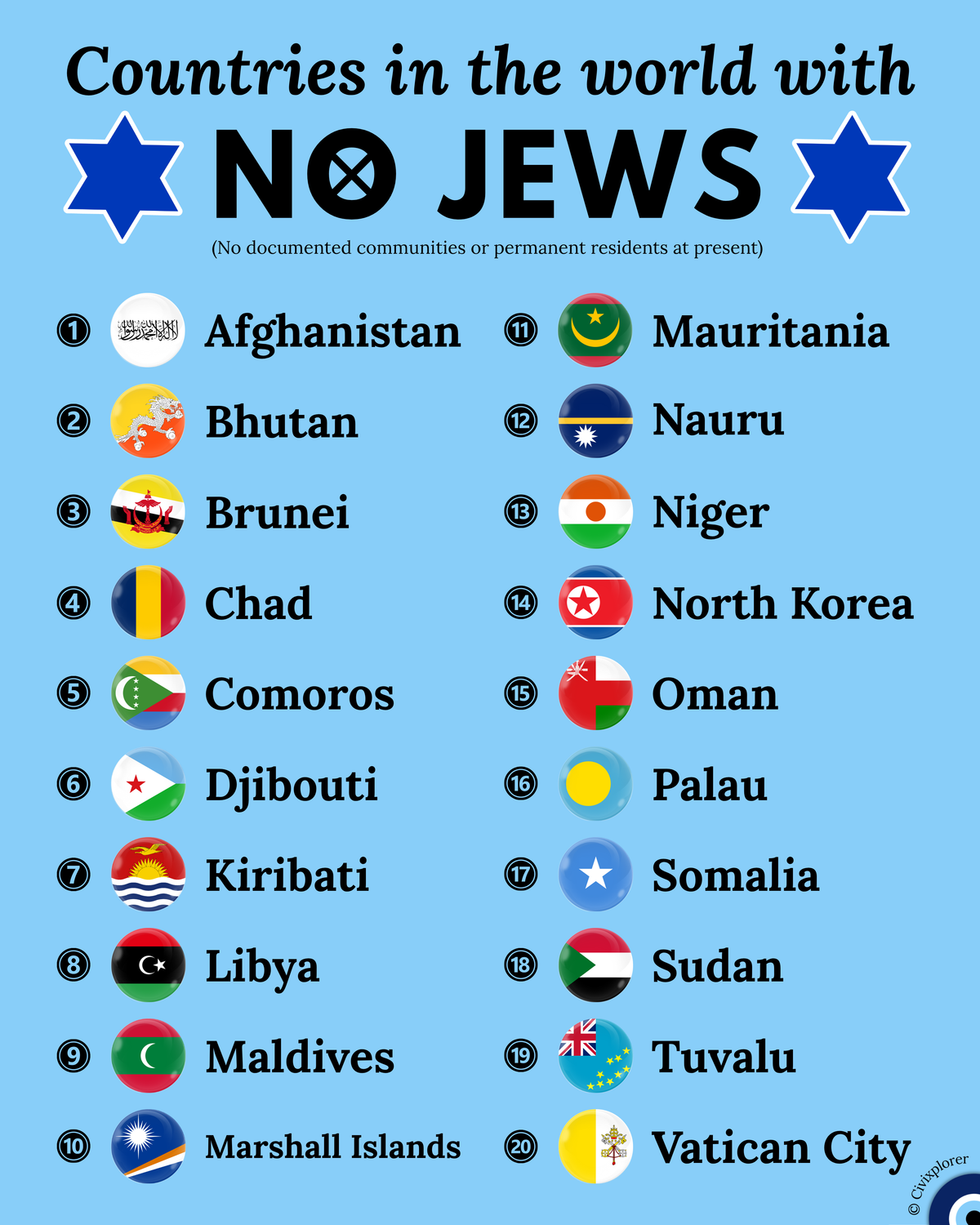
The global distribution of the Jewish diaspora has undergone a radical transformation over the last century. While Jewish life once flourished across nearly every corner of the Middle East, North Africa, and Central Asia, modern datasets identify sovereign states and territories that currently host no established Jewish communities or permanent residents. Understanding this "zero" requires looking past the simple number and analyzing the complex interplay of geopolitical conflict, constitutional law, and geographic isolation.
A vital distinction must be made. In our interconnected world, Jewish diplomats, UN staff, or tourists may temporarily visit or work in places like Oman or Somalia. However, these individuals do not constitute a self-sustaining demographic with civic infrastructure, such as synagogues, schools, or cemeteries. The countries on this list represent a total absence of permanent, multi-generational residency.
The Historical Exodus and 20th-Century Shifts
For many nations on this list, the absence of a Jewish population is the result of a completed demographic exit rather than a historical lack of presence. Countries like Libya, Afghanistan, and Sudan once hosted ancient and vibrant Jewish communities. Libya, for instance, had a diaspora population of roughly 38,000 before the mid-20th century. Following the establishment of the State of Israel in 1948, a series of anti-Jewish pogroms and the rise of local totalitarian regimes triggered massive waves of emigration. The departure of the last known Jews from Libya (2003) and Afghanistan (2021) marked the definitive end of thousands of years of continuous history in those regions.
Legal and Institutional Barriers
In other cases, the absence is driven by strict constitutional frameworks. The Maldives, while a popular global travel destination, maintains a 2008 Constitution that designates Sunni Islam as the state religion and limits citizenship to Muslims. This makes it legally impossible for a practicing Jew to obtain permanent residency. Similarly, Vatican City represents a unique institutional case. As an ecclesiastical city-state, its population consists almost entirely of Catholic clergy and staff, meaning its demographic structure inherently excludes a civilian Jewish community.
Geographic Isolation and Migration Routes
A significant portion of the list comprises remote Pacific microstates—such as Nauru, Tuvalu, and the Marshall Islands—and the Himalayan kingdom of Bhutan. The reason for "zero" here is often structural. Historical Jewish migratory routes, whether driven by trade or seeking refuge, followed specific paths through major urban commercial hubs and imperial networks. These isolated nations simply fell outside those traditional migration corridors. Without a historical catalyst for settlement, no established communities ever formed.
Finally, North Korea stands as a unique case of totalitarian isolation and data opacity. The state enforces strict ideology and heavily restricts foreign residency, making it a "data-blind" spot where no Jewish presence has ever been documented or permitted under current conditions. Together, these 20 nations provide a striking snapshot of how history and geography continue to shape the modern world map.

Comments (0)
Join the Conversation
Login to share your thoughts with the community.
Login to Comment