
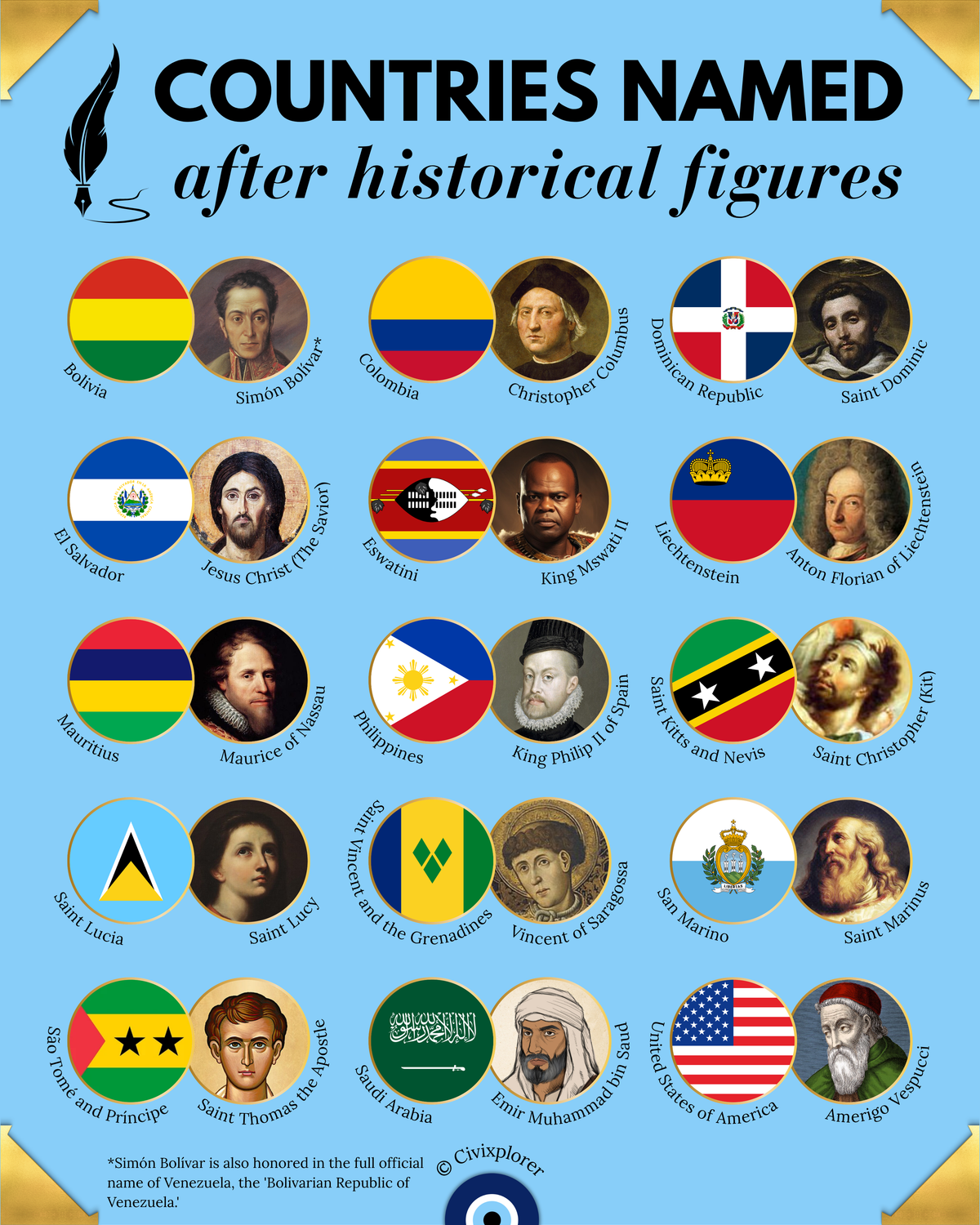
The study of place names, known as toponymy, offers a unique window into the forces that have shaped our modern world map. While most nations derive their names from ethnic groups, geographic landmarks, or ancient kingdoms, a rare and significant category exists: countries named after specific historical or religious figures. Naming a sovereign state after an individual is a heavy historical act, reflecting deep ties to colonialism, dynastic power, or the revolutionary struggle for independence.
The Power of Dynasties
In the modern era, it is exceedingly rare for a state to be named directly after a ruling family, yet two prominent examples remain. Saudi Arabia is named after the House of Saud, tracing back to Saud bin Muhammad Al Muqrin. Unlike most nations, this name explicitly identifies the polity as the possession of the dynasty. Similarly, the Principality of Liechtenstein bears the name of the House of Liechtenstein. This connection is unique, as the family originally took its name from a distant Austrian castle meaning "light stone" before the territory itself was granted to Prince Anton Florian in 1719.
Liberators and Explorers of the Americas
The nomenclature of the Americas reflects the turbulent transition from European conquest to sovereign independence. Bolivia stands as a direct homage to Simón Bolívar, the Venezuelan military leader who orchestrated the liberation of much of South America. It is one of the few instances where a country was named after a leader who was still alive to witness the honor.
Conversely, Colombia and the United States of America highlight the influence of cartographic publicity. Colombia honors Christopher Columbus, despite the fact that the explorer never actually set foot in the territory of the modern republic. The name was championed by revolutionaries like Francisco de Miranda as a symbol of a New World identity. The United States of America derives its name from Amerigo Vespucci, the Italian explorer who first recognized that the landmasses were a new continent rather than the outskirts of Asia.
The Saints and the Explorer’s Calendar
A significant cluster of eponymous countries, particularly in the Caribbean and Atlantic, stems from the Catholic calendar. During the age of maritime expansion, Spanish and Portuguese explorers lacked modern mapping tools and frequently named landfalls after the saint whose feast day coincided with their discovery. São Tomé and Príncipe (Saint Thomas), Saint Lucia (Saint Lucy), and Saint Vincent and the Grenadines (Vincent of Saragossa) all follow this tradition.
San Marino provides a fascinating outlier to this trend. Rather than being named by a colonial navigator, it is a microstate named after Saint Marinus, a stonemason who founded a monastic community in 301 AD to escape religious persecution. This makes it one of the world’s oldest surviving republics, named from the bottom up by its own tradition rather than external discovery.
Royal Tributes and Reclaimed Identities
Imperial history is preserved in names like the Philippines, named by explorer Ruy López de Villalobos in 1543 to honor Philip II of Spain, who was then the Crown Prince. While many nations shed their colonial titles upon independence, the Philippines retained this royal designation.
In contrast, Eswatini represents a modern move toward reclaiming indigenous identity. Formerly known as Swaziland—an anglicized version of the name of King Mswati II—the nation officially changed its name in 2018. King Mswati III restored the native form "Eswatini," meaning "Land of the Swazis," to honor the 19th-century king who unified the people while distancing the country from its colonial past and avoiding international confusion with Switzerland.
These names are more than just labels; they are historical artifacts that reveal the intersections of religious devotion, imperial ambition, and the enduring legacy of those who shaped the global landscape.

Comments (0)
Join the Conversation
Login to share your thoughts with the community.
Login to Comment