
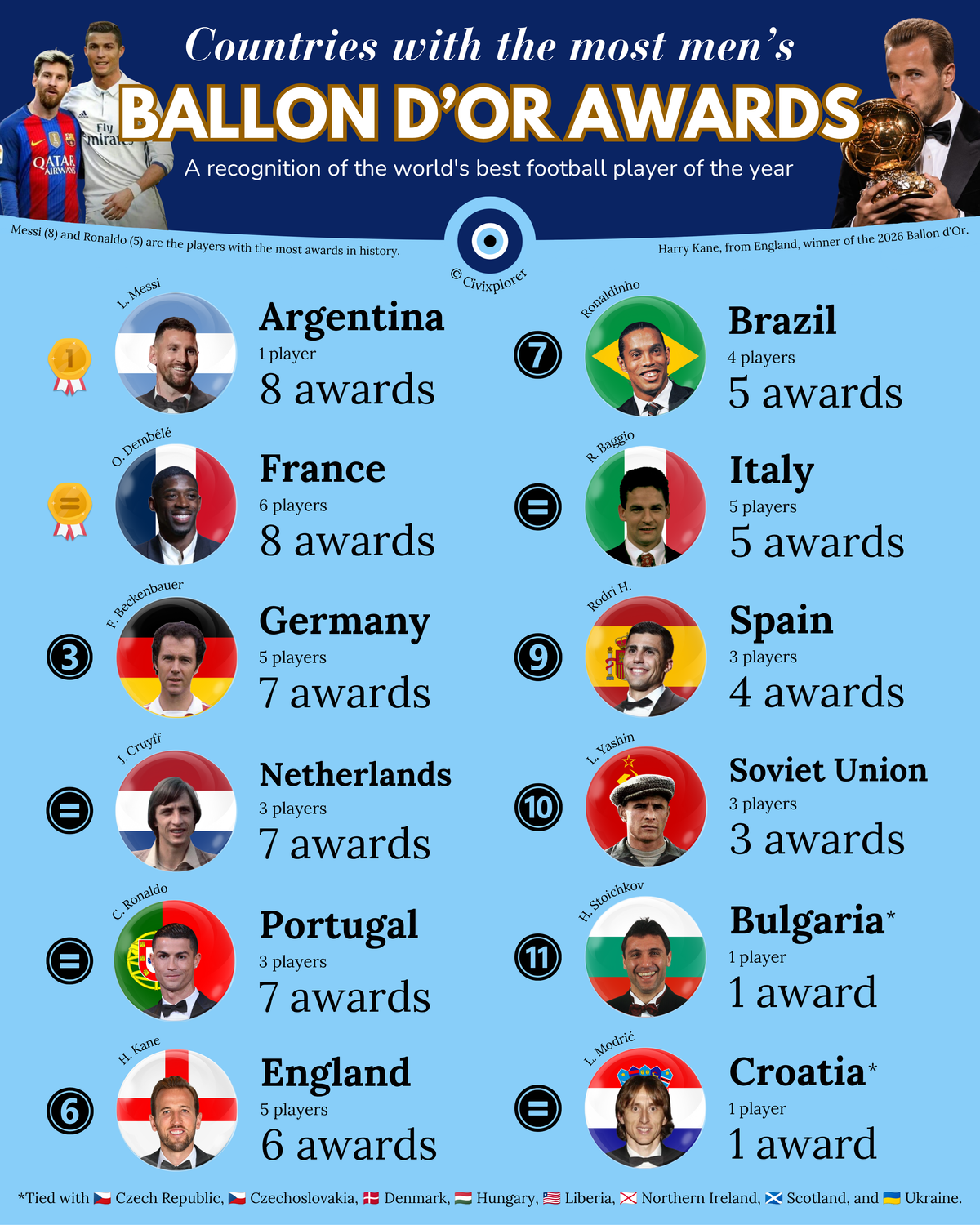
The historical distribution of the men's Ballon d'Or reveals a compelling balance between individual superstar dynasties and collective national depth. As of late 2026, Argentina and France stand tied at the top of the global standings with eight awards each. However, the path each country took to achieve this total couldn't be more distinct. Argentina's entire accumulation of eight trophies is concentrated in a single legendary player, Lionel Messi, who claimed titles in 2009, 2010, 2011, 2012, 2015, 2019, 2021, and 2023. In contrast, France's eight victories are distributed across six different players across several generations, including Raymond Kopa, Michel Platini, Jean-Pierre Papin, Zinédine Zidane, Karim Benzema, and Ousmane Dembélé.
Just behind the leaders, Germany, the Netherlands, and Portugal form the next tier with seven awards apiece. Germany's tally demonstrates broad, multi-generational strength across five distinct winners: Gerd Müller, Franz Beckenbauer, Karl-Heinz Rummenigge, Lothar Matthäus, and Matthias Sammer. Conversely, the Netherlands relies heavily on two three-time winners, Johan Cruyff and Marco van Basten, alongside Ruud Gullit. Portugal's position is similarly anchored by Cristiano Ronaldo, who accounts for five of the nation's seven trophies alongside Eusébio and Luís Figo. Meanwhile, England recently surged to six awards across five individual winners following Harry Kane's 2026 victory, which ended a 25-year wait for an English recipient since Michael Owen won in 2001. Further down the list, Brazil and Italy each hold five awards, with Italy standing out as the only major nation where all five honors were earned by five completely different players.
Understanding these national totals requires examining the evolution of voting criteria and eligibility rules since the award was established by France Football in 1956. From 1956 until 1994, the prize was restricted exclusively to European players, meaning iconic South American legends like Pelé and Diego Maradona were ineligible during their careers. The 1995 expansion to any player at a European club allowed George Weah of Liberia to become the first non-European winner, while global eligibility was finally introduced in 2007. Additionally, historical counting conventions and geopolitical shifts play a major role in how totals are categorized. For instance, Alfredo Di Stéfano and Omar Sívori, both born in Argentina, had their victories credited to Spain and Italy respectively after gaining European citizenship under early eligibility rules. Similarly, Cold War-era achievements split totals across historical entities like the Soviet Union and Czechoslovakia, reflecting how footballing history tracks closely alongside shifting political boundaries.

Comments (0)
Join the Conversation
Login to share your thoughts with the community.
Login to Comment