
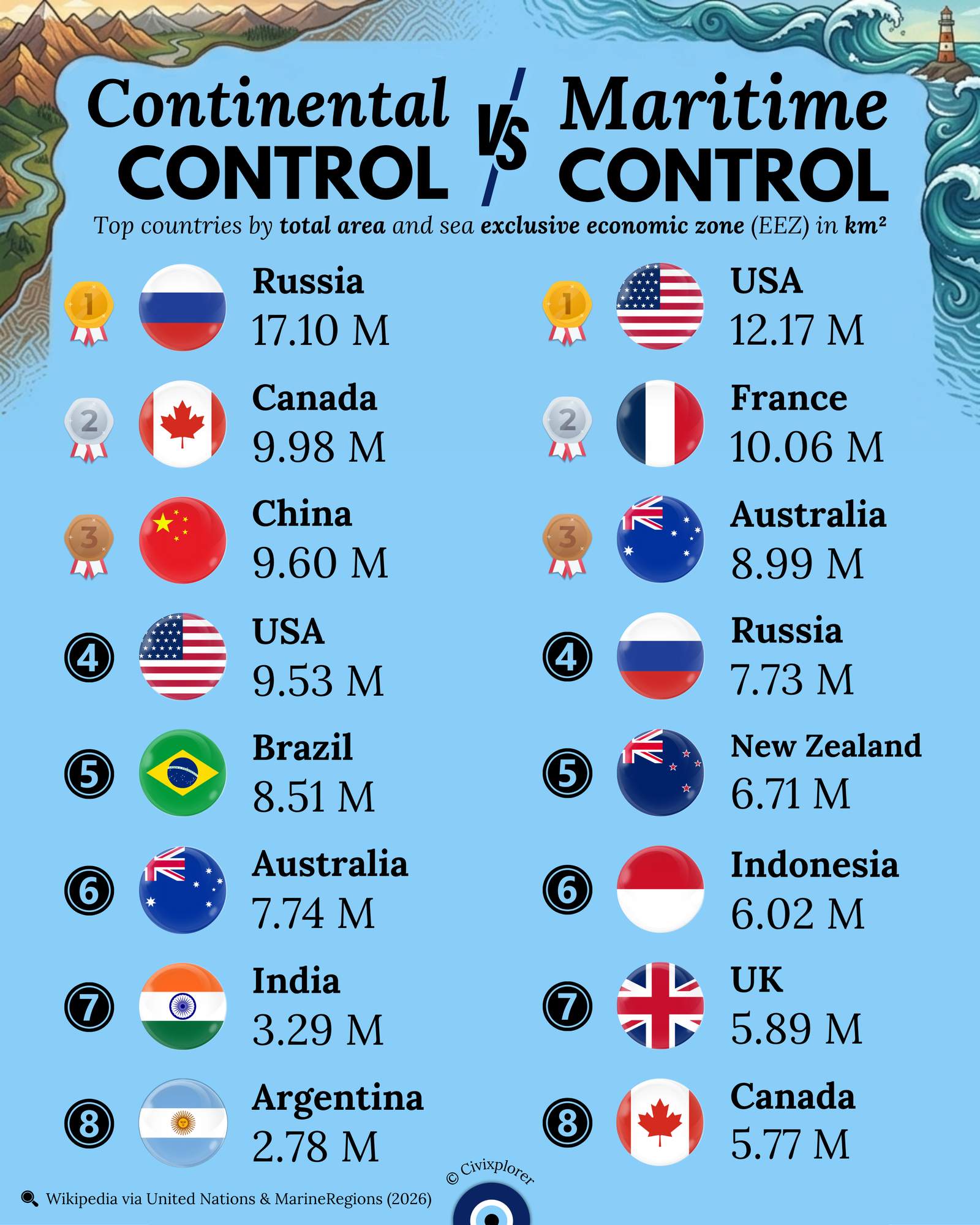
Geopolitics is often viewed through the lens of vast landmasses and "boots on the ground," but a nation's true reach extends far beyond its visible borders. This analysis explores the tension between Continental Control—defined by total (inland) area—and Maritime Control, measured by the Exclusive Economic Zone (EEZ). Under the 1982 UN Convention on the Law of the Sea, an EEZ grants a country rights to resources within 200 nautical miles of its coast, effectively turning scattered islands into vast oceanic empires.
The discrepancy between land and sea rankings is most visible in the cases of France and the United Kingdom. While neither cracks the top eight for continental landmass, France holds the #2 spot globally for maritime control, with over 10 million km² of ocean. This is a direct legacy of colonial history; remote territories like French Polynesia, New Caledonia, and Réunion allow Paris to project influence across every major ocean basin except the Arctic. Similarly, the UK’s maritime rank at #7 is bolstered by far-flung claims like the Falkland Islands.
In contrast, the United States stands as a unique dual-power player, maintaining the #1 spot in maritime control while ranking #4 in land area. Its dominance is driven by a massive continental coastline, particularly in Alaska, combined with a network of Pacific and Caribbean territories such as Hawaii and Guam.
Geography also plays a decisive role for isolated island nations. New Zealand (#5 maritime) and Australia (#3 maritime) punch far above their weight because they are surrounded by open oceans. Unlike countries in congested regions, these nations can project their borders outward into the Pacific and Southern Oceans relatively unobstructed.
Conversely, continental giants like China and India face significant geographic "bottlenecks." Despite their massive land footprints, their maritime reach is constrained by overlapping claims in crowded waters like the South China Sea. This geographic reality heavily contextualizes modern tensions and the strategic race for resources in the 21st century.
Comments (0)
Join the Conversation
Login to share your thoughts with the community.
Login to Comment