
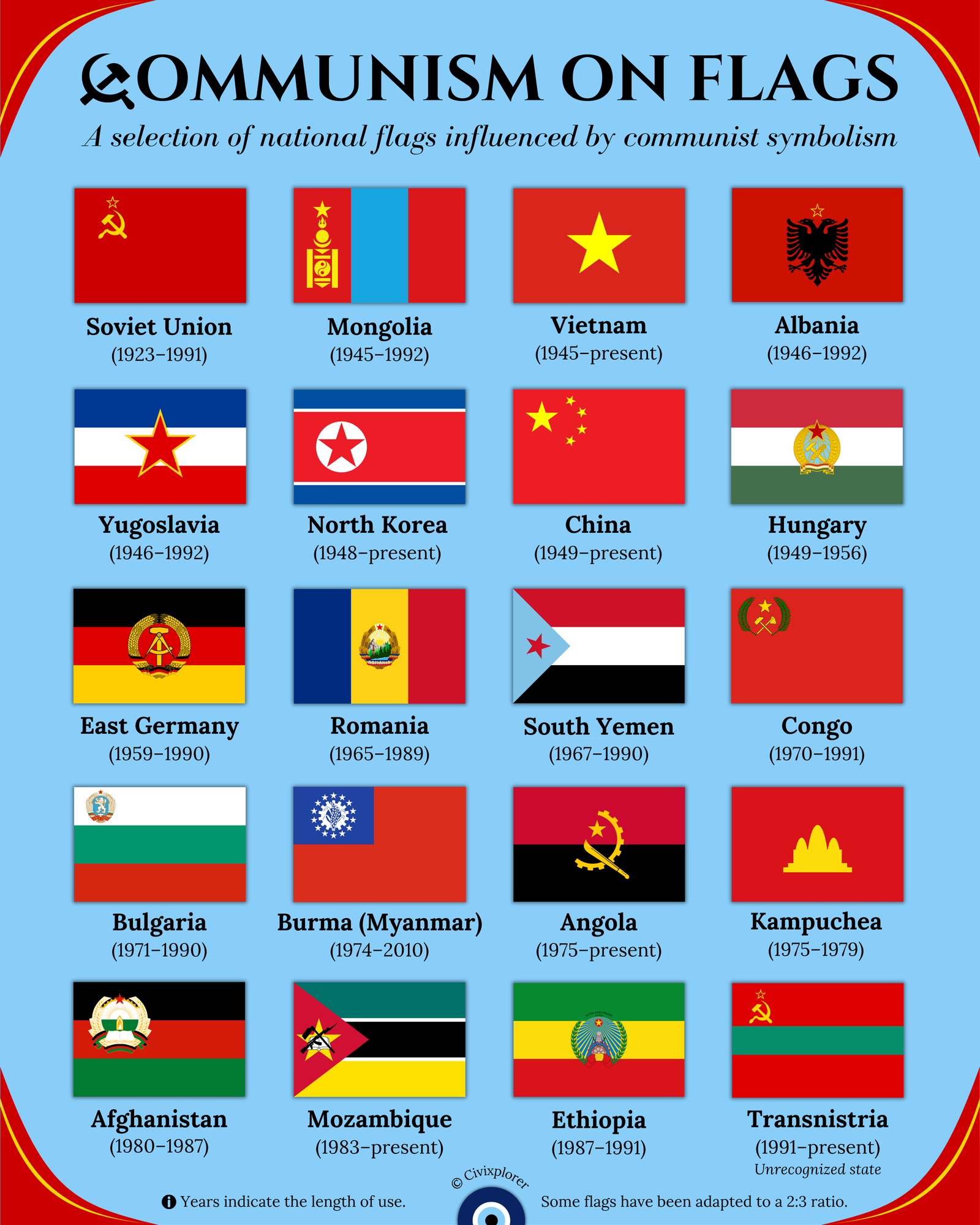
The visual branding of communist states was highly intentional, designed to instantly communicate ideological alignment, class solidarity, and revolutionary struggle. From the early Soviet era through the Cold War, a specific set of symbols—originating almost entirely from the Bolshevik Revolution—spread across the globe, often blending with local motifs to create unique national identities.
The Foundation: The Power of Red
The most striking element across nearly all Marxist-Leninist flags is the heavy use of the color red. Long before the Soviet Union, the red flag was a symbol of defiance, popularized during the French Revolution and the 1871 Paris Commune. In communist iconography, red represents the blood spilled by the working class in their struggle against capitalism and imperialism. Flags like those of the Soviet Union, China, Vietnam, and Kampuchea used red as their dominant field, making their ideological stance unmistakable.
The Core Symbols: Hammer, Sickle, and Star
The hammer and sickle remains the quintessential emblem of the movement. Formalized on the Soviet flag in 1924, the hammer represents industrial workers (the urban proletariat) while the sickle represents agricultural peasants. Together, they symbolize an unbreakable alliance between the two classes.
The five-pointed star is equally ubiquitous. It often represented the Communist Party as a "guiding light" toward a socialist future. In other contexts, the five points symbolized global solidarity across the five inhabited continents. In the case of China, the large star represents the Party, while the four smaller stars represent the four social classes defined by Mao Zedong: the working class, the peasantry, the urban petite bourgeoisie, and the national bourgeoisie.
Localized Adaptations and Tropicalization
What makes this history fascinating is how nations adapted the rigid Soviet template to fit their own socio-economic realities. East Germany (GDR) added a compass to its state emblem to represent the intelligentsia, sitting alongside the hammer and rye.
In Africa, during the 1970s decolonization wave, symbols were "tropicalized." Angola replaced the sickle with a machete, while Mozambique famously included an AK-47 assault rifle on its flag to represent defense, vigilance, and the armed struggle for independence. Meanwhile, Kampuchea under the Khmer Rouge rejected traditional tools in favor of a stylized silhouette of Angkor Wat, leaning into ethno-nationalism.
The Rise and Fall of the Global Bloc
The timeline of these flags mirrors the geopolitical shifts of the 20th century. A massive wave of new designs appeared between 1945 and 1949 as Soviet influence expanded across Eastern Europe and revolutions succeeded in Asia. Conversely, the collapse of these regimes between 1989 and 1992 led to a rapid reversion to historical, pre-communist designs.
Today, a few "survivors" like Vietnam, China, and North Korea still fly their original socialist flags. A unique anomaly exists in Transnistria, an unrecognized breakaway state of Moldova that still uses the traditional hammer and sickle, serving as a living relic of Soviet heraldry.
Comments (0)
Join the Conversation
Login to share your thoughts with the community.
Login to Comment