
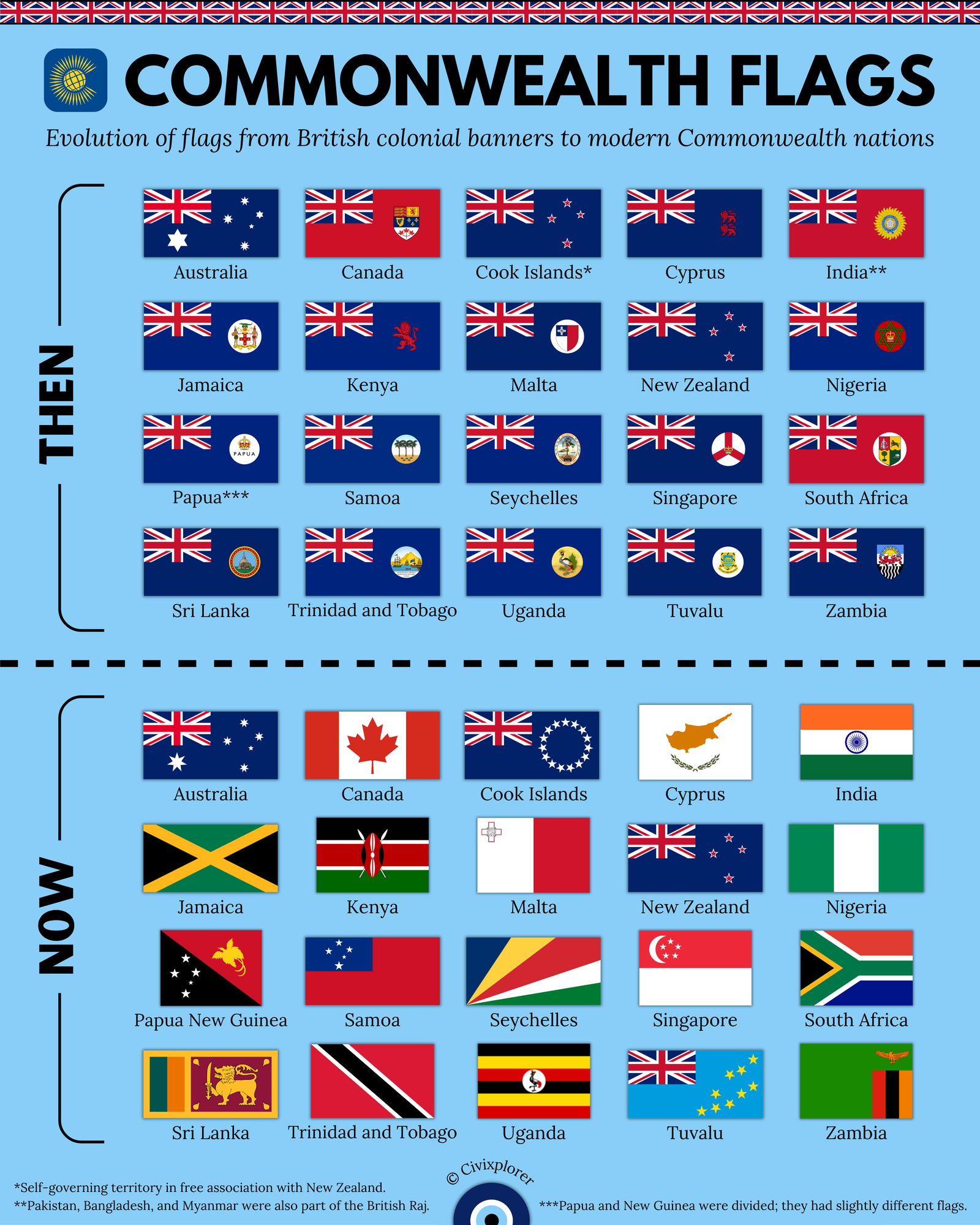
The transition from the British Empire to the modern Commonwealth of Nations is one of the most significant shifts in modern history, and perhaps nowhere is this more visually evident than in the evolution of national flags. At its peak, the British Empire controlled approximately one-fifth of the world’s land surface. To maintain a sense of uniform power, the Empire utilized a standardized maritime flag system, resulting in "defaced" Blue or Red Ensigns across its territories. These historical flags featured the Union Jack in the canton, with a localized badge or shield placed in the fly, reinforcing the message that ultimate authority resided in London.
The journey toward independence was marked by key legal milestones, such as the 1931 Statute of Westminster, which granted legislative independence to self-governing dominions. The definitive shift occurred with the 1949 London Declaration, which allowed nations to remain in the Commonwealth as republics, recognizing the British monarch only as a symbolic head. This allowed the association to evolve into a voluntary group of 56 sovereign member states united by shared goals rather than imperial subordination.
In the "NOW" section of this visual history, we see how diverse nations chose to represent their new identities. Some countries, including Australia, New Zealand, and Tuvalu, elected to retain the Union Jack. This choice reflects their continued status as constitutional monarchies and their historical ties to the British Crown. Other nations underwent famous debates to redefine themselves; Canada, for instance, replaced the Canadian Red Ensign with the iconic Maple Leaf in 1965 to create a symbol distinct from its colonial origins.
Across Africa and the Caribbean, decolonization often led to radical visual breaks from the past. Nations like Jamaica, Kenya, and Uganda abandoned the ensign system entirely in favor of designs rich in local symbolism. Kenya’s flag prominently features a traditional Maasai shield and spears, symbolizing the defense of freedom, while Jamaica adopted a bold diagonal cross with colors representing the sun, the land, and historical hardships.
Other flags serve as unique diplomatic tools. The modern flag of Cyprus was intentionally designed to be neutral, featuring a copper-colored map of the island and olive branches to encourage peace between its Greek and Turkish communities. Similarly, South Africa’s "rainbow" flag, adopted in 1994, was designed to symbolize reconciliation and unity following the end of apartheid. These visual records highlight a pivotal arc from a world of imposed uniformity to a Commonwealth of diverse, self-determined nations.
Comments (0)
Join the Conversation
Login to share your thoughts with the community.
Login to Comment