
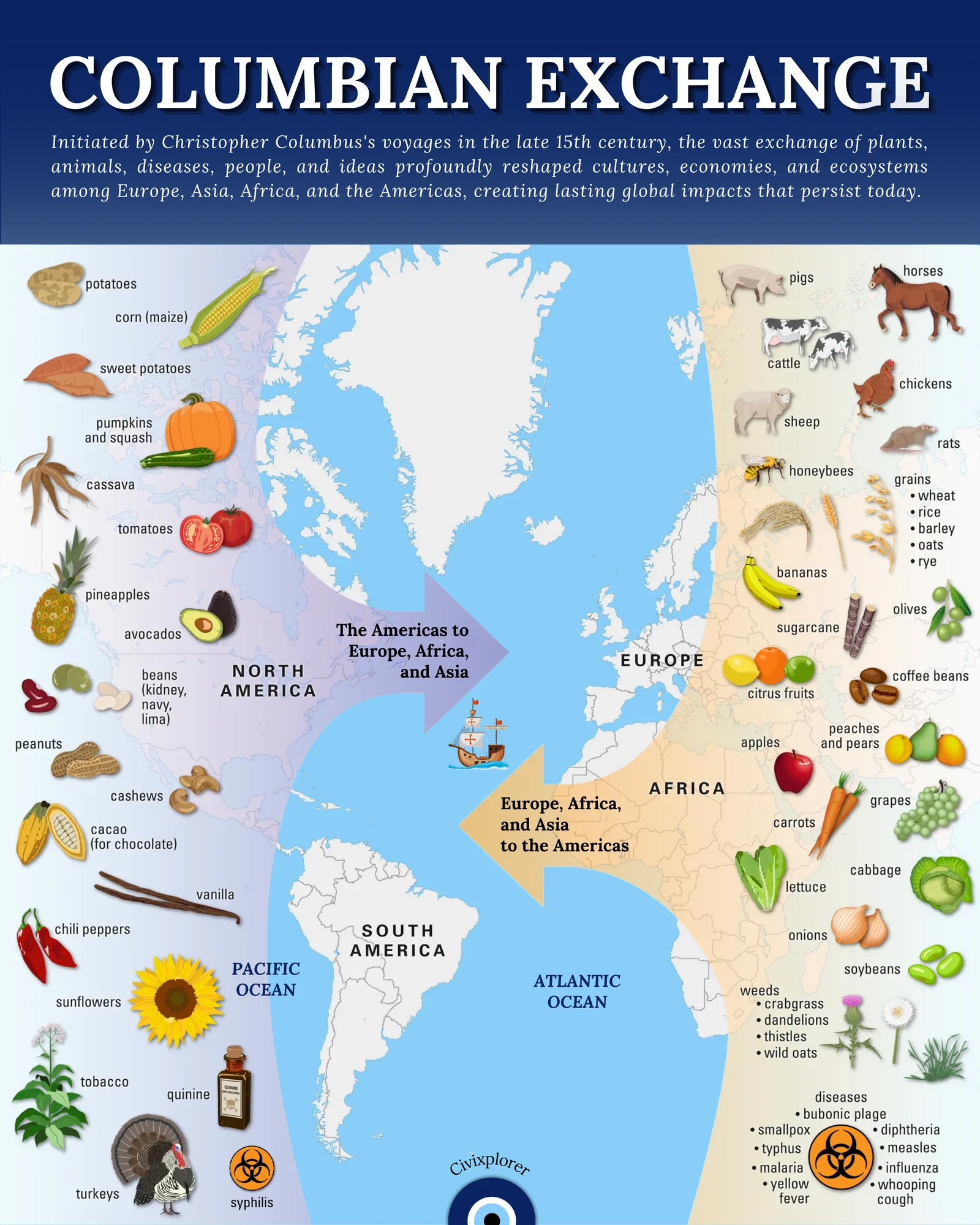
The Columbian Exchange, beginning after Christopher Columbus's 1492 voyage, marked a transformative period in history, reshaping ecosystems, societies, and economies. Through exploration, trade, and colonization, plants, animals, and diseases were exchanged between the Americas, Europe, Africa, and Asia.
The impact was profound—crops like potatoes and maize, originally from the Americas, became staples across continents, transforming diets and fueling population growth. Potatoes, for instance, played a crucial role in Europe’s population boom and industrial expansion, while maize provided a drought-resistant food source that supported the growth of states and trade networks, especially in Africa. One of the most remarkable transfers was the introduction of horses to the Americas. These animals reshaped Indigenous cultures, especially for the Plains Indians, enhancing mobility, hunting, and warfare.
On the flip side, multiple diseases like smallpox and measles really decimated native populations of the Americas, while syphilis traveled the other way to Europe. Despite the devastating consequences, this exchange also had positive impacts, such as the introduction of quinine, which helped combat malaria and allowed for European expansion into tropical regions.
This fascinating period of exchange not only shaped global economies but also transformed cuisines, with foods like chocolate from cacao becoming universal delights.
Comments (0)
Join the Conversation
Login to share your thoughts with the community.
Login to Comment