
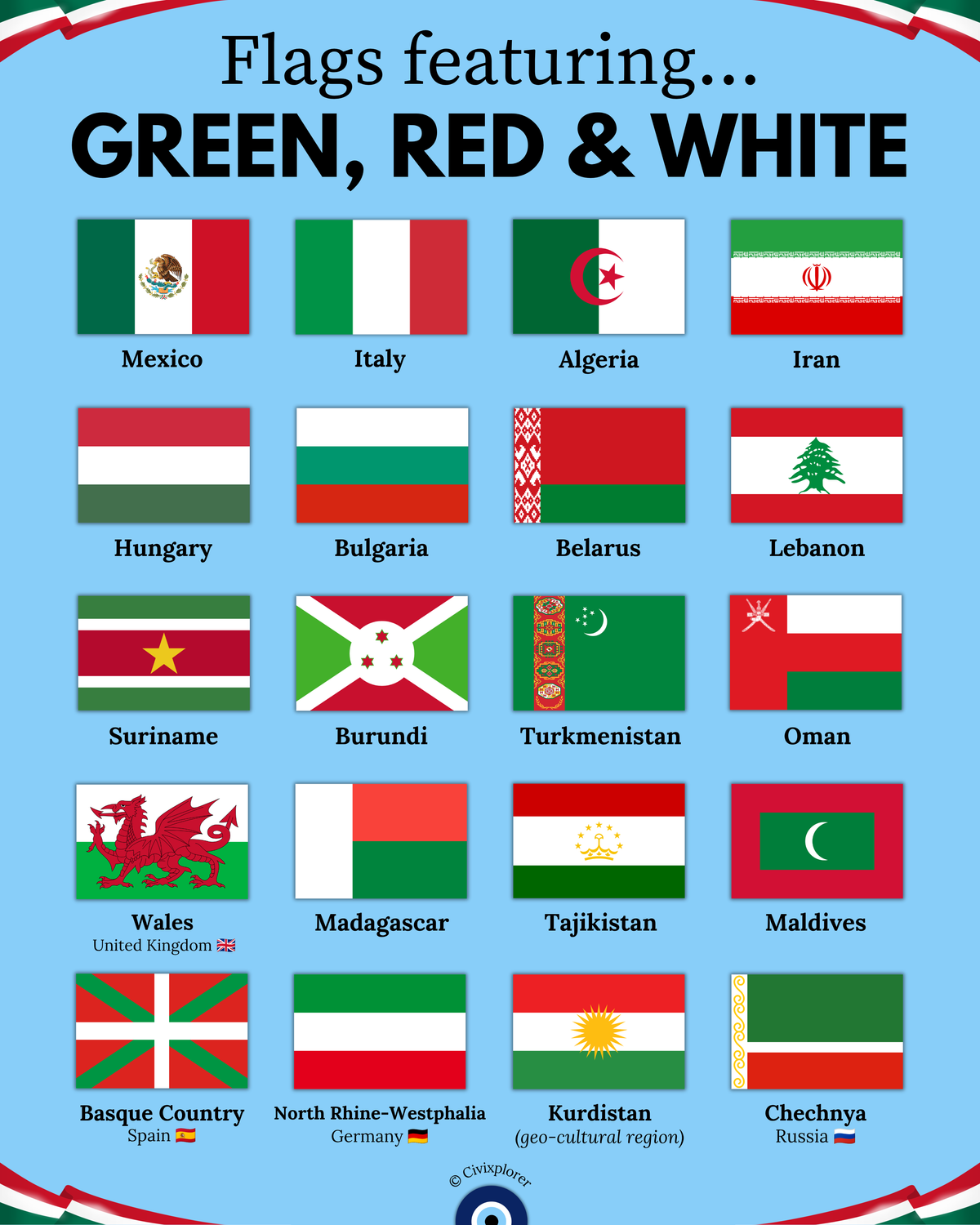
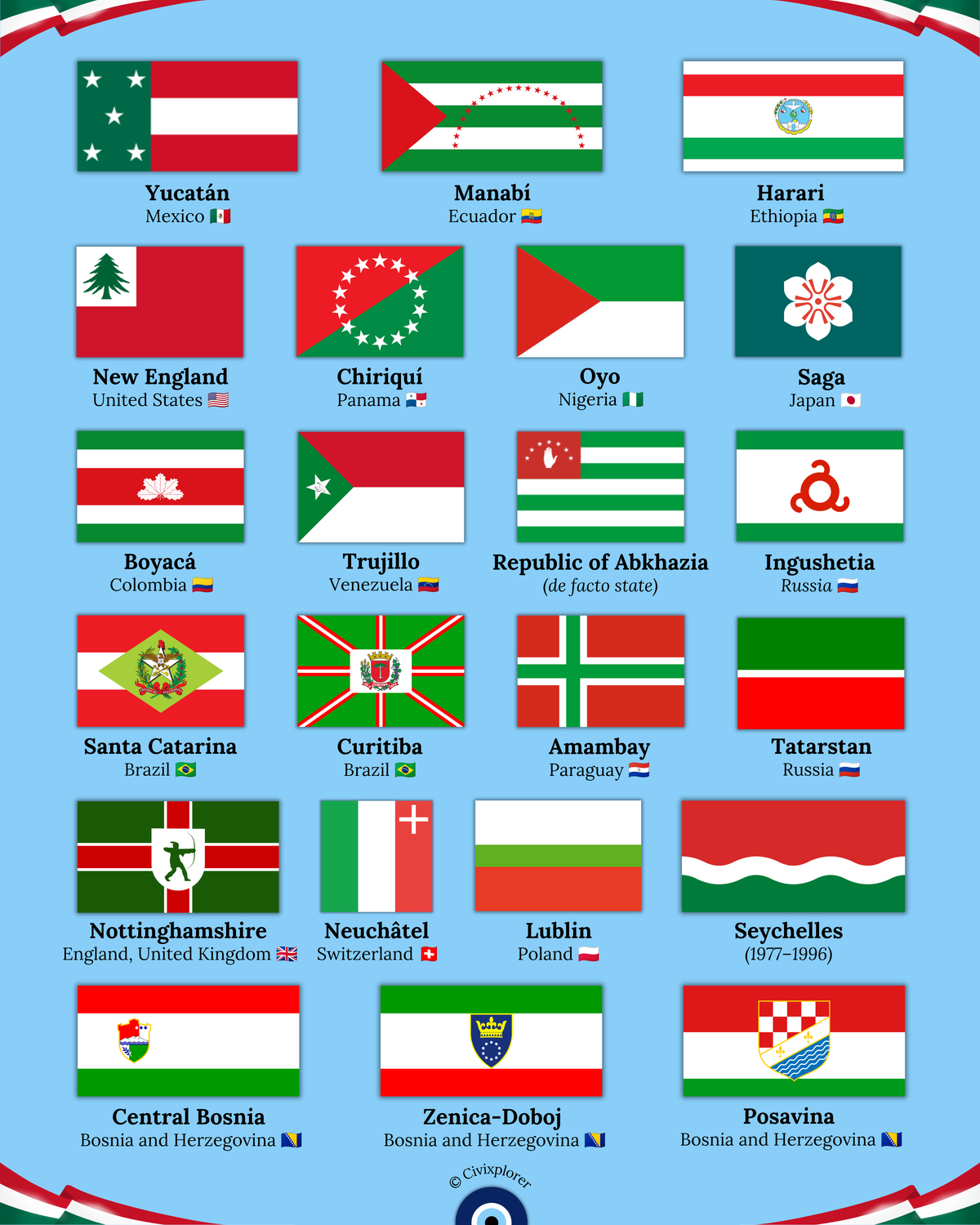
Vexillology is a global visual language, and few color palettes are as widely recognized yet culturally diverse as the combination of green, red, and white. From the national flags of sovereign states to the proud emblems of historical regions and de facto territories, this triad of colors has been adapted across every continent to tell unique stories of human experience.
While these flags belong to the same visual family, there is actually no single, universal meaning behind their colors. Instead, their designs represent a complex tapestry of revolution, independence, religious faith, and local identity. Broadly speaking, green conventionally evokes the richness of nature, agriculture, hope, or spiritual traditions like Islam; red represents bravery, strength, and the sacrifices made for liberty; while white is the global symbol of peace, purity, and unity.
The Global Giants: National Tricolors and Their Origins
Several of the world's most famous national flags utilize this striking combination, each carrying its own distinct historical weight.
- Italy: The iconic vertical green-white-red tricolor, known as Il Tricolore, traces its roots to the late 1790s during the Napoleonic era. The colors originally drew from the uniforms of the Lombard Legion, featuring green from Milanese civic guard coats and white and red from the historic coat of arms of Milan. It eventually became the rallying symbol of Italian unification, the Risorgimento, in the 19th century. While popular modern stories link the colors to Italy’s green plains, the snowy Alps, and the blood of patriots, these are secondary to the flag's revolutionary and regional origins.
- Mexico: The Mexican flag is a masterclass in combining modern republican design with ancient history. Officially originating in 1821 with the Army of the Three Guarantees, the colors initially represented independence (green), the Catholic religion (white), and the union between Europeans and Americans (red). Following secularization under Benito Juárez, these meanings evolved to symbolize hope, unity, and the blood of national heroes. What makes Mexico's flag truly unique is its central emblem: an eagle perched on a cactus devouring a serpent, a symbol originating from the Mexica (Aztec) foundation legend of Tenochtitlan.
- Hungary: This horizontal red-white-green flag has roots in medieval Hungarian heraldry, combining the historic red-and-white Árpád stripes with green elements found on royal seals. The modern tricolor arrangement was formalized during the Hungarian Revolution of 1848 as a direct challenge to Habsburg rule. Historically, red stands for strength, white for faithfulness, and green for hope.
- Iran: The Persian identity has been intertwined with green, white, and red for centuries, with the tricolor layout first established in 1906. Following the 1979 revolution, the central Lion and Sun emblem was replaced by a stylized red tulip representing the word "Allah". To reflect the date of the revolution, the phrase "Allahu Akbar" (God is Great) is written 22 times in Kufic script along the borders. In this context, green represents Islam, growth, and prosperity; white signifies peace; and red denotes courage and martyrdom.
European Republicanism and Regional Identity
Beyond sovereign nations, the green-red-white palette serves as a powerful medium for subnational groups and regional independence movements.
- The Basque Country: The Basque national banner, known as the Ikurriña, was designed in 1894 by the Arana brothers. Each element carries a specific, localized meaning: the vibrant red background represents the Basque people, the green saltire (Saint Andrew's cross) represents the historic Oak of Guernica and regional liberties (fueros), and the white cross represents the Catholic faith.
- Neuchâtel: At first glance, the flag of this Swiss canton looks remarkably like the Italian flag with a small white cross added to the fly. However, this flag evolved entirely independently. Adopted in 1848, the vertical tricolor was created to celebrate Neuchâtel's republican revolution and signal its permanent detachment from Prussian monarchical control. It serves as a reminder that visual similarities in flags do not always equal cultural or historical connections.
- Wales: Wales stands out with its legendary red dragon (Y Ddraig Goch) placed over a horizontal field of green and white. While the dragon has deep roots in Celtic mythology and Romano-British standards, the green-and-white field represents the Tudor livery colors flown by Henry VII at the Battle of Bosworth Field in 1485.
Unique Historical and De Facto Flags
Vexillology is also filled with flags from transitional historical eras and territories with complex political statuses.
- New England: Though not an official modern regional flag, the historical New England "Pine Tree" flag is legendary. Used during the American Revolution, it featured a white field with a green pine tree, a symbol of local natural resources and defiant resistance against British maritime authority. The pine tree became a rallying point after the Pine Tree Riot of 1772, representing a Lockean appeal to heaven and the right of revolution.
- Seychelles (1977–1996): Prior to its current radiating design, Seychelles utilized a striking red-over-green flag divided by a wavy white stripe. This design reflected the political colors of the ruling Seychelles People's United Party following a 1977 coup. It was eventually retired in 1996 as the nation transitioned toward a multi-party democracy.
- The Republic of Abkhazia: A de facto state in the Caucasus, Abkhazia uses a flag featuring seven alternating green and white horizontal stripes, representing religious tolerance. Its red canton houses a white open hand, a traditional symbol of hospitality and peaceful welcome to friends, alongside seven stars representing the seven historical regions of the territory.
A Global Visual Language
From the subnational heraldry of Bosnian cantons like Central Bosnia and Posavina to Latin American regions like Manabí in Ecuador, the green, red, and white color scheme continues to capture the imagination of communities worldwide. These colors are far more than mere decorations—they are a versatile canvas where different societies repeatedly write their own unique histories of sacrifice, faith, and hope.

Comments (0)
Join the Conversation
Login to share your thoughts with the community.
Login to Comment