
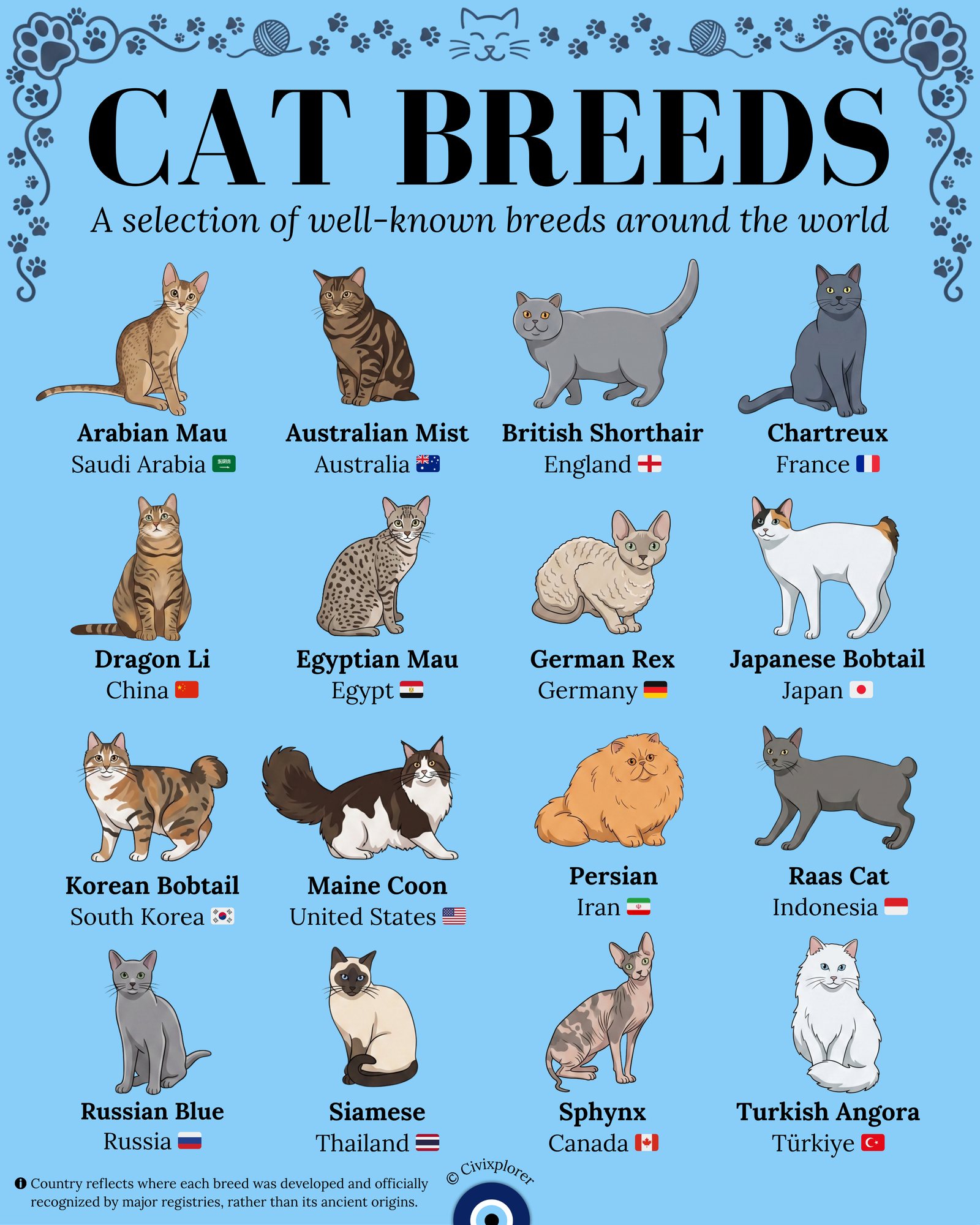
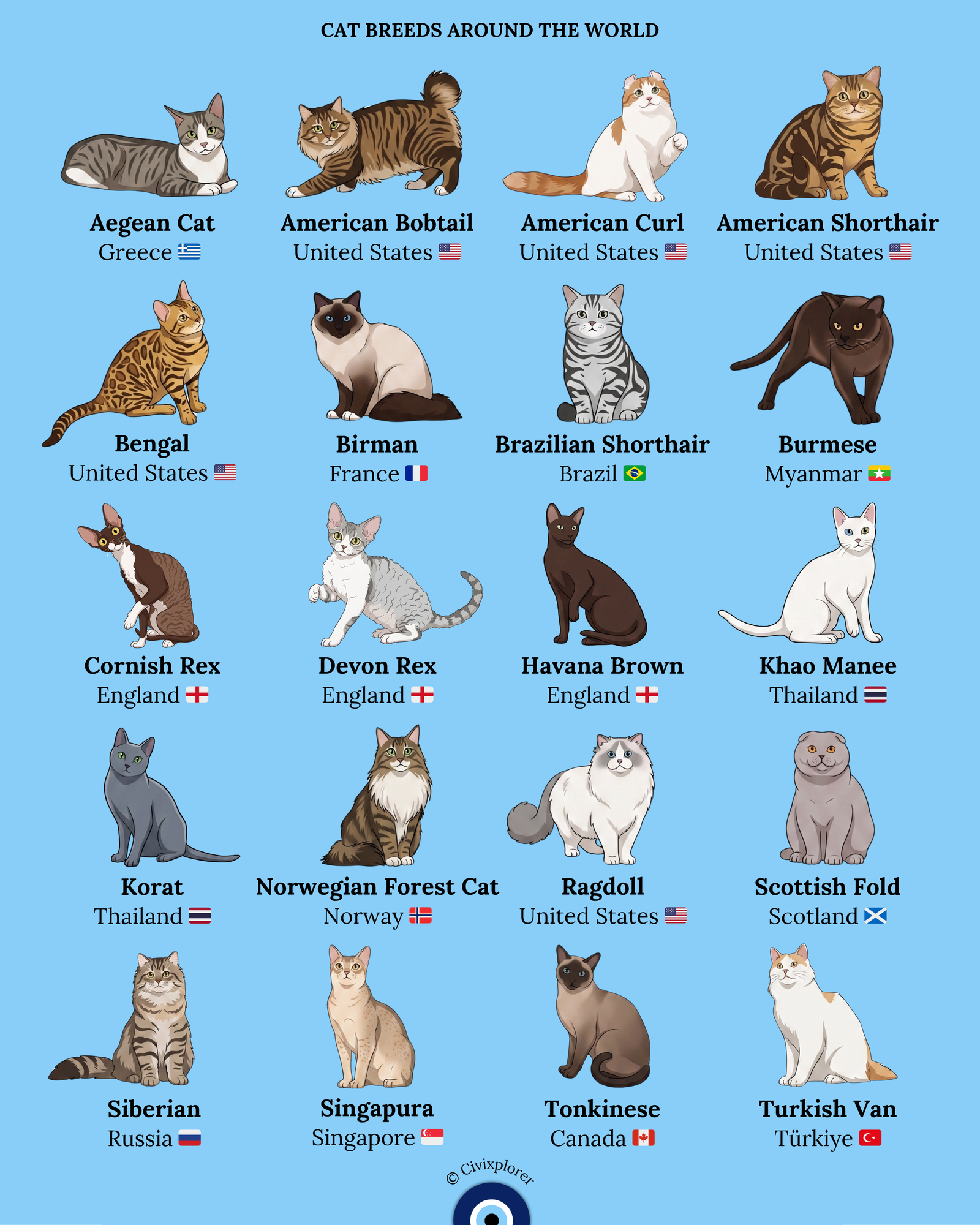
While domestic cats have shared our homes for nearly 10,000 years, the diversity of breeds we see today is a result of a complex interplay between natural evolution and human intervention. From the rugged mountains of Siberia to the royal palaces of Thailand, every feline carries a genetic map of its ancestral home.
The Deception of Names
One of the most intriguing aspects of feline history is how names can be geographically misleading. The Sphynx, for example, evokes the ancient monuments of Egypt but actually originated in Toronto, Canada, in 1966 due to a spontaneous genetic mutation. Similarly, the Havana Brown was meticulously developed in England, named only for the tobacco-like hue of its coat, while the Birman, often called the "Sacred Cat of Burma," was formally recognized and standardized in France.
Natural Adaptation and Landraces
In contrast to human-developed varieties, some breeds are "landraces"—cats that evolved naturally to survive specific environments. The Maine Coon (USA), Norwegian Forest Cat (Norway), and Siberian (Russia) all exhibit convergent evolution. To survive brutal winters, these breeds independently developed massive frames, water-resistant double coats, and tufted "snowshoe" paws.
In warmer climates, nature took a different path. The Egyptian Mau is notable as the only naturally spotted domestic cat, descending from the felines revered in ancient Egyptian art. In Southeast Asia, the Khao Manee and Siamese are deeply rooted in Thai heritage, with descriptions appearing in manuscripts dating back to the Ayutthaya Kingdom. These "White Gems" were once kept exclusively by royalty, representing a living link to the region's historical past.
The Era of Modern Hybrids and Mutations
The 20th century saw a surge in selective breeding, particularly in the United States, which became a hub for "novelty" breeds. The Bengal was created by crossing domestic cats with the wild Asian Leopard Cat to achieve a jungle aesthetic. Meanwhile, other breeds arose from singular, lucky encounters with nature's quirks, such as the American Curl, which traces back to a single stray in California with a unique ear mutation.
Preserving Rare Heritage
Beyond the famous faces are rare, localized breeds that serve as biological treasures. The Raas Cat of Indonesia is an endemic landrace from a single isolated island, while the Dragon Li (or Li Hua) is considered the "national cat" of China, tracing its roots to ancient mountain cats. These breeds offer a reminder that behind every infographic lies centuries of migration, isolation, and the enduring bond between humans and their feline companions.
Comments (0)
Join the Conversation
Login to share your thoughts with the community.
Login to Comment