
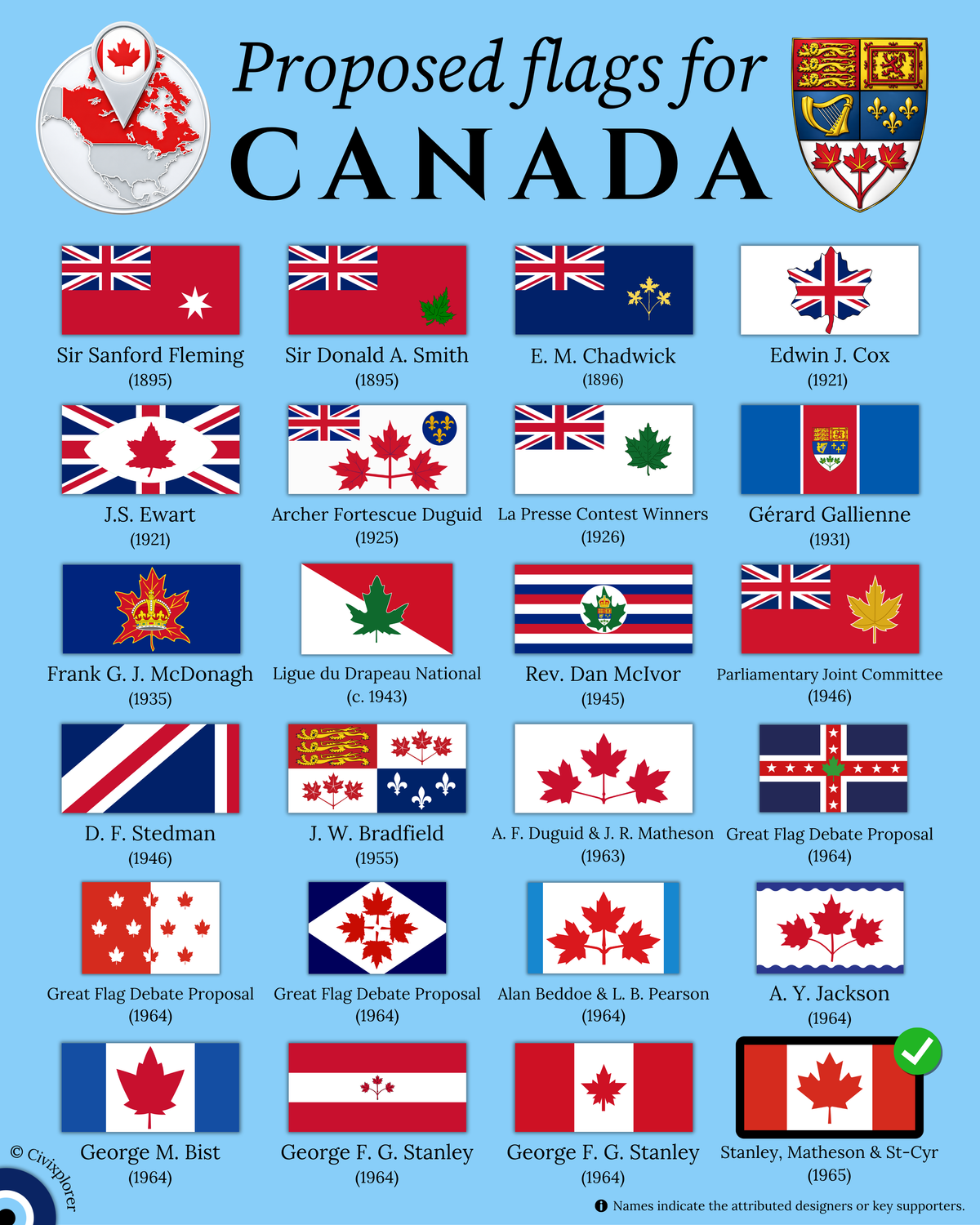
The journey toward a distinct Canadian national symbol is a fascinating 70-year vexillological evolution. For decades, Canada lacked an official flag of its own, instead relying on the British Union Jack and the Canadian Red Ensign. This visual history reflects the country’s gradual transition from a British dominion to a sovereign nation seeking a unifying identity that could bridge its diverse heritage.
The Era of Colonial Ties (1895–1955)
Early proposals were heavily anchored in imperial heraldry. Designs from figures like Sir Sanford Fleming (1895) and Edwin J. Cox (1921) sought to harmonize British loyalty with Canadian distinctiveness. Many of these early concepts utilized the Red Ensign as a base, often adding provincial shields or stars. Interestingly, the maple leaf was not always the scarlet red we recognize today; early versions by Sir Donald A. Smith and the Ligue du Drapeau National featured green maple leaves, reflecting the natural color of the foliage before the official national colors of red and white were established by King George V in 1921.
The Great Flag Debate of 1964
The search for a symbol reached a fever pitch during the Great Flag Debate. Prime Minister Lester B. Pearson made the adoption of a new flag a priority to foster national unity ahead of Canada’s 1967 Centennial. This period saw a massive influx of public creativity and political friction. Pearson himself favored the Pearson Pennant, which featured three red maple leaves flanked by blue vertical borders meant to represent Canada stretching from sea to sea. However, critics argued that a truly Canadian flag should stick to the official colors of red and white, leading to the rejection of blue elements.
The Use of the Red Maple Leaf
The final, iconic design was conceptualized by historian George F.G. Stanley, who drew inspiration from the flag of the Royal Military College of Canada. Stanley advocated for simplicity and legibility, pushing for a single leaf that would act as a neutral, unifying emblem. This concept was refined by John Matheson and graphic artist Jacques St-Cyr, who finalized the 11-point maple leaf.
A common misconception is that these 11 points represent Canada’s provinces and territories. In reality, the geometry was chosen following wind tunnel tests conducted by the National Research Council; the 11-point design proved to be the most visually legible when flapping in high winds. On February 15, 1965, the new flag was officially hoisted on Parliament Hill, marking the end of a long search for a visual identity that remains one of the most recognizable symbols in the world today.

Comments (0)
Join the Conversation
Login to share your thoughts with the community.
Login to Comment