
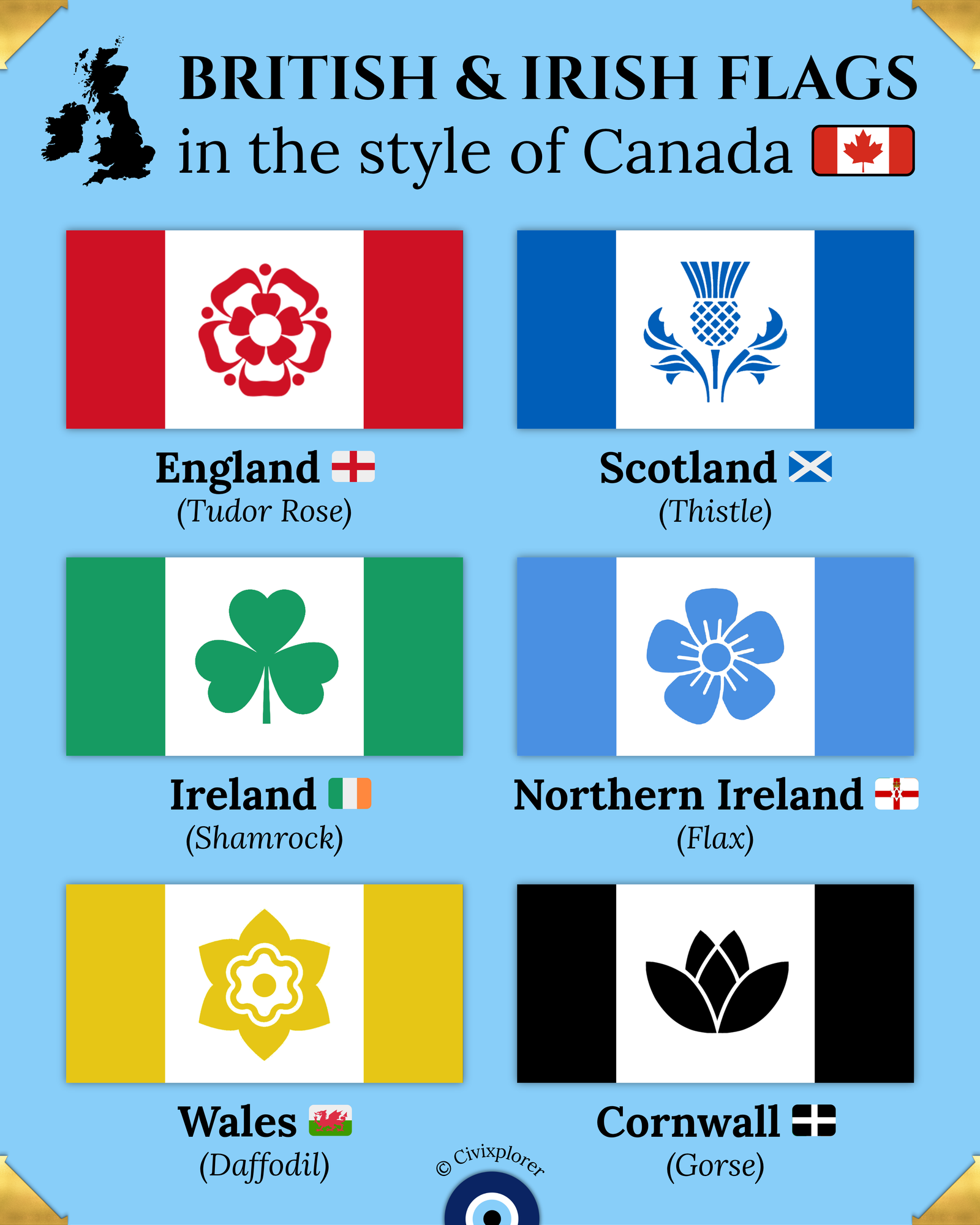
The world of vexillology often finds inspiration in simplicity, and few designs are as globally admired as the 1965 Canadian Maple Leaf. This post explores a creative reinterpretation of the British and Irish flags using the "Canadian Pale" template. By replacing complex heraldry like lions and dragons with stylized botanical emblems, these designs offer a fresh, nature-focused perspective on regional identity.
The Canadian Pale is a specific flag geometry where the central vertical stripe takes up half the width of the flag (a 1:2:1 ratio). This creates a perfect square canvas in the center, ensuring that the chosen symbol remains highly visible whether the flag is limp or flapping in the wind.
The Symbols of the British Isles
Each redesign focuses on a plant deeply rooted in the history and folklore of its respective region. England is represented by the Tudor Rose, a symbol of unity created after the Wars of the Roses. Scotland features the Thistle, a rugged emblem of resilience dating back to the 13th century. The Republic of Ireland is depicted with the Shamrock, the iconic three-leaved clover associated with Saint Patrick and the Emerald Isle.
Unique Regional Identities
Two of the most thoughtful choices in this collection involve the selection of colors for Wales and Northern Ireland. The Wales flag uses yellow side bars, which were selected to mirror the bright hue of the daffodil and evoke the historical Flag of Saint David. For Northern Ireland, the blue side bars were chosen to reflect historical associations with "Irish blue" while maintaining a neutral, non-sectarian identity through the use of the flax flower, a nod to the region's historic linen industry.
Cornwall and the Celtic Connection
The inclusion of Cornwall highlights a distinct Celtic cultural identity often overlooked in broader national representations. Represented by the Gorse—a hardy shrub native to the Cornish moorlands—its black and white color scheme directly echoes the St. Piran’s Cross. By placing these diverse identities on equal aesthetic footing, this project strips away hierarchical baggage in favor of a clean, modern, and unified visual language.

Comments (0)
Join the Conversation
Login to share your thoughts with the community.
Login to Comment